Most searches no longer end on your website. SparkToro found that Google searches ended without a click 68.01% of the time in the US during the first four months of 2026, up from 60.45% in 2024. The answer is increasingly given on the results page, in an AI summary, or in a chat.
That changes the goal. Ranking on page one still matters, but the bigger prize is being the source the answer is built from. That’s what answer engine optimisation (AEO) is for.
The good news: AEO isn’t mysterious. Research into what AI tools cite keeps pointing to the same habits: direct answers near the top, question-led headings, focused sections and real evidence. This playbook turns those habits into a seven-step strategy you can apply to any site, with before-and-after examples, a checklist and a 90-day plan.
New to the term? Start with our explainer on SEO vs AEO vs GEO.
Table of Contents
ToggleQuick Answer
What is an AEO strategy? An AEO strategy is a repeatable plan for making your content the answer that search engines, AI Overviews, AI Mode, ChatGPT and voice assistants show or quote. It has seven steps: (1) build a question inventory from real searches and prompts, (2) map each question to one best page, (3) open every section with a 40–60-word direct answer, (4) structure pages with question headings, lists and tables, (5) add evidence and expertise that make the answer trustworthy, (6) make pages technically extractable with clean HTML and accurate schema, and (7) measure snippets, AI citations and answer share, then refresh.
Where answers appear in 2026, and why it matters
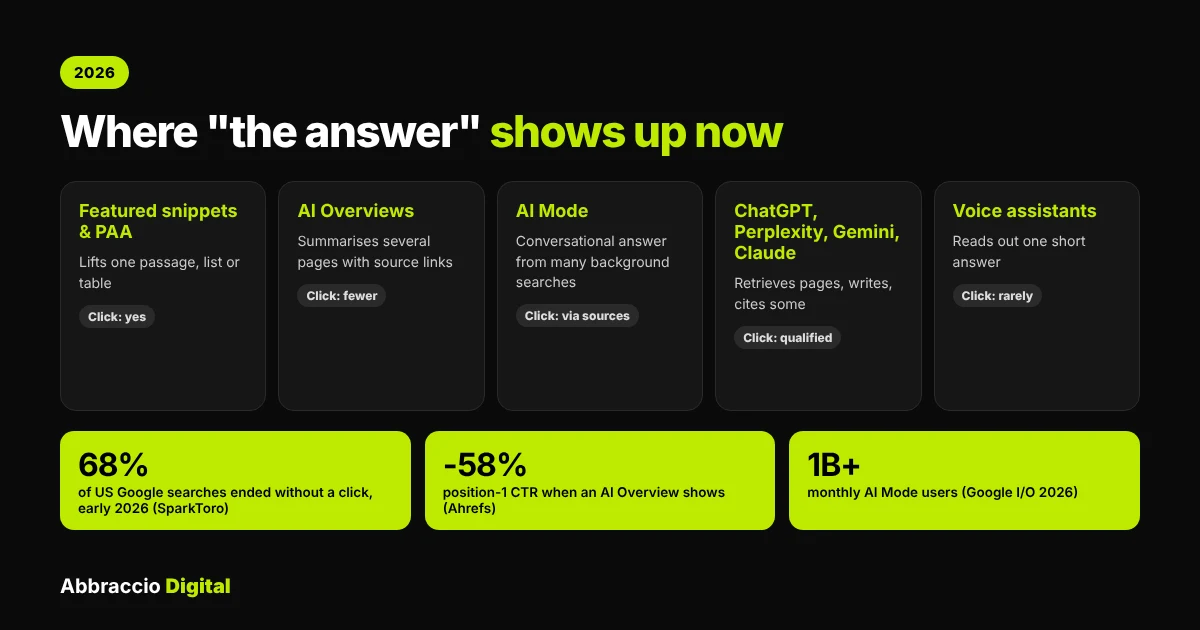
“The answer” now shows up in at least five places, and each one pulls from your content in a slightly different way.
|
Answer surface
|
How it uses your content
|
Can it send a click?
|
|---|---|---|
|
Featured snippets and "People also ask"
|
Lifts a passage, list or table from one page
|
Yes, with a link
|
|
Google AI Overviews
|
Summarises several pages and links to sources
|
Yes, but fewer clicks overall
|
|
Google AI Mode
|
Conversational answer from many searches run behind the scenes
|
Yes, through source links
|
|
ChatGPT, Perplexity, Gemini, Claude
|
Retrieves pages, writes an answer, cites some sources
|
Yes, often highly qualified
|
|
Voice assistants
|
Reads out a single short answer
|
Rarely
|
What the data says:
- Zero-click is the norm. 68.01% of US Google searches ended without a click in early 2026 (SparkToro, Similarweb data).
- AI Overviews are common and take clicks. They appear on more than 20% of Google searches, and when they do, click-through rates drop by nearly 60%, according to the same research. Ahrefs found that AI Overviews now reduce the organic click-through rate for position one by 58%.
- AI Mode is growing fast. Google said at I/O 2026 that AI Mode had passed 1 billion monthly users, with query volume more than doubling each quarter.
What this means: if the answer is shown without a click, you want it to be your answer, with your brand and link attached. AEO makes that more likely, and the clicks you do get tend to come from people who already trust you.
The 7-step AEO strategy
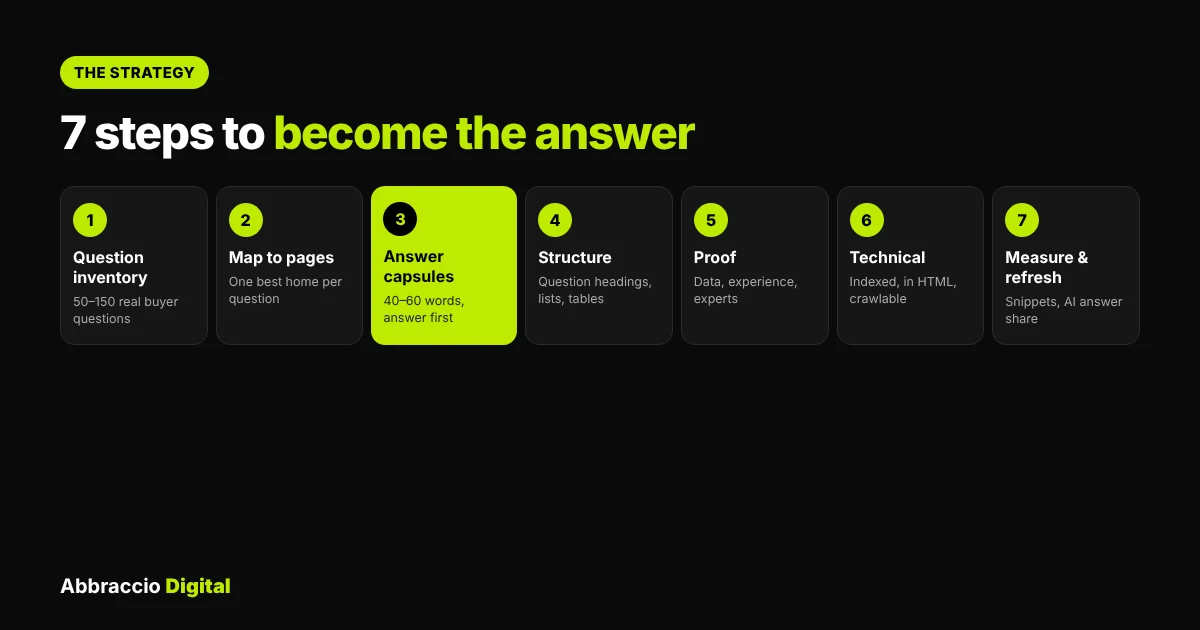
Step 1: Build a question inventory
AEO starts with questions, not keywords. Collect the real questions your buyers ask, in their words.
Where to find them:
- Google’s “People also ask” boxes and autocomplete for your main topics
- Search Console queries containing who, what, why, how, which, can, is, does, vs, best
- Sales calls, support tickets, WhatsApp and email enquiries
- Reddit, Quora and community forums in your niche
- AI tools themselves: ask ChatGPT or AI Mode about your topic and note the follow-up questions they suggest
Aim for 50–150 questions to start. Group them by topic and buyer stage (learning, comparing, deciding). The free kit includes a scoring sheet to prioritise them by business value, demand and how well you answer them today.
Step 2: Map each question to one best page
Every important question needs one clear home. Don’t answer the same question in five half-ways across five posts.
- Broad questions (“What is X?”) go on pillar or definition pages.
- Specific questions (“How much does X cost in India?”) get their own section or post.
- Short related questions belong in an FAQ section on the most relevant page.
This also helps with query fan-out: AI tools break one prompt into many sub-questions, so covering the cluster of related questions on connected pages makes you useful for more of them.
Step 3: Write an answer capsule for every key question
An answer capsule is a short, self-contained answer placed right under the question heading, before the detail. It’s the single most useful AEO habit.
In an analysis of ChatGPT referrals, 72.4% of cited blog posts included an identifiable answer capsule, the strongest shared trait across the dataset.
How to write one:
- 40–60 words, 2–3 sentences
- Answer the question in the first sentence, using the key words from the question
- State it plainly and definitively; save caveats for the next paragraph
- Make it make sense on its own, without “as mentioned above”
- Keep links out of the capsule itself; put them in the detail below
Step 4: Structure the page for extraction
Answer engines read pages in sections. Make each section easy to lift.
- Question-style H2s and H3s that mirror how people ask. In one study, 78.4% of citations tied to questions came from headings; AI often treats a heading as the prompt and the paragraph below as the answer.
- Put the main answer early. The same study found 44% of ChatGPT citations come from the first third of content.
- Use the right format for the question: steps for “how to”, a table for “X vs Y”, a short list for “best” or “types of”, a single sentence for “what is”.
- One topic per section. Focused sections beat long, wandering ones.
Length isn’t the goal. Ahrefs found a near-zero correlation between word count and being cited in AI Overviews, and 53.4% of cited pages were under 1,000 words.
Step 5: Add proof and expertise
Answer engines prefer answers they can trust. Back up your capsules with:
- Specific numbers, dates and sources
- First-hand experience: your tests, client results, photos, examples
- A named author or reviewer with real credentials
- Clear, up-to-date facts (prices, specs, policies) that match everywhere online
This is also what Google asks for: original, “non-commodity” content. See our summary of Google’s official AI search guide.
Step 6: Make pages technically extractable
The best answer is useless if crawlers can’t read it.
- Pages indexed and eligible for snippets (no accidental
nosnippet) - Answers in the HTML, not loaded only by JavaScript (see can AI crawlers render JavaScript?)
- AI search crawlers allowed in robots.txt
- Semantic HTML: real headings, lists and tables, not styled
<div>s - Accurate structured data that matches visible content (details in the checklist below)
Step 7: Measure, then refresh
Track which questions you win, which you lose and who wins instead. Refresh losing answers first: sharpen the capsule, add evidence, fix the format. Then re-check. See the measurement section below.
Answer formats that get extracted (with before and after)
Match the format to the type of question. Here’s what works, with rewrites of typical blog writing.
|
Question type
|
Best format
|
Example question
|
|---|---|---|
|
What is / definition
|
1–2 sentence definition, then detail
|
"What is GEO?"
|
|
How to
|
Numbered steps, one action each
|
"How do I add FAQ schema in WordPress?"
|
|
X vs Y
|
Comparison table + one-line verdict
|
"AEO vs SEO"
|
|
Best / types of
|
Short list with one line on each
|
"Best AEO tools"
|
|
How much / how long
|
Number or range first, then factors
|
"How much does GEO cost in India?"
|
|
Yes/no (can, is, does)
|
"Yes" or "No" first, then why
|
"Does llms.txt help SEO?"
|
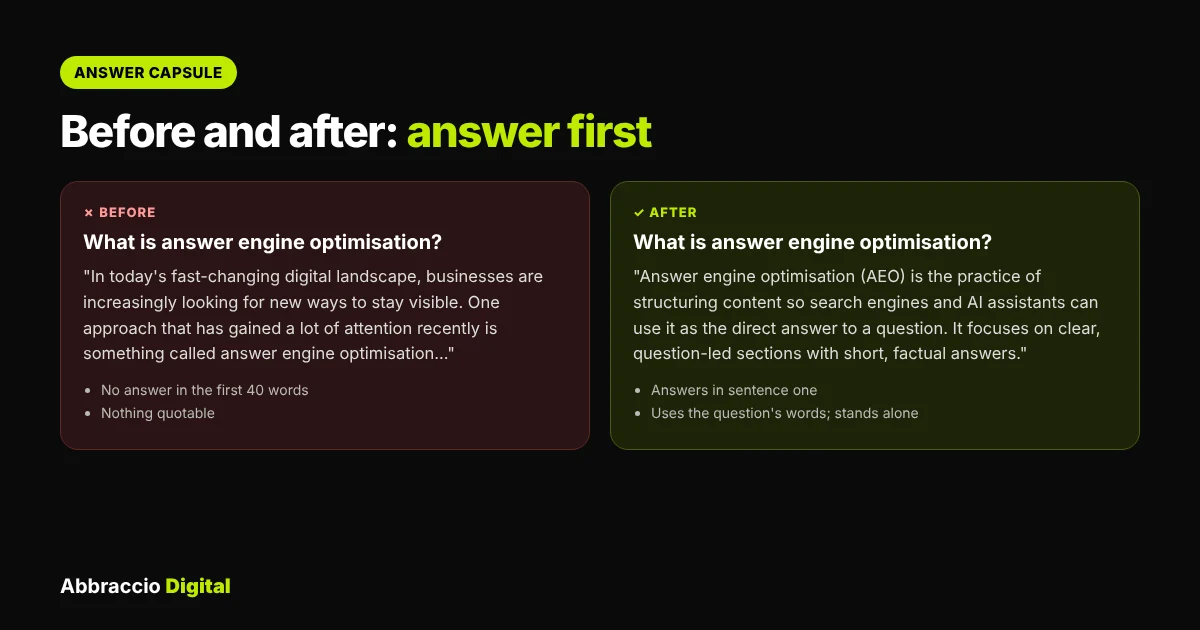
Example 1: definition
Before: “In today’s fast-changing digital landscape, businesses are increasingly looking for new ways to stay visible. One approach that has gained a lot of attention recently is something called answer engine optimisation…”
After: “Answer engine optimisation (AEO) is the practice of structuring content so search engines and AI assistants can use it as the direct answer to a question. It focuses on clear, question-led sections with short, factual answers that work in featured snippets, AI Overviews, ChatGPT and voice search.”
Example 2: cost question
Before: “Pricing for GEO services can vary a great deal depending on many different factors, so it’s hard to give one figure…”
After: “GEO services in India typically cost [₹X–₹Y] per month for small businesses and more for large brands, depending on the number of pages, competition and how much content and outreach is included.” (Fill in ranges you can stand behind; see our GEO pricing guide.)
Example 3: yes/no question
Before: “There’s a lot of debate about llms.txt and whether it’s worth the effort…”
After: “No, llms.txt doesn’t improve visibility in Google: Google says its AI search doesn’t use the file, and large log studies show AI crawlers rarely request it. It can still be useful for developer documentation.”
The pattern: answer first, use the question’s own words, be specific, then explain.
Technical and schema checklist for AEO
Crawling and indexing
- Key answer pages indexed (check URL Inspection in Search Console)
- No
nosnippet,data-nosnippetor very lowmax-snippeton content you want quoted - Answers present in the raw HTML (view source), not injected only by JavaScript
- AI search crawlers (OAI-SearchBot, PerplexityBot, Claude-SearchBot) allowed in robots.txt, and not blocked by your firewall
Page structure
- One
<h1>; questions as<h2>/<h3>headings - Real
<ol>,<ul>and<table>elements, not styled text - Answer capsule directly below each question heading
- Author name, credentials and “last updated” date visible
Structured data (be realistic about what it does)
Article/BlogPostingwith author and dates on postsOrganizationwith logo and official profiles on the home pageProduct,LocalBusinessorServicewhere relevant, with facts that match the pageFAQPageonly for genuine FAQs on the page. Note: Google now shows FAQ rich results only for well-known government and health sites, and has dropped HowTo rich results, so treat this markup as a clear description of your content, not a guaranteed visual boost- No schema for content that isn’t visible on the page
Google states that structured data isn’t required to appear in its generative AI features. Its value is accuracy and clarity, not a shortcut.
How to measure AEO
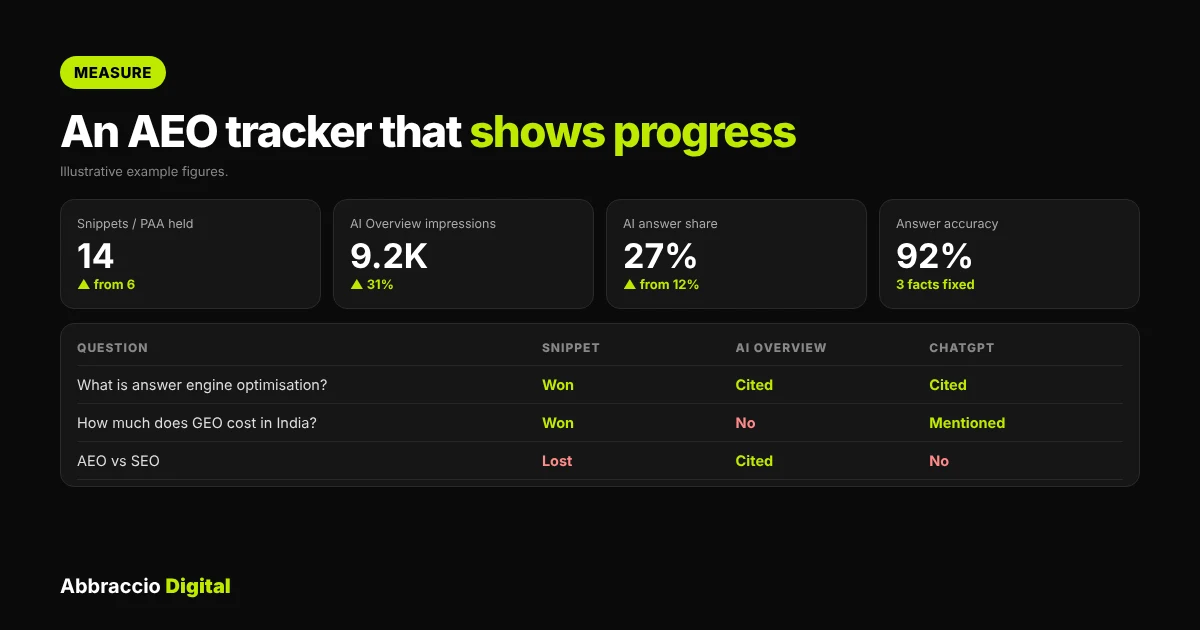
AEO is measured by how often you are the answer, not just where you rank.
|
What to track
|
How
|
Tool
|
|---|---|---|
|
Featured snippets and "People also ask" wins
|
Count target questions where you hold the snippet or a PAA answer
|
Ahrefs, Semrush or manual checks
|
|
AI Overview and AI Mode presence
|
Impressions in Google's generative AI features by page
|
Search Console, Generative AI performance report
|
|
AI answer share
|
% of your priority questions where ChatGPT, Perplexity and Gemini mention or cite you, across repeated runs
|
Prompt tracking tool or a monthly manual check
|
|
Answer accuracy
|
Are AI tools stating your facts correctly?
|
Manual review
|
|
Traffic and conversions from answers
|
AI-referred sessions and key events
|
GA4 AI Assistant channel
|
Keep the question set fixed month to month so trends mean something. For a full KPI set, see GEO KPIs, and for a quick start, run a free manual AI visibility audit.
Common AEO mistakes
|
Mistake
|
Why it hurts
|
Fix
|
|---|---|---|
|
Long scene-setting intros
|
The answer is buried below the part AI reads most
|
Put the answer in the first 40–60 words of the section
|
|
Clever headings ("The secret sauce")
|
Don't match how people ask
|
Use the question itself as the heading
|
|
One giant FAQ page for everything
|
Answers lose context and relevance
|
Put FAQs on the page each question belongs to
|
|
Hedged answers ("it depends…") with no specifics
|
Nothing quotable
|
Give the most common answer first, then the exceptions
|
|
Padding to hit a word count
|
Length doesn't drive citations
|
Cover the question fully, then stop
|
|
Different facts on different pages
|
AI repeats the wrong one, or skips you
|
Keep one source of truth for prices, specs and policies
|
|
Answers hidden in tabs, accordions loaded on click, or images
|
Crawlers can't read them
|
Keep text in the HTML; use for accordions
|
|
Writing for bots
|
Reads badly, and Google warns against rewriting for AI
|
Write for a smart reader in a hurry; that's what answer engines want too
|
Your 90-day AEO plan
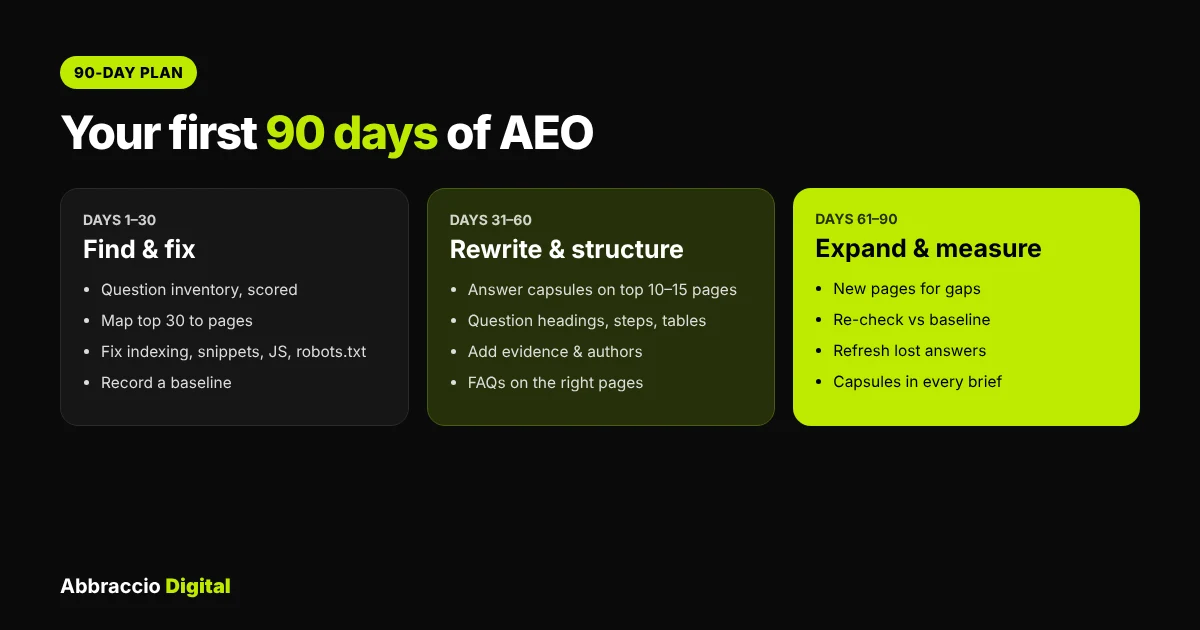
Days 1–30: Find and fix
- Build a question inventory of 50–150 questions and score them
- Map the top 30 questions to one best page each
- Fix technical blockers: indexing, snippet controls, JavaScript-only content, robots.txt
- Record a baseline: snippets held, AI Overview impressions, AI answer share for the top 30
Days 31–60: Rewrite and structure
- Add answer capsules to the top 10–15 pages
- Turn headings into questions; add steps, tables and lists where they fit
- Add evidence: data, examples, author credentials, updated dates
- Move FAQs onto the right pages; check structured data matches visible content
Days 61–90: Expand and measure
- Publish new pages for high-value questions you don’t answer yet
- Re-check snippets and AI answer share against the baseline
- Refresh the answers you’re still losing, starting with the highest business value
- Make answer capsules a required part of every content brief
Key takeaways
- Most Google searches now end without a click, so being the answer matters as much as ranking.
- An AEO strategy has seven steps: question inventory, page mapping, answer capsules, extractable structure, proof, technical access and measurement.
- Answer capsules (40–60-word direct answers under question headings) are the most consistent trait of content AI tools cite.
- Put answers early and use question headings; length alone doesn’t earn citations.
- Back answers with evidence and expertise, and keep facts consistent everywhere.
- Structured data helps clarity but isn’t required for Google’s AI features, and FAQ and HowTo rich results are now limited.
- Measure snippets, AI Overview impressions and AI answer share on a fixed question set, then refresh what you’re losing.
Frequently Asked Questions
An AEO strategy is a repeatable plan to make your content the answer that search engines, AI Overviews, AI Mode, ChatGPT and voice assistants show or quote. It covers finding real questions, writing direct answers, structuring pages for extraction, adding proof, fixing technical access and measuring results.
An answer capsule is a short, self-contained answer of about 40–60 words placed directly under a question heading, before the detailed explanation. It answers the question in the first sentence and makes sense on its own.
The core answer should be about 40–60 words, followed by as much detail as the question needs. Research shows page length on its own doesn’t predict AI citations.
It helps describe your content clearly, but Google now shows FAQ rich results only for well-known government and health websites, and Google says structured data isn’t required for its AI features. Use it for genuine FAQs, not as a shortcut.
SEO aims to rank pages and earn clicks. AEO aims to make your content the direct answer, wherever it’s shown. AEO builds on SEO: pages still need to be crawlable, indexed and trusted.
Formatting changes on pages that already rank can show up in snippets and AI answers within weeks. New topics usually take two to three months, depending on competition.
Yes. Use “People also ask”, Search Console and customer questions to build your list, rewrite key pages with answer capsules, and check answers monthly by hand in Google, ChatGPT and Perplexity.
Conclusion
Becoming the answer isn’t about tricks. It’s about doing the reader a favour: find the questions they actually ask, answer them clearly and early, prove you know what you’re talking about, and make it easy for machines to read.
Start small. Pick your 30 most valuable questions, give each one a home and an answer capsule, fix anything that stops crawlers reading them, and measure what changes. Then build the habit into every new piece of content.
Download the AEO Strategy Kit to build your question inventory, check every page against the answer-capsule checklist and track your wins.
Sources
- Search Engine Land — Google zero-click searches (SparkToro, 2026)
- Search Engine Land — Google zero-click searches hit 68% in early 2026
- Ahrefs — AI Overviews reduce clicks by 58%
- Search Engine Land — How to get cited by ChatGPT: the content traits LLMs quote most
- Search Engine Land — 44% of ChatGPT citations come from the first third of content
- Ahrefs — Short vs long content in AI Overviews
- Google Search Central — Optimizing your website for generative AI features on Google Search