
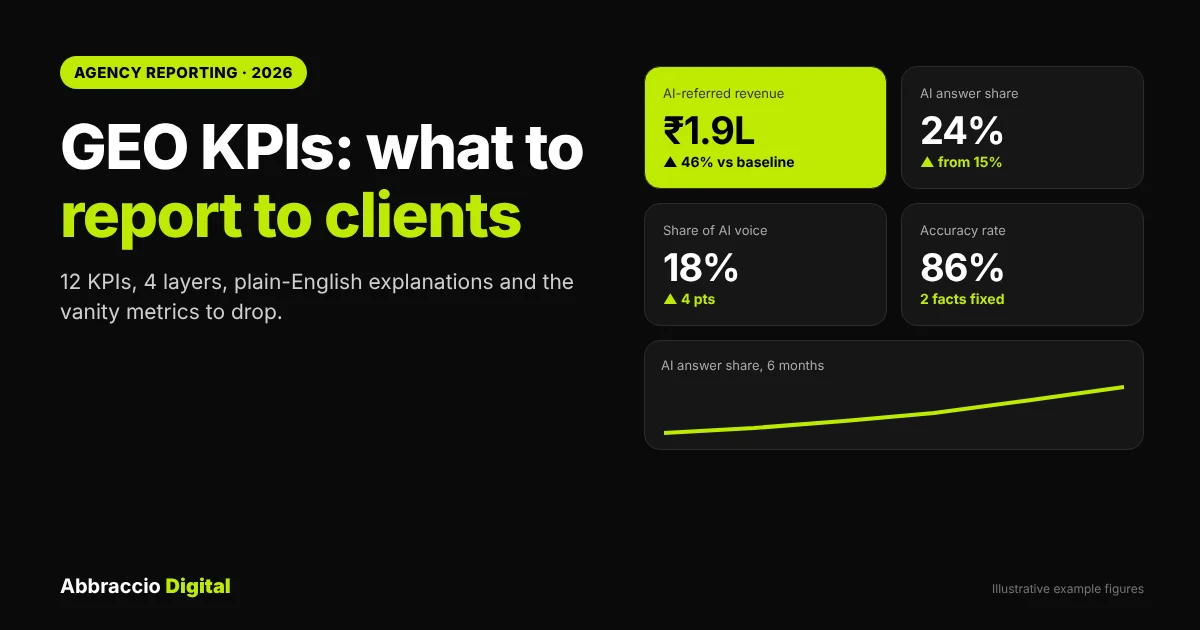
Every GEO retainer eventually hits the same meeting. The client asks: “So, is it working?” And the agency shows a screenshot of ChatGPT mentioning the brand once.
That isn’t reporting. AI answers change with almost every query: in a SparkToro and Gumshoe study, ChatGPT and Google’s AI features returned the same list of brands less than 1% of the time when the same prompt was repeated. One screenshot proves nothing. A rank position in ChatGPT doesn’t really exist.
What clients need is a small set of GEO KPIs that are measured the same way every month, tie back to business results, and are explained in plain English.
This guide gives you the 12 GEO KPIs worth tracking, with formulas, data sources and frequency; which to report to which client; word-for-word explanations you can use in your next client call; and the vanity metrics to stop reporting.
Quick Answer
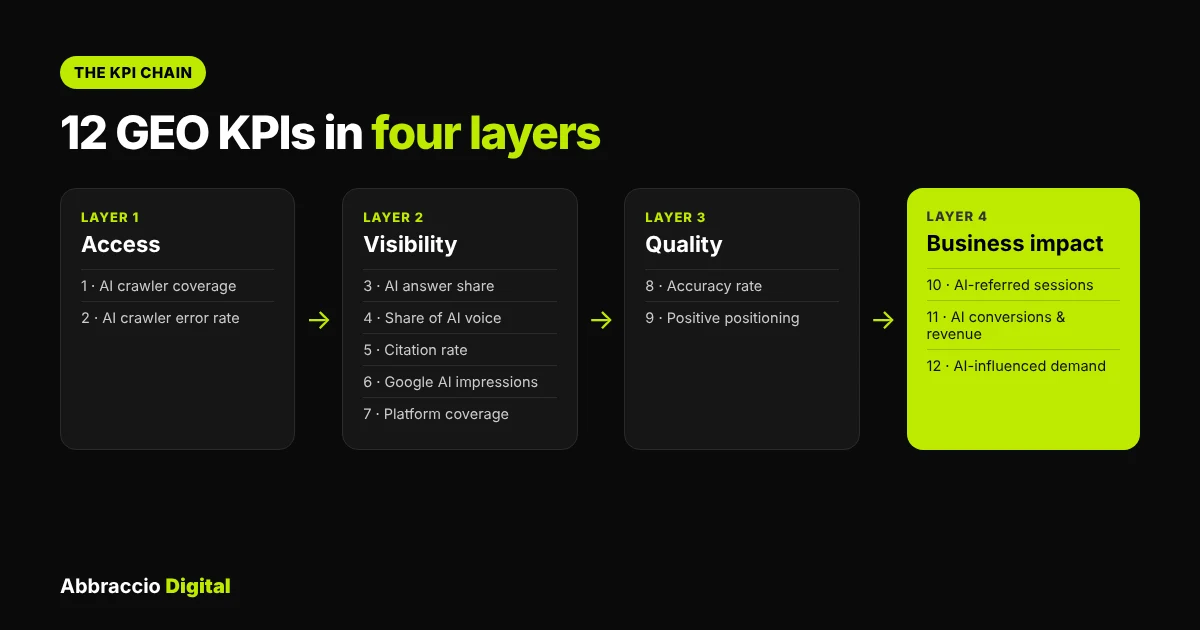
What GEO KPIs should you report to clients? Report a few KPIs across four layers: access (AI crawlers reaching key pages), visibility (share of AI answers, share of voice versus competitors, citation rate, Google AI impressions), quality (accuracy and sentiment of what AI says about the brand) and business impact (AI-referred sessions, conversions, revenue and “heard about us via AI” leads). Measure visibility as a percentage across many prompts and repeated runs, never as a single “AI ranking”. Lead the report with business impact and trends, and keep diagnostics in an appendix.
Why GEO reporting is different from SEO reporting
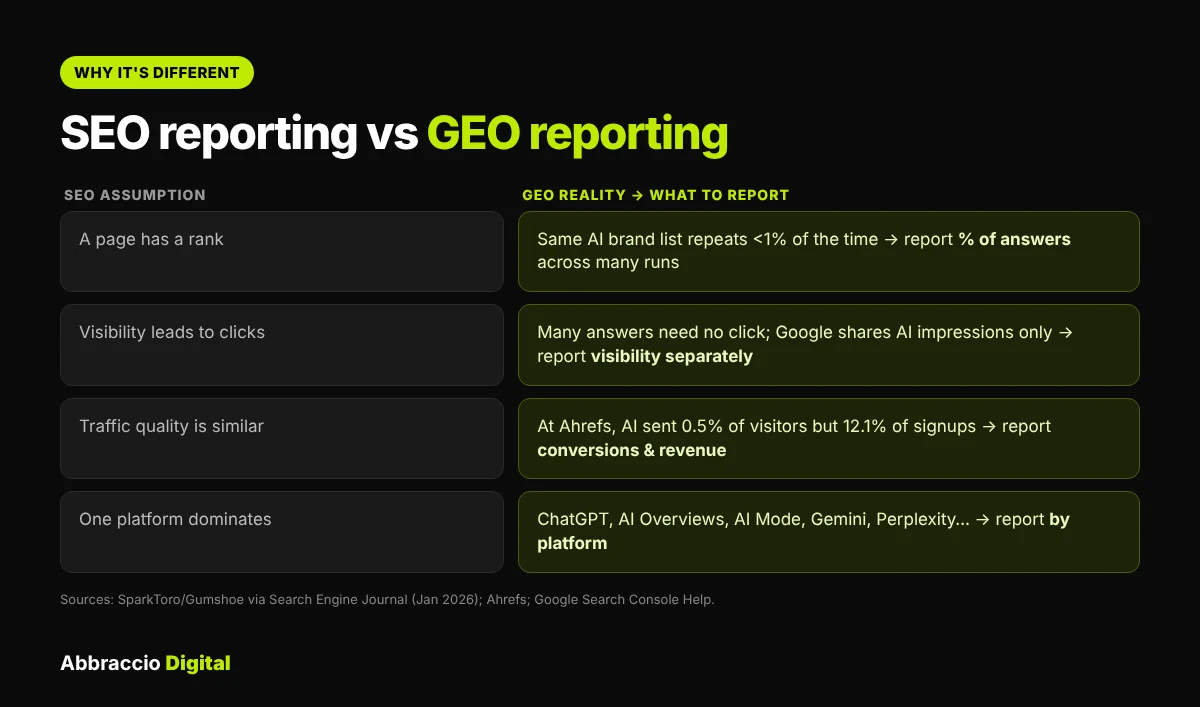
SEO reporting grew up around stable numbers: rankings, clicks, sessions. GEO breaks four of those assumptions.
|
SEO assumption
|
What's different in AI search
|
What it means for KPIs
|
|---|---|---|
|
A page has a rank
|
AI answers vary run to run. In the SparkToro study, the same brand list repeated less than 1% of the time, and in the same order less than 0.1%
|
Report how often you appear across many prompts and runs, not a position
|
|
Visibility leads to clicks
|
Track visibility separately from traffic, and don't judge GEO on clicks alone
|
|
|
Traffic quality is similar across sources
|
Report conversions and revenue from AI, not just sessions
|
|
|
One platform dominates
|
Buyers use ChatGPT, Google AI Overviews and AI Mode, Gemini, Perplexity, Copilot and Claude
|
Report by platform, weighted to where the client's buyers are
|
There’s also an attribution gap. Someone may see your brand in ChatGPT, then search your name on Google a week later and buy. That sale shows up as branded search or direct traffic, not AI. That’s why good GEO reports include branded search trends and self-reported attribution (“How did you hear about us?”), not just referral data.
Before you choose which KPIs to report, you need a reliable way to track how often your client’s brand appears in AI answers. Our guide on how to measure AI search visibility walks through the tools and methods to set that up.
The 12 GEO KPIs, in four layers
Think of GEO KPIs as a chain. If AI can’t reach the content, it can’t mention it. If it doesn’t mention the brand, nobody clicks. If nobody clicks, there’s no revenue. Report each layer, so a client can see where the chain breaks.
Layer 1: Access
|
KPI
|
Formula
|
Data source
|
Frequency
|
|---|---|---|---|
|
AI crawler coverage
|
Key pages fetched by AI search crawlers in the period ÷ total key pages
|
Server logs, CDN bot reports
|
Monthly
|
|
AI crawler error rate
|
AI crawler requests returning 4xx/5xx ÷ all AI crawler requests
|
Server logs
|
Monthly
|
Layer 2: Visibility
|
KPI
|
Formula
|
Data source
|
Frequency
|
|---|---|---|---|
|
AI answer share (mention rate)
|
Answers that mention the brand ÷ all answers checked, across the prompt set and repeated runs
|
Prompt tracking tool or manual sampling
|
Monthly
|
|
Share of AI voice
|
Brand mentions ÷ total mentions of the brand and named competitors
|
Prompt tracking
|
Monthly
|
|
Citation rate
|
Answers that link to the client's site ÷ all answers checked
|
Prompt tracking
|
Monthly
|
|
Google AI impressions
|
Impressions in AI Overviews and AI Mode
|
Search Console, Generative AI performance report
|
Monthly
|
|
Platform coverage
|
Platforms where AI answer share is above the client's threshold ÷ platforms tracked
|
Prompt tracking
|
Quarterly
|
Layer 3: Quality
|
KPI
|
Formula
|
Data source
|
Frequency
|
|---|---|---|---|
|
Accuracy rate
|
Answers with correct facts (prices, services, locations, claims) ÷ answers that mention the brand
|
Manual review of sampled answers
|
Monthly
|
|
Positive positioning rate
|
Mentions that are positive or recommend the brand ÷ all mentions
|
Manual review or tool sentiment, spot-checked
|
Monthly
|
Layer 4: Business impact
|
KPI
|
Formula
|
Data source
|
Frequency
|
|---|---|---|---|
|
AI-referred sessions
|
Sessions from AI assistants
|
GA4 AI Assistant channel (plus custom channel for older properties)
|
Monthly
|
|
AI-referred conversions and revenue
|
Key events and revenue from AI-referred sessions; also conversion rate vs organic
|
GA4, CRM
|
Monthly
|
|
AI-influenced demand
|
Branded search impressions trend + leads saying they found you via AI
|
Search Console, form or sales-call field
|
Monthly / quarterly
|
A note on prompt tracking: KPIs 3, 4, 5, 7, 8 and 9 all rely on a fixed prompt set. Use 30–100 real buyer questions per client, keep the set the same each month, and run each prompt several times per platform. Because AI answers vary, the SparkToro researchers found that a brand’s visibility percentage across many runs was far more stable than any single answer. Show the client how many prompts and runs sit behind each number.
Tracking all these metrics by hand every month gets messy fast. Our GEO reporting template brings AI citations, brand mentions and visibility trends into one client-ready report.
Which KPIs to report to which client
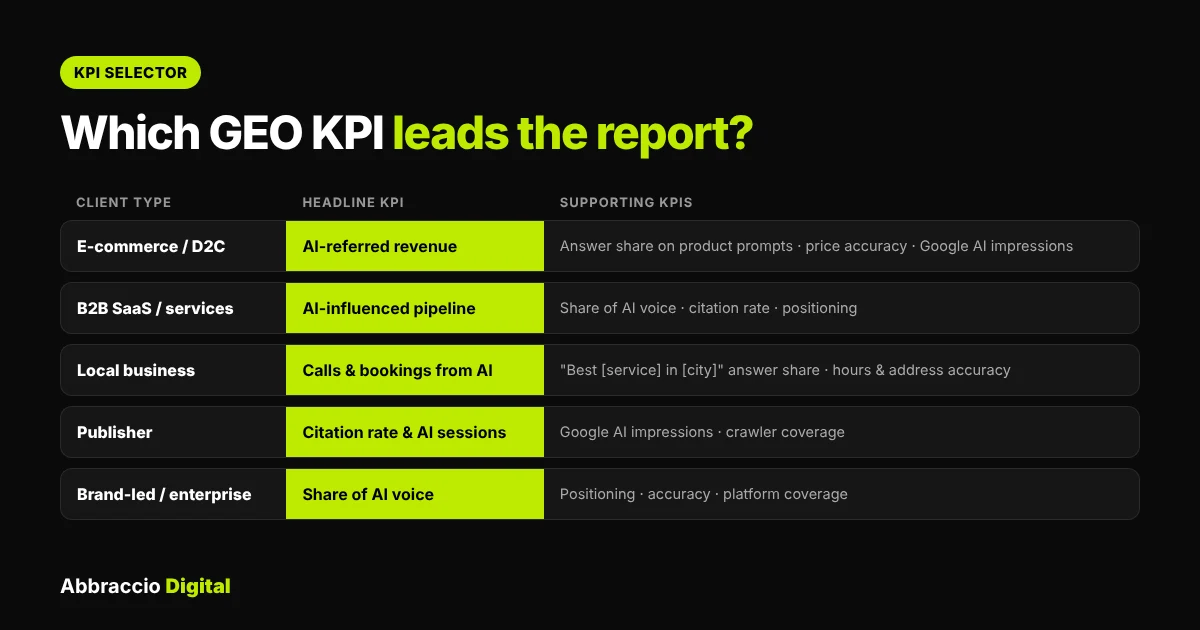
Not every client needs all 12. Pick a headline KPI that matches how the client makes money, then 3–5 supporting KPIs. Keep the rest in an appendix or your internal tracker.
|
Client type
|
Headline KPI
|
Supporting KPIs
|
Why
|
|---|---|---|---|
|
E-commerce / D2C
|
AI-referred revenue (11)
|
AI answer share on product prompts (3), accuracy of prices and specs (8), Google AI impressions (6)
|
Shoppers buy, or shortlist, from AI answers; wrong prices cost sales
|
|
B2B SaaS / services
|
AI-influenced pipeline: AI-referred conversions + "found via AI" leads (11, 12)
|
Share of AI voice vs competitors (4), citation rate (5), positive positioning (9)
|
Long sales cycles; buyers research in AI and convert later
|
|
Local business (clinics, restaurants, home services)
|
Calls, bookings and direction requests from AI-referred visits (11)
|
AI answer share on "near me" and "best [service] in [city]" prompts (3), accuracy of hours and locations (8)
|
Wrong hours or addresses lose customers immediately
|
|
Publisher / content site
|
Citation rate (5) and AI-referred sessions (10)
|
Google AI impressions (6), AI crawler coverage (1)
|
Links and traffic are the business model
|
|
Brand-led / enterprise
|
Share of AI voice (4)
|
Positive positioning (9), accuracy (8), platform coverage (7)
|
Reputation and category leadership matter more than direct clicks
|
By stage of the engagement
- Months 1–2 (foundation): Lead with access and baseline visibility: crawler coverage, error rate, the first AI answer share benchmark. Set expectations that business KPIs lag.
- Months 3–6 (growth): Lead with movement in AI answer share, share of voice and citation rate against the baseline. Start showing AI-referred sessions and conversions.
- Month 6+ (proof): Lead with business impact: AI-referred conversions and revenue, AI-influenced leads, and branded search trend. Visibility KPIs move to supporting role.
How to explain each KPI to clients
Clients don’t need the formula. They need to know what the number means for their business. Here’s wording you can use as-is or adapt.
|
KPI
|
Say this to the client
|
|---|---|
|
AI crawler coverage
|
"This shows how many of your important pages AI tools like ChatGPT and Perplexity actually read this month. If they can't read a page, they can't recommend you from it."
|
|
AI answer share
|
"We asked AI tools [80] questions your buyers ask, several times each. You were recommended in [24%] of answers, up from [15%] last quarter."
|
|
Share of AI voice
|
"When AI tools recommend anyone in your category, you get [18%] of the mentions. [Competitor] gets [31%]. That's the gap we're closing."
|
|
Citation rate
|
"In [9%] of answers, AI linked to your website as a source. Links are how AI sends people to you."
|
|
Google AI impressions
|
"Google showed a link to your site in its AI Overviews and AI Mode [12,400] times this month. Google doesn't share clicks for these yet, so this shows reach."
|
|
Accuracy rate
|
"When AI mentions you, it gets your facts right [86%] of the time. We found [two] wrong prices and fixed the source pages."
|
|
Positive positioning
|
"Most mentions describe you as [‘best for small teams’]. [One] answer still repeats an old complaint, and here's our plan for it."
|
|
AI-referred sessions
|
"[640] people came to your site straight from an AI tool this month."
|
|
AI-referred conversions and revenue
|
"Those visitors made [38] enquiries / [₹1.9 lakh] in sales. They convert at [2.4x] the rate of regular organic visitors."
|
|
AI-influenced demand
|
"[11] new leads told us they heard about you from ChatGPT or Gemini, and searches for your brand name are up [14%]."
|
Three phrases that build trust:
- “Across [X] prompts and [Y] runs”: shows the number isn’t a lucky screenshot.
- “Compared with last month / our baseline”: GEO numbers mean more as trends than as single values.
- “Here’s what we’re doing about it”: every KPI that dropped gets a reason and a next step.
AI referral traffic is one of the easiest GEO wins to show clients, but only if it isn’t hidden under “Referral” or “Direct.” Setting up a dedicated GA4 AI assistant channel lets you report visits from ChatGPT, Gemini, Perplexity and Copilot as their own line item.
Vanity metrics and reporting mistakes to avoid
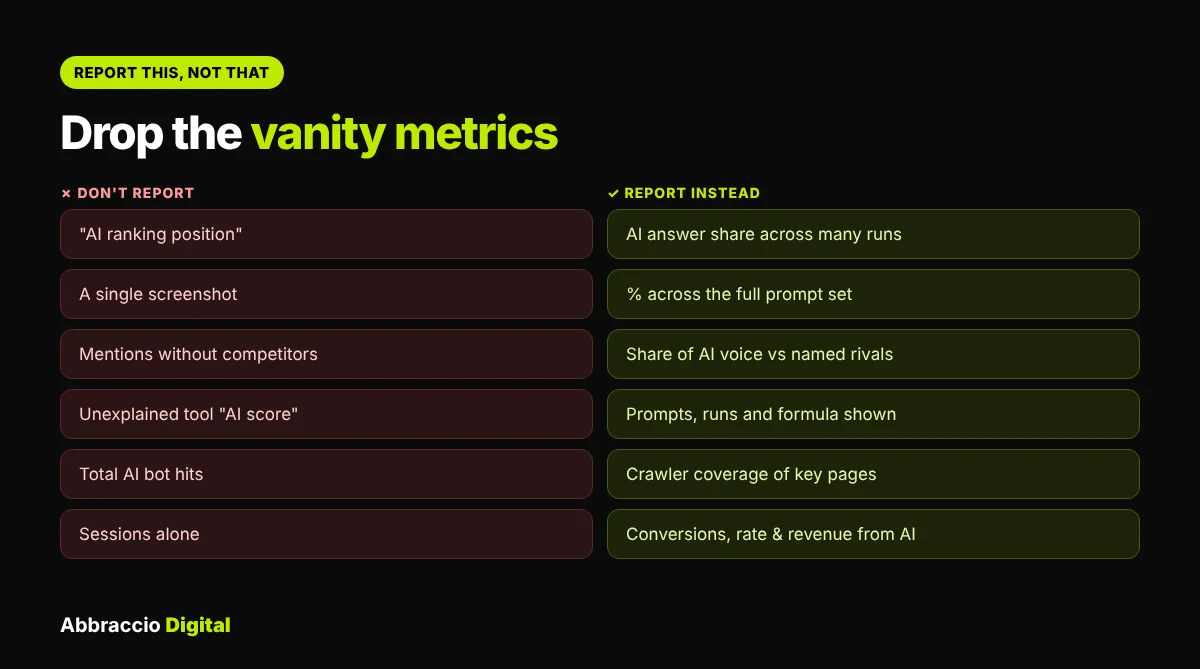
|
Don't report
|
Why it misleads
|
Report instead
|
|---|---|---|
|
"AI ranking position"
|
AI answers vary almost every run; SparkToro's Rand Fishkin said any tool giving a "ranking position in AI" is "full of baloney"
|
AI answer share across many runs
|
|
A single screenshot
|
One answer is a sample of one
|
Percentage across the full prompt set
|
|
Mentions without competitors
|
20% sounds bad or good depending on the category
|
Share of AI voice vs named competitors
|
|
A tool's "AI visibility score" with no method
|
You can't explain or defend it
|
The underlying prompts, runs and formula
|
|
Total AI bot hits
|
Training crawlers can hit thousands of pages without ever sending visitors
|
AI search crawler coverage of key pages
|
|
Sessions alone
|
Small numbers look disappointing next to organic
|
Conversions, conversion rate and revenue from AI
|
|
Prompts chosen to look good
|
Branded or very niche prompts inflate results
|
A fixed set of real, unbranded buyer questions
|
Other mistakes we see:
- Changing the prompt set every month. Trends become meaningless. Add new prompts in a separate group and keep the core set fixed.
- Mixing platforms into one number. ChatGPT and AI Overviews behave differently. Report by platform, then a weighted total.
- Promising a number. No agency controls AI answers. Commit to the work and to transparent measurement, not to “30% share of voice in 90 days”.
- Hiding the downs. AI visibility fluctuates. Clients trust a report that explains a dip more than one that never shows one.
Before you can report on GEO KPIs, you need a baseline. A free AI visibility audit shows where your client’s brand currently appears in ChatGPT, Gemini and Google AI Overviews, so every later report has a clear starting point.
A sample monthly GEO report (one page)
Keep the client-facing report to one page or one dashboard screen. Put detail in an appendix.
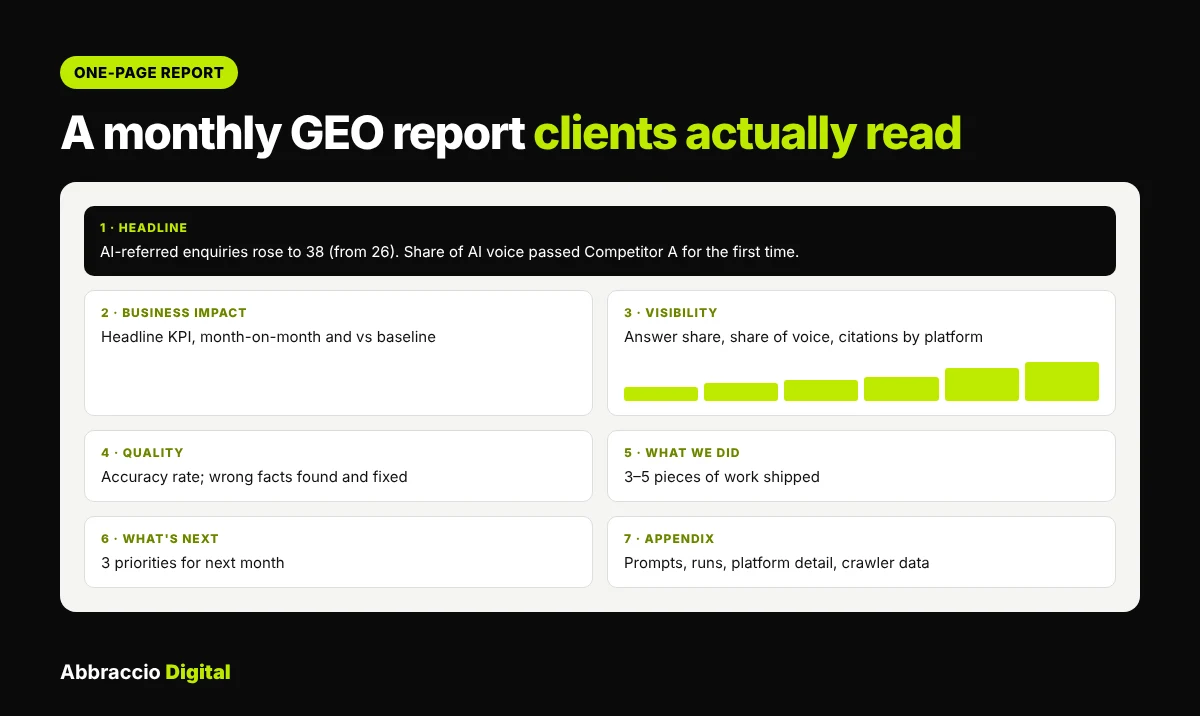
- Headline (2–3 sentences): the business result and the biggest change. “AI-referred enquiries rose to 38, from 26. Our share of AI voice for ‘GST software for small business’ prompts passed Competitor A for the first time.”
- Business impact: headline KPI with month-on-month and vs-baseline change.
- Visibility: AI answer share, share of voice and citation rate, by platform, with a 6-month trend line.
- Quality: accuracy rate and any wrong facts found and fixed.
- What we did: 3–5 bullets of work shipped.
- What’s next: 3 priorities for next month.
- Appendix: prompt list, runs per prompt, platform-by-platform detail, crawler coverage and errors.
For a ready-made version, use our GEO reporting template.
Clients often ask why AI Mode clicks don’t show up as a separate line in Search Console. Our breakdown of Google’s official AI search guide explains how Google reports this traffic and what that means for your client reports.
Setting targets
There are no reliable industry benchmarks for GEO KPIs yet: results vary hugely by category, prompt set and tool. So set targets from the client’s own baseline:
|
KPI
|
Sensible way to set a target
|
|---|---|
|
AI answer share
|
Improve on the month-2 baseline, and close a set % of the gap to the leading competitor in 6 months
|
|
Share of AI voice
|
Match your share of the market, or your share of organic search visibility, as a first goal
|
|
Accuracy rate
|
Aim high (90%+) and fix every wrong fact you find, since this is largely in your control
|
|
AI crawler error rate
|
Keep as close to zero as possible on key pages
|
|
AI-referred conversions
|
Grow month on month; compare conversion rate with organic to show quality
|
Agree targets in writing in month 2, once the baseline is in, not in the sales proposal.
Key takeaways
- GEO KPIs need a different approach from SEO: AI answers vary almost every run, so there’s no stable “AI rank”.
- Track 12 KPIs in four layers: access, visibility, quality and business impact.
- Measure visibility as a percentage across a fixed prompt set and repeated runs, and show the method.
- Choose one headline KPI per client based on how they make money, plus 3–5 supporting KPIs.
- Explain each KPI in business terms, as a trend, with a next step.
- Drop vanity metrics: AI ranking positions, single screenshots, total bot hits and unexplained tool scores.
- Set targets from the client’s own baseline, agreed after month 2.
Frequently Asked Questions
GEO KPIs are the measures used to track how well a brand shows up and performs in AI search tools like ChatGPT, Google AI Overviews and AI Mode, Gemini and Perplexity. They cover access (can AI read the site), visibility (how often the brand is mentioned or cited), quality (accuracy and sentiment) and business impact (AI-referred traffic, leads and revenue).
The one tied to the client’s revenue: AI-referred revenue for e-commerce, AI-influenced leads for B2B, bookings for local businesses. Visibility KPIs such as AI answer share explain why that number moves.
Run a fixed set of buyer prompts several times on each AI platform, count mentions of the brand and named competitors, then divide the brand’s mentions by total mentions. Keep the prompt set and competitors the same every month.
Not meaningfully. AI answers change with almost every run, so a single position isn’t stable. Report how often the brand appears across many prompts and runs instead.
Monthly for most KPIs, with a quarterly review of platform coverage, competitors and the prompt set.
Server logs or CDN reports for access; a prompt tracking tool or a manual sampling process for visibility and quality; Search Console for Google AI impressions; and GA4 plus your CRM for business impact.
Access and accuracy can improve within weeks. Visibility usually needs two to three months to show a clear trend, and business impact often lags further behind.
Conclusion
Good GEO reporting doesn’t try to make AI search look like SEO. It accepts that answers vary, measures across enough prompts to see real trends, and connects visibility to the client’s business.
Pick a headline KPI for each client, add a few supporting KPIs, explain them in plain English, and show your method. That’s how you turn “Is it working?” into a conversation about growth, not a hunt for screenshots.
Sources
- Search Engine Journal, 30 Jan 2026 — AI recommendations change with nearly every query: SparkToro
- Ahrefs — Does AI search traffic convert better than traditional search? For Ahrefs, yes
- Search Console Help — Generative AI performance report