Ask five agencies what GEO costs and you’ll get five very different numbers. One quotes ₹40,000 a month, another ₹3 lakh, and a US agency asks for $10,000. They may all call it “GEO”, but they’re rarely selling the same thing.
Pricing is confusing because generative engine optimisation is new, and its scope isn’t standard yet. Some quotes cover only AI-friendly blog posts. Others include technical fixes, digital PR, original research and monthly AI visibility tracking. Without knowing what drives the price, it’s impossible to tell a fair quote from an expensive rename of SEO.
This guide breaks it down: published 2026 price ranges for India and globally, the five pricing models, what each deliverable costs, current AI visibility tool prices, the factors that push a quote up or down, and a simple way to estimate whether GEO will pay for itself. There’s also a free budget calculator to run your own numbers.
Quick answer
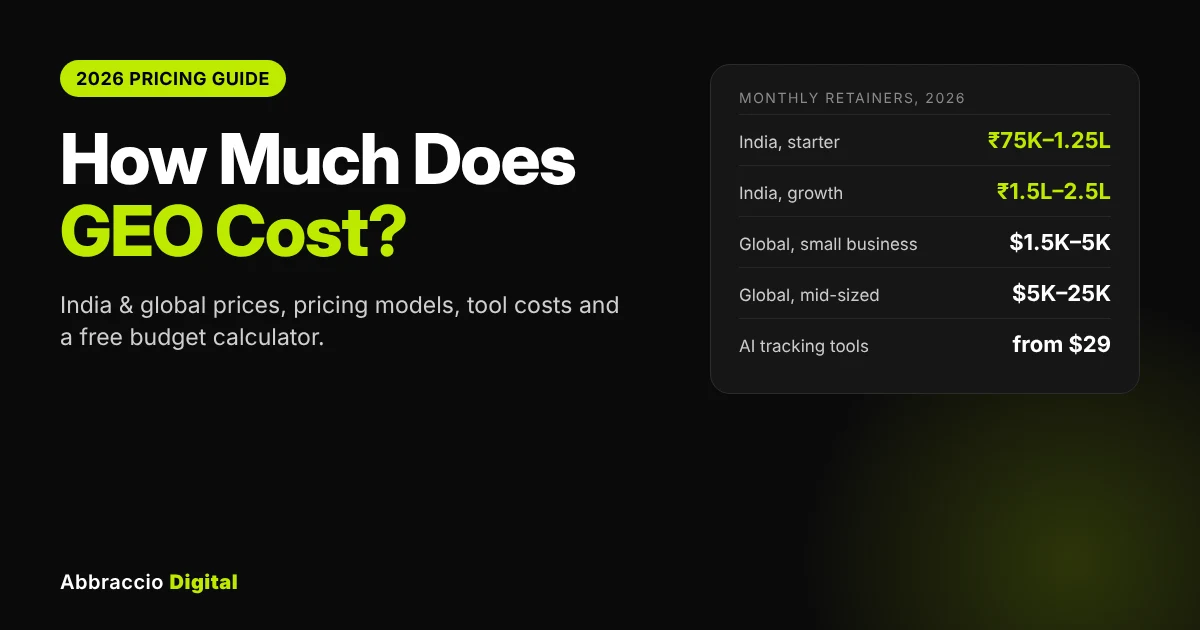
How much do GEO services cost? In India, most GEO agency retainers run ₹75,000–₹3,50,000 a month, with one-time audits from about ₹1.5 lakh. Globally, small businesses typically pay $1,500–$5,000 a month, mid-sized companies $5,000–$25,000, and enterprises $25,000–$50,000+. AI visibility tracking tools add roughly $29–$300 a month at entry level.
GEO pricing at a glance (2026)
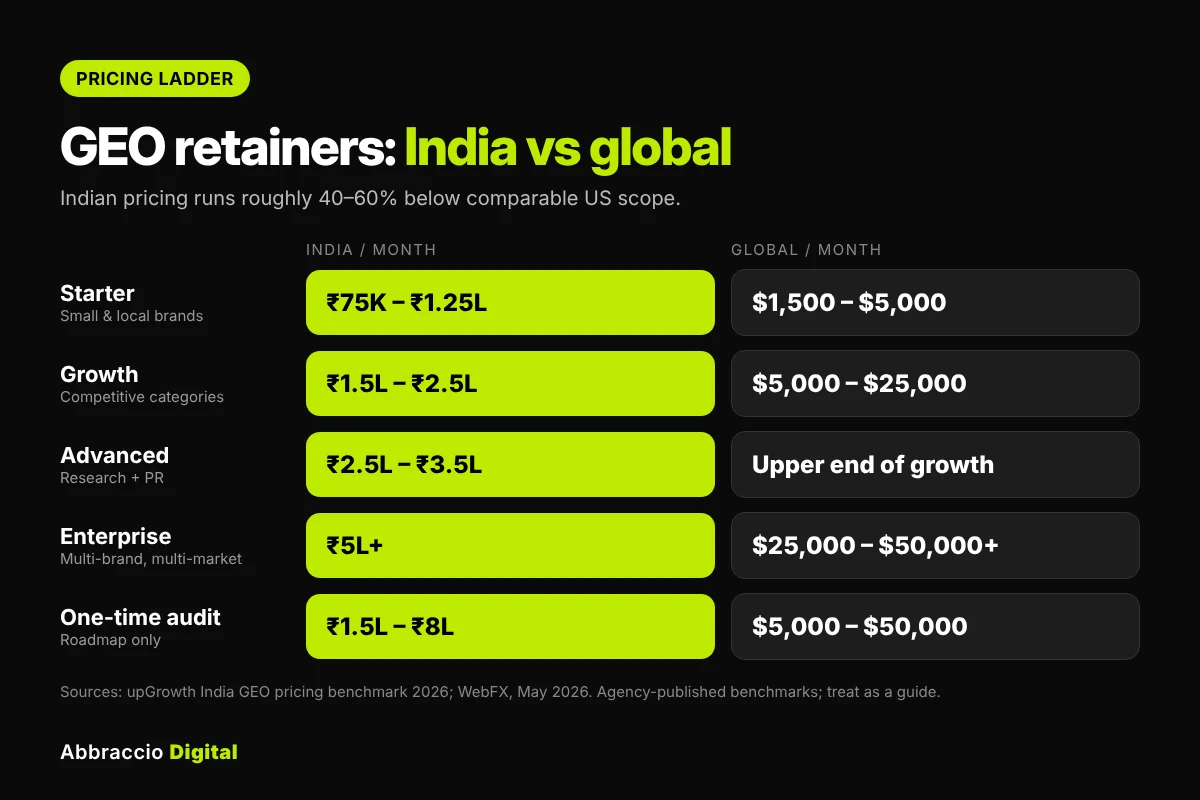
Published 2026 benchmarks put Indian GEO retainers at roughly 40–60% below comparable US scope. Here are the ranges side by side.
|
Tier
|
India (per month)
|
Global (per month)
|
Typically fits
|
|---|---|---|---|
|
Starter
|
₹75,000–₹1,25,000
|
$1,500–$5,000
|
Small businesses, local brands, one market
|
|
Growth
|
₹1,50,000–₹2,50,000
|
$5,000–$25,000
|
Mid-sized brands in competitive categories
|
|
Advanced
|
₹2,50,000–₹3,50,000
|
$5,000–$25,000 (upper end)
|
Brands needing original research and PR
|
|
Enterprise
|
₹5,00,000+
|
$25,000–$50,000+
|
Multi-brand, multi-market companies
|
|
One-time audit or project
|
₹1,50,000–₹8,00,000
|
$5,000–$50,000
|
A roadmap your team executes
|
|
Hourly consulting
|
Varies
|
$50–$300/hour
|
Advice, reviews, training
|
India ranges: upGrowth 2026 India pricing benchmark, an agency-published benchmark without a stated sampling method. Global ranges: WebFX, May 2026. Both are agency sources, so treat them as a guide.
GEO pricing models compared
How you pay matters as much as how much. Each model suits a different stage.
|
Model
|
Typical price
|
Best for
|
Watch out for
|
|---|---|---|---|
|
Monthly retainer
|
₹75,000–₹3,50,000 / $1,500–$25,000+
|
Ongoing improvement; most brands
|
Minimum terms (six months is common) and vague deliverables
|
|
One-time audit
|
₹1,50,000–₹8,00,000 / $5,000–$50,000
|
A baseline and roadmap your team executes
|
An audit with no prioritised fix list is just a report
|
|
Starter sprint (fixed 3 months)
|
₹3,00,000–₹4,00,000 total in India
|
Testing GEO before committing
|
Three months is short for share-of-voice gains
|
|
Performance-linked
|
Base fee (₹75,000–₹1,00,000 in India) plus a visibility bonus
|
Brands with clear, agreed KPIs
|
Disputes over how "visibility" is measured; usually 12-month terms
|
|
Hourly consulting
|
$50–$300/hour
|
Strategy reviews, in-house team training
|
Costs can creep without a clear scope
|
Sources as above. The starter sprint and performance-linked figures are from the upGrowth India benchmark.
Which should you pick? If you’ve never measured your AI visibility, start with an audit (or the free DIY audit). If the audit shows real gaps and you lack in-house capacity, move to a retainer. Consider performance pricing only once both sides agree on the exact KPI formulas.
What you actually get at each price point
The clearest way to compare quotes is to look at deliverables, not the headline fee. The upGrowth benchmark lists sample packages for the Indian market:
|
Deliverable
|
₹1,00,000 / month
|
₹2,00,000 / month
|
₹3,50,000 / month
|
|---|---|---|---|
|
AI platforms tracked
|
3
|
5
|
5
|
|
Optimised articles per month
|
4
|
8
|
8+
|
|
Schema work
|
Basic
|
Schema engineering
|
Large-scale
|
|
Digital PR placements
|
-
|
2–3 a month
|
Included, plus video and podcast appearances
|
|
Original research and data
|
-
|
-
|
Included
|
|
Competitor benchmark
|
Quarterly
|
Not specified
|
Not specified
|
|
Strategy reviews
|
Monthly
|
Every two weeks
|
Dedicated four-person team
|
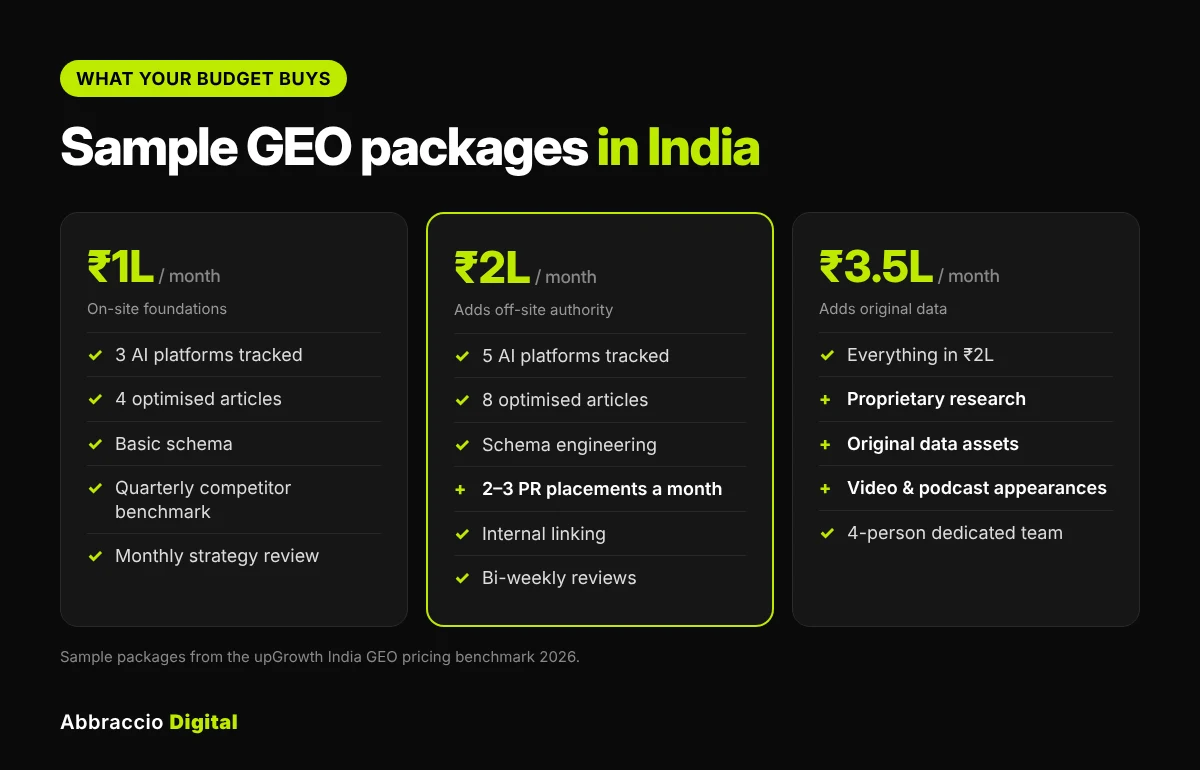
The pattern is clear. Entry-level budgets buy on-site work: content and schema. Mid-level budgets add the off-site work, digital PR and mentions, that AI engines weight heavily. In Ahrefs’ study of 75,000 brands, branded web mentions correlated with AI Overview visibility at 0.664, versus 0.218 for backlinks. If your quote has no off-site component, you’re paying for half of GEO.
AI visibility tool costs
Whether you hire an agency or do it yourself, someone pays for tracking. Entry plans start under $30 a month, but the number of prompts and AI engines included varies widely.
|
Tool
|
Entry plan (per month)
|
What the entry plan includes
|
|---|---|---|
|
Otterly.AI Lite
|
$29
|
15 prompts; ChatGPT, AI Overviews, Perplexity, Copilot (others are add-ons)
|
|
Mangools Basic
|
$61
|
500 prompts, bundled with SEO tools (monthly figure derived from yearly price)
|
|
Peec AI Starter
|
$95
|
50 prompts, 3 AI models, 1 project
|
|
Moz Pro Standard
|
$99
|
150 prompts tracked weekly, bundled with SEO tools
|
|
Ahrefs Lite
|
$129
|
Brand Radar custom prompts included with paid plans
|
|
SE Ranking Core
|
$129
|
100 prompts tracked daily, bundled with SEO tools
|
|
Semrush SEO + AI Search Starter
|
$199
|
50 prompts, bundled with SEO tools
|
|
Scrunch Core
|
$250
|
125 prompts, 4 AI models
|
|
AthenaHQ Starter
|
$295
|
Credit-based: 3,600 credits a month across 11 models
|
|
Profound
|
Custom
|
Free 7-day trial; enterprise pricing on request
|
List prices as checked on 24 October 2026 by GTM 80/20. Annual billing is usually cheaper. Confirm on each vendor’s site before buying.
Budget tip: if you already pay for Ahrefs, Semrush, SE Ranking or Moz, check your plan first. AI prompt tracking is often bundled, so you may not need a separate tool.
7 factors that push a GEO quote up or down
If AI crawlers are blocked, nothing else in this audit matters. Open yourdomain.com/robots.txt and check these user agents:
|
Factor
|
Pushes price up
|
Keeps price down
|
|---|---|---|
|
OAI-SearchBot
|
Crowded categories (SaaS, fintech, D2C) where rivals already invest in AI visibility
|
Niche or local categories with few strong competitors
|
|
YMYL industry
|
Fintech, healthcare, legal and insurance need expert review; the India benchmark puts the premium at 20–35%
|
Low-risk categories like hobbies or home goods
|
|
Site size and technical state
|
Large sites, JavaScript-heavy builds, many templates to fix
|
Small, clean WordPress sites
|
|
Number of AI platforms and prompts tracked
|
5+ engines, 100+ prompts, several markets
|
3 engines, 25–50 prompts, one market
|
|
Off-site work
|
Digital PR, review generation, YouTube and community programmes
|
On-site content and schema only
|
|
Languages and markets
|
Hindi and regional-language content, multiple countries
|
One language, one country
|
|
Original research
|
Surveys, proprietary data studies, expert interviews
|
Content built from existing information
|
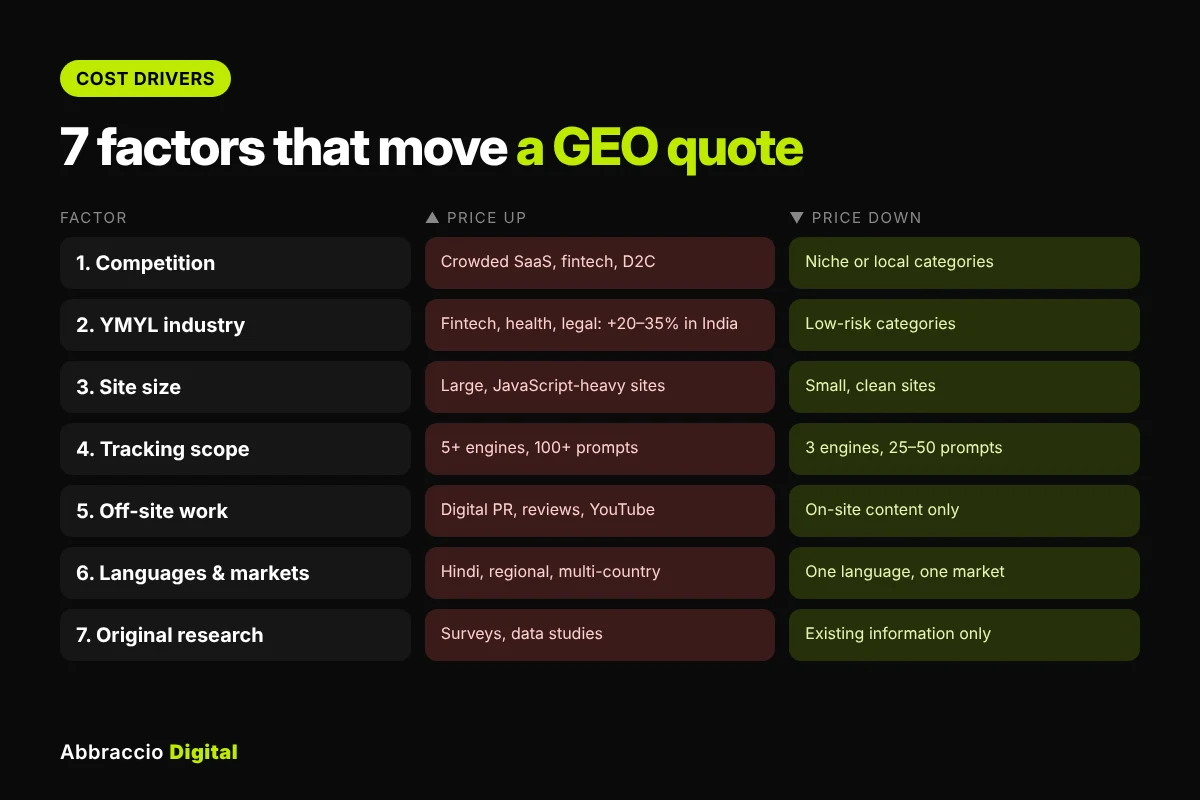
Factors 5 and 7 cost the most but often matter the most, because they create the third-party mentions and unique facts AI engines cite. If you need to save money, reduce the number of prompts and platforms tracked before you cut off-site work.
DIY vs freelancer vs agency: the real 12-month cost
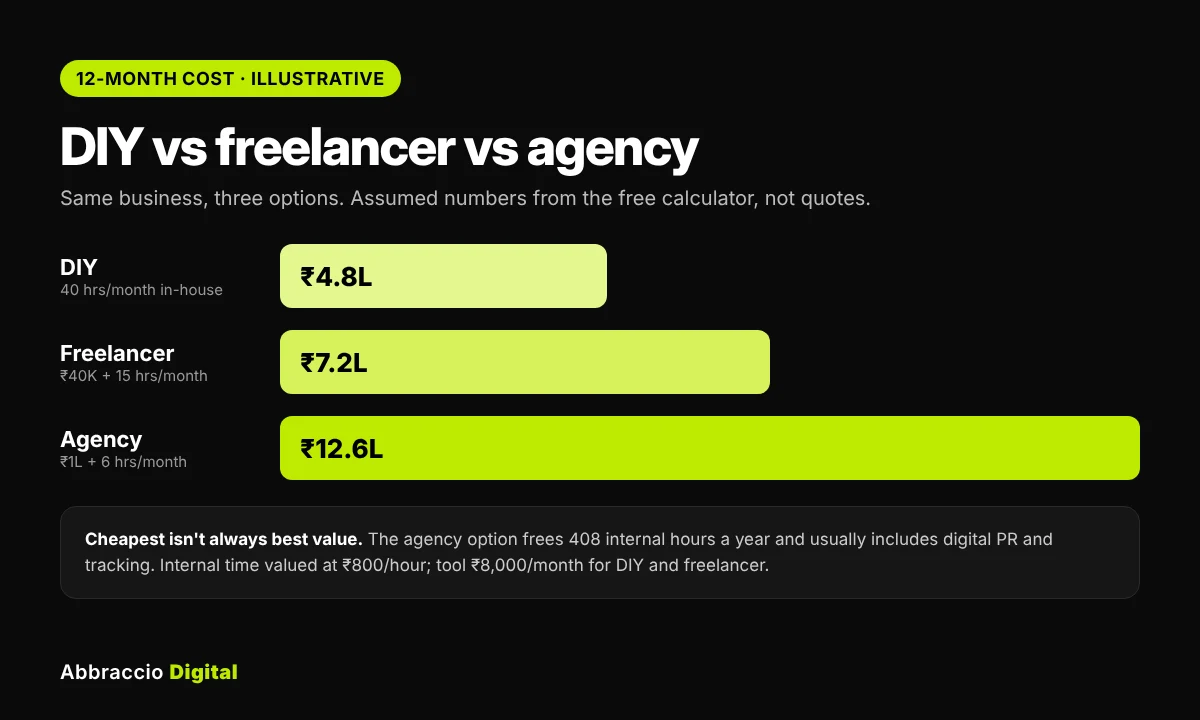
The cheapest option on paper often isn’t the cheapest in practice, because DIY time has a cost too. Compare the full 12-month picture:
12 month cost = (monthly fee + tool cost + internal hours X hourly cost) X 12 + one-time costs.
|
|
DIY (in-house)
|
Freelancer
|
Agency
|
|---|---|---|---|
|
Monthly fee
|
None
|
Freelancer's rate
|
Retainer
|
|
Tools
|
You pay ($29–$300/month entry level)
|
||
|
Usually included
|
High: prompt testing, content, outreach
|
Medium: briefing and review
|
Low: approvals and reviews
|
|
Off-site / PR
|
Only if you have the contacts
|
Rarely included
|
Often included at mid-tier
|
|
Hidden cost
|
Learning curve, slower results
|
Coverage gaps, single point of failure
|
Lock-in, paying for unused scope
|
After fixing sources, re-test the brand prompts in four to six weeks. Engines that search live, like Perplexity and Copilot, tend to update faster than answers drawn mainly from a model’s training data.
Step 6: Check your first-party AI data
Your own analytics show whether AI is already sending you visitors or citing you. Three free sources:
|
Source
|
Where to look
|
What it tells you
|
|---|---|---|
|
GA4
|
Reports → Acquisition → Traffic acquisition, Session default channel group = AI Assistant
|
Sessions and key events from ChatGPT, Gemini, Claude and other recognised assistants. GA4 added this channel on 13 May 2026
|
|
Bing Webmaster Tools
|
AI Performance report
|
|
|
Google Search Console
|
Performance report, filtered to long question-style queries
|
Rising impressions with flat clicks on question queries often signal AI Overviews answering above you
|
Illustrative example (assumed numbers, not a quote): a marketer earning the equivalent of ₹800 an hour spends 40 hours a month on GEO with a ₹8,000 tool. That’s about ₹40,000 a month, or ₹4.8 lakh a year, before any PR or content spend. A ₹1,00,000 retainer costs ₹12 lakh a year but frees most of those 40 hours. Which is better depends on what those hours are worth elsewhere. The free calculator does this maths with your own numbers.
How to set a GEO budget and estimate ROI
Start from what a new customer is worth, not from what agencies charge. The break-even question is simple: how many extra customers a month does GEO need to bring in to pay for itself?
Break-even sutomers per month = monthly GEO cost/average order value x gross margin
Illustrative example (assumed numbers): a ₹1,00,000 monthly retainer, a ₹5,000 average order and a 40% margin means each customer earns ₹2,000 in gross profit. GEO needs to bring in 50 extra customers a month to break even. For a B2B company with a ₹5 lakh average deal at 60% margin, the same retainer breaks even at one extra deal every three months.
That’s why GEO usually pays back fastest for high-value sales (B2B, education, real estate, healthcare) and needs scale for low-ticket D2C products.
Measure the return honestly:
- Direct: key events and revenue from GA4’s AI Assistant channel. This undercounts, because visits from AI apps often arrive without a referrer.
- Assisted: add “How did you hear about us?” with a “ChatGPT / AI assistant” option to forms and checkout. Many AI-influenced buyers never click a link; they search your brand name later.
- Leading indicators: monthly AI mention rate and share of voice (see the GEO reporting template). These move before revenue does.
6 ways to get more from a GEO budget
- Start with an audit, not a retainer. A DIY or one-time audit shows where the gaps are, so you only pay for the work you need.
- Use tools you already own. Check whether your Ahrefs, Semrush, SE Ranking or Moz plan already includes AI prompt tracking.
- Track fewer, better prompts. Thirty prompts tied to revenue beat 200 generic ones, and tracking costs scale with prompt count.
- Keep content in-house, outsource off-site work. Your team knows the product best. Digital PR and outreach are where agency contacts add the most value.
- Reuse what you have. Customer data, support tickets and sales FAQs can become original research and answer-first content at almost no cost.
- Negotiate deliverables, not discounts. Ask for a clearer scope (named KPIs, number of mentions earned, platforms tracked) rather than a lower fee for the same vague package.
Key takeaways
- GEO retainers in India typically cost ₹75,000–₹3,50,000 a month; globally, $1,500–$5,000 for small businesses and $5,000–$25,000+ for mid-sized companies.
- One-time audits cost ₹1.5–8 lakh in India or $5,000–$50,000 globally, and are the safest first step.
- AI visibility tools start around $29–$95 a month; check whether your existing SEO suite already includes prompt tracking.
- Entry budgets buy on-site work; mid-tier budgets add the off-site mentions that AI engines weight heavily.
- Budget from customer value: break-even customers = monthly cost ÷ (average order value × margin).
Conclusion
GEO doesn’t have a fixed price because it doesn’t have a fixed scope yet. A fair quote shows exactly what you get: how many platforms and prompts are tracked, what’s done on your site, how many third-party mentions are earned, and which KPIs are reported each month.
Set your budget from what a customer is worth, start with an audit, use the tools you already pay for, and spend the rest where AI engines look hardest: on what other sites say about you.
Sources
- GEO & AEO pricing benchmark India 2026 — upGrowth, updated Sept 2026
- Generative engine optimization cost — WebFX, May 2026
- How much do AI visibility tools cost in 2026? — GTM 80/20, prices checked 24 Oct 2026
- AI Overview brand correlation study — Ahrefs, May 2025, updated April 2026
Frequently Asked Questions
Published 2026 benchmarks put most GEO retainers in India between ₹75,000 and ₹3,50,000 a month. Starter packages with audit-led optimisation sit at the lower end; packages with digital PR and original research sit at the upper end.
Agency benchmarks from 2026 put US and global GEO retainers at $1,500–$5,000 a month for small businesses, $5,000–$25,000 for mid-sized companies and $25,000–$50,000+ for enterprises. Hourly consulting runs about $50–$300.
GEO is often priced as an add-on to SEO or bundled with it, because the foundations overlap. Standalone GEO tends to cost more when it includes digital PR, original research and multi-platform AI tracking, which classic SEO packages don’t always cover.
Yes, especially at the start. A free DIY audit, a $29–$95 tracking tool and in-house content can cover the basics. The hardest part to do alone is earning third-party mentions, which is where agencies add the most value.
It depends on your order value. High-value B2B or service businesses can break even on a single extra deal; low-ticket products need many extra customers a month. Expect early AI citations within two months and meaningful share-of-voice gains in three to six.
Because scope isn’t standard yet. Quotes differ in the number of AI platforms and prompts tracked, whether digital PR and original research are included, how many languages and markets are covered, and how competitive or regulated your industry is.