
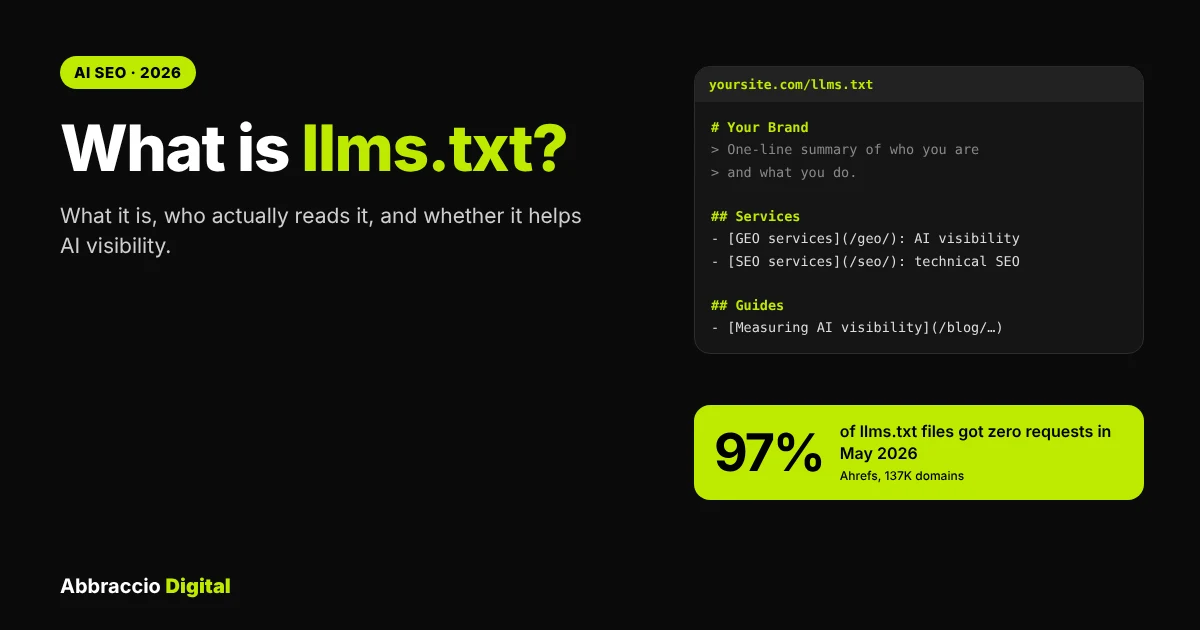
Few things in AI search have spread as fast as llms.txt. It’s been called “the robots.txt for AI”, SEO plugins added one-click generators, and agencies started selling it as a GEO quick win.
There’s just one problem: almost nothing reads it. In a study of 137,000 domains, Ahrefs found that 97% of llms.txt files received zero requests in May 2026: no bots, no humans, nothing. And Google’s official AI search guide lists “you need llms.txt” among its myths.
So is llms.txt pointless? Not quite. It has real uses for documentation sites and AI coding tools, it’s cheap to add, and it might matter more later. But it won’t get a business into ChatGPT or AI Overviews on its own.
This guide explains what llms.txt is, what each AI platform does with it, what the data shows, when it’s worth adding, how to create one in WordPress, and what actually moves AI visibility instead.
Table of Contents
ToggleQuick Answer
What is llms.txt, and does it help AI visibility? llms.txt is a proposed Markdown file at the root of a website (yoursite.com/llms.txt) that gives AI models a short summary of the site and links to its most useful pages. It was proposed in September 2024 and isn’t an official standard. Google says its AI search doesn’t use it, no major AI platform has committed to reading it, and large log studies show AI crawlers rarely fetch it. It’s worth a few minutes for documentation, developer and SaaS sites, but for most businesses, crawler access, server-rendered content and genuine brand mentions matter far more.
What is llms.txt?
llms.txt is a plain-text file written in Markdown and placed at the root of a website, like example.com/llms.txt. It was proposed by Jeremy Howard of Answer.AI in September 2024. The idea: AI models have small context windows and struggle with cluttered HTML, so give them a clean, curated guide to the site’s most useful content.
A companion file, llms-full.txt, contains the full text of the key pages in one Markdown file, so a model can read everything without following links.
What it isn't
|
People think llms.txt…
|
In reality
|
|---|---|
|
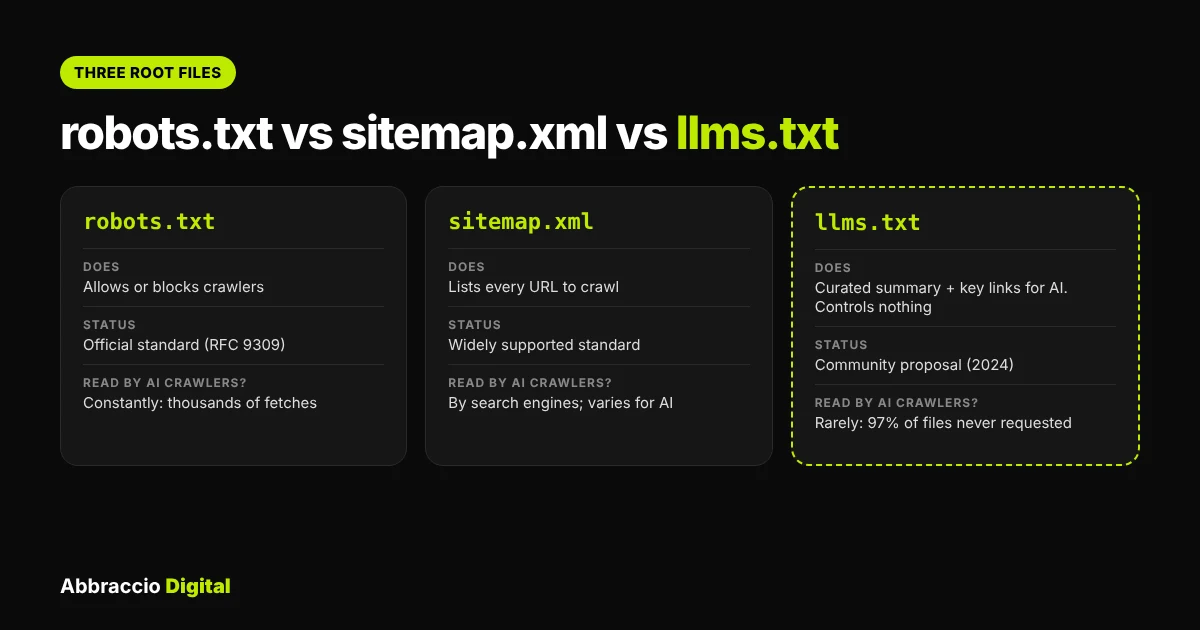
Controls AI crawlers, like robots.txt
|
It controls nothing and blocks nothing. Crawler access is still managed in robots.txt
|
|
Is an official web standard
|
|
|
Is read by ChatGPT, Google and Perplexity
|
|
|
Replaces a sitemap
|
Sitemaps are for search engines and list every URL; llms.txt is a short, curated summary
|
The format
The proposal defines a simple structure:
- An
# H1with the site or project name (the only required part) - A
>blockquote with a one- or two-sentence summary - Optional plain paragraphs with key details
## H2sections with lists of links, each with a short description- An optional
## Optionalsection for links a model can skip
Example for an agency site
Abbraccio Digital
Abbraccio Digital is a digital marketing agency in New Delhi, India,
specialising in SEO and generative engine optimisation (GEO) for
Indian and global brands.
Services
- GEO services: AI search visibility for ChatGPT, Gemini and Google AI Overviews
- SEO services: technical SEO, content and link building
Guides
- How to measure AI search visibility: KPIs, tools and a measurement plan
- GEO KPIs: what to report to clients
Company
Optional
Which AI platforms use llms.txt?
You’ll find bold claims online that “Anthropic and Perplexity support llms.txt”. We couldn’t find any official statement from either confirming that their crawlers or search products use other sites’ llms.txt files. Here’s what’s actually documented, as of November 2026.
|
Platform
|
Official position
|
What server logs show
|
|---|---|---|
|
Google (AI Overviews, AI Mode)
|
Googlebot fetched llms.txt 67 times vs robots.txt 5,125 times across 83 sites (EZY)
|
|
|
OpenAI (ChatGPT)
|
No official statement of support
|
GPTBot family: 7 llms.txt fetches vs 3,990 robots.txt fetches in 12 weeks (EZY)
|
|
Anthropic (Claude)
|
Publishes llms.txt files for its own developer docs; no statement that its crawlers use other sites' files
|
ClaudeBot: 9 llms.txt fetches vs 3,120 robots.txt fetches (EZY)
|
|
Perplexity
|
No official statement of support
|
PerplexityBot: 0 llms.txt fetches vs 775 robots.txt fetches (EZY)
|
|
Meta (Meta AI)
|
No official statement
|
Meta-ExternalAgent was the exception: 193 llms.txt fetches vs 172 robots.txt (EZY)
|
|
AI coding tools and agents
|
Many developer tools and docs platforms use llms.txt-style files as documentation context
|
Strongest real-world use case today
|
Server-log figures: EZY Research, 83 sites, 27 April–19 July 2026. EZY sells AEO tools including llms.txt generation, and its panel skews to small-business sites.
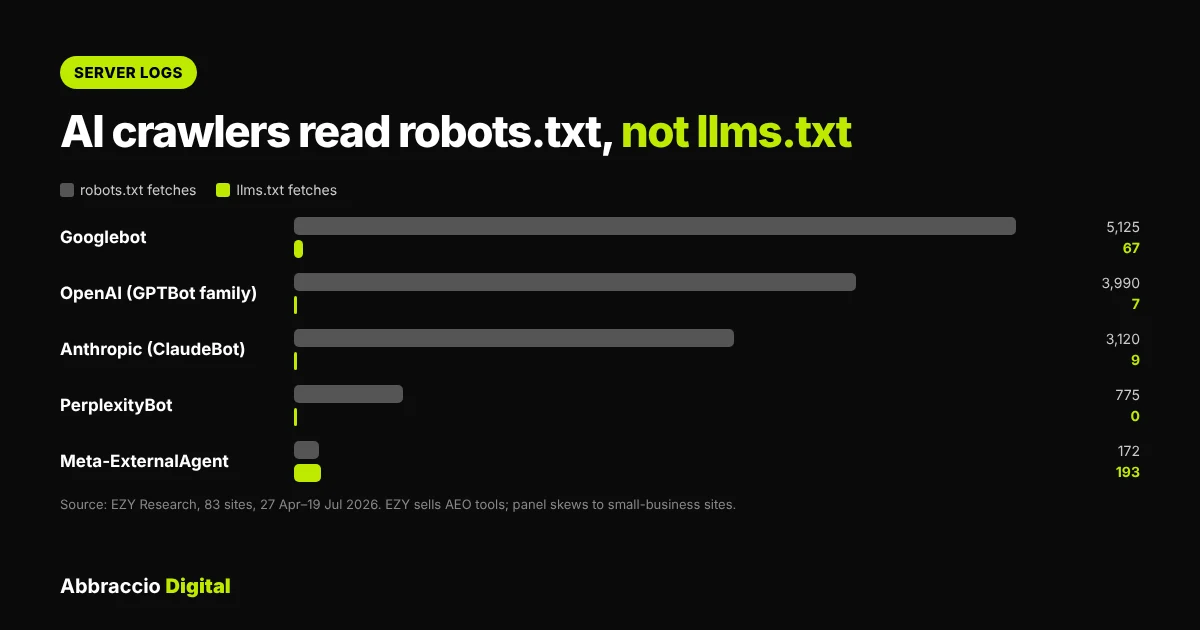
The takeaway: AI crawlers read robots.txt thousands of times and llms.txt a handful of times. robots.txt is where AI access is actually decided.
What the data says
Two things are true at once: lots of sites publish llms.txt, and almost nothing reads it.
|
Finding
|
Number
|
Source
|
|---|---|---|
|
Domains (Ahrefs Web Analytics users) publishing a valid llms.txt
|
28% of 137,210
|
|
|
Of ~38,000 valid files, share with zero requests in May 2026
|
97%
|
Ahrefs
|
|
Share of requests that came from bots (not people)
|
96%
|
Ahrefs
|
|
Share of requests from AI retrieval bots (ChatGPT, Perplexity)
|
About 1%
|
|
|
Ahrefs
|
||
|
AI bot requests for llms.txt files that don't exist
|
Zero: they never go looking
|
Ahrefs
|
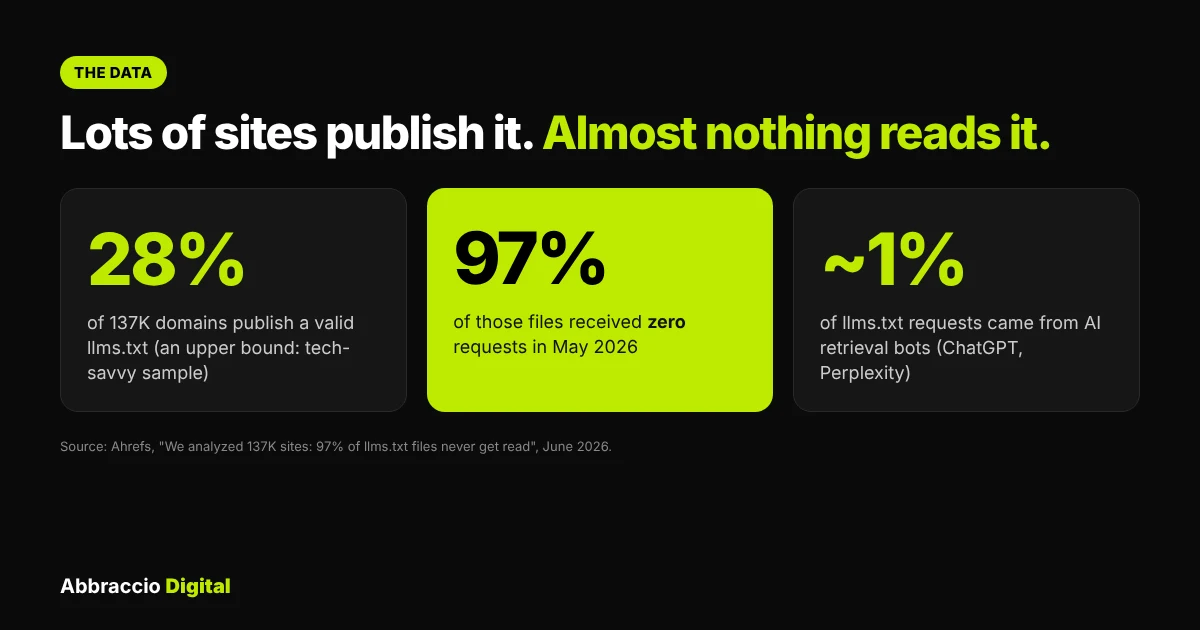
Ahrefs notes its users skew technical and SEO-aware, so treat 28% as an upper bound for adoption. The last point matters most: if AI bots were actively using llms.txt, they would check for it on sites that don’t have one. They don’t.
Why so many sites have one anyway: adoption has been driven by speculation that AI platforms might start using the file, by SEO plugins that generate it automatically, and by agencies selling it as a quick win.
llms.txt is only one small piece of AI visibility. Crawler access, content structure and brand mentions matter far more. To see where your site really stands, get our free AI visibility audit.
Should you add llms.txt to your site?
It depends on what kind of site you run. The file costs very little, but so far it delivers little for most businesses.
|
Site type
|
Recommendation
|
Why
|
|---|---|---|
|
Developer docs, APIs, SaaS with docs
|
Add it (plus llms-full.txt)
|
Developers point AI coding tools at docs; a clean Markdown index genuinely helps there
|
|
SaaS marketing site
|
Optional, low priority
|
Cheap to add; won't move ChatGPT or Google visibility on its own
|
|
E-commerce / D2C
|
Low priority
|
Product feeds, Merchant Center and server-rendered product pages matter far more
|
|
Local business
|
Skip for now
|
Google Business Profile, reviews and accurate NAP data matter far more
|
|
Publisher / blog
|
Optional
|
Harmless; focus on crawler access, rendering and original content first
|
|
Agency selling it to clients
|
Be honest
|
Present it as an inexpensive experiment, never as a ranking or citation lever
|
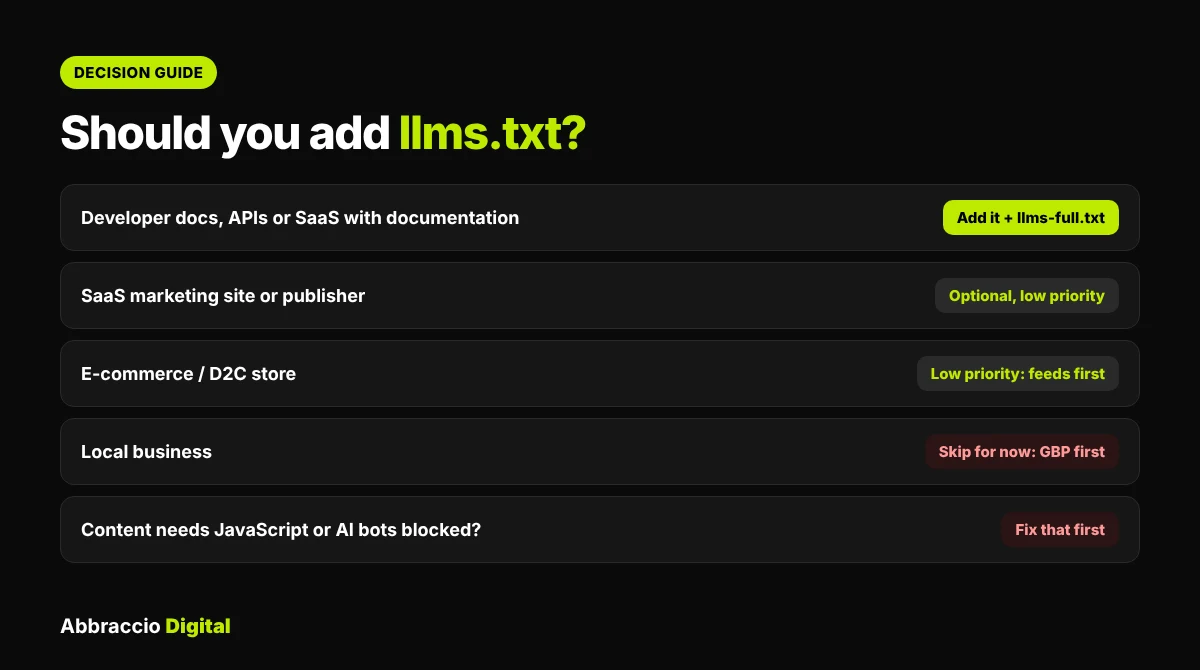
Our view at Abbraccio Digital: llms.txt is fine as a 15-minute task once the things that matter are done. If a site’s content only loads with JavaScript, or robots.txt blocks AI search crawlers, llms.txt won’t fix that, and those problems are far more common.
Keep it accurate if you add one. An outdated llms.txt with old prices, dead links or retired services is worse than none. Add it to your quarterly content review.
How to create llms.txt (including WordPress)
Step 1: Choose your 10–30 most useful pages
Pick the pages you’d want an AI to read first: core services or products, pricing, about, contact, and your best guides. Skip thin pages, tags and archives.
Step 2: Write the file
Use the structure above: an H1 with your name, a one-to-two-sentence summary in a blockquote, then H2 sections with links and one-line descriptions. Write the summary in plain, factual language: who you are, what you do, where, and for whom. Use the starter template in our download.
Step 3: Upload it to your site's root
The file must load at https://yoursite.com/llms.txt and return a 200 status.
On WordPress, three options:
- SEO plugin: Some SEO plugins, such as Rank Math and Yoast, offer an llms.txt option that generates the file for you. Check your plugin’s settings, then review and edit what it creates; auto-generated files often list too many pages.
- File upload: Upload
llms.txtto the root folder (the same folder aswp-config.php) through your host’s file manager or SFTP. - Check for conflicts: If both a plugin and an uploaded file exist, make sure only one is served.
Step 4: Test it
Open yoursite.com/llms.txt in a browser. It should show plain text, not your theme or a 404 page. Check that every link works.
Step 5 (optional): Add llms-full.txt
For docs and developer sites, also publish llms-full.txt with the full Markdown text of your key pages.
Step 6: Check whether anything reads it
After a month, search your server logs for requests to /llms.txt and note which user agents fetched it. Our AI crawler log file guide shows how. If nothing does, you’ve lost 15 minutes, not a strategy.
What actually moves AI visibility (do these first)
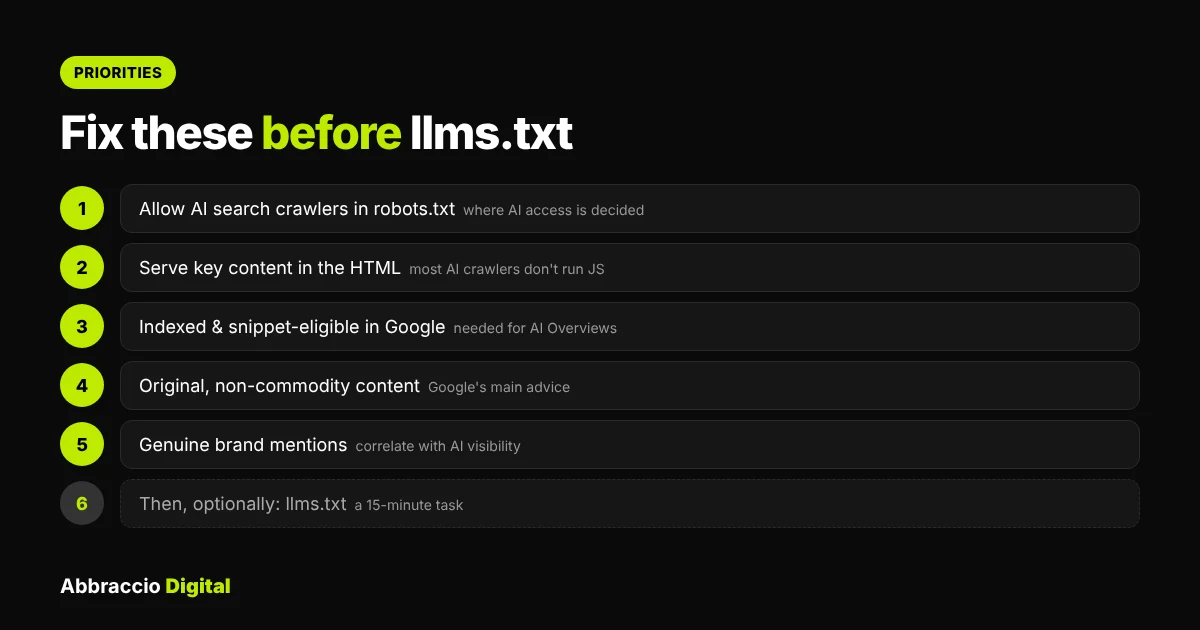
If you have limited time, these deliver far more than llms.txt:
|
Priority
|
KPI
|
Say this to the client
|
Our guide
|
|---|---|---|---|
|
1
|
Allow AI search crawlers in robots.txt
|
AI crawlers read robots.txt thousands of times; blocking OAI-SearchBot or PerplexityBot by mistake removes you from their answers
|
|
|
2
|
Serve key content in the HTML
|
Most AI crawlers don't run JavaScript
|
|
|
3
|
Be indexed and snippet-eligible in Google
|
Required for AI Overviews and AI Mode
|
Google's official AI search guide
|
|
4
|
Publish original, non-commodity content
|
Google's main content advice for AI features
|
Google's official AI search guide
|
|
5
|
Earn genuine brand mentions
|
Branded web mentions correlate strongly with AI Overview visibility
|
|
|
6
|
Measure across a fixed prompt set
|
Shows whether any of this is working
|
A robots.txt snippet that allows AI search crawlers (adjust to your policy; this example allows search and user-requested fetches while leaving training crawlers to your default rule):
User-agent: OAI-SearchBot
Allow: /

User-agent: ChatGPT-User
Allow: /

User-agent: Claude-SearchBot
Allow: /

User-agent: Claude-User
Allow: /

User-agent: PerplexityBot
Allow: /

User-agent: Perplexity-User
Allow: /
Key takeaways
- llms.txt is a proposed Markdown file at a site’s root that summarises the site and links to key pages for AI models. It isn’t an official standard.
- It doesn’t control or block crawlers; robots.txt does that.
- Google says its AI search doesn’t use llms.txt. No major AI platform has committed to reading it.
- Ahrefs found 97% of llms.txt files got zero requests in May 2026; AI retrieval bots made about 1% of requests.
- In one 12-week study, OpenAI’s crawlers fetched llms.txt 7 times versus robots.txt 3,990 times.
- It’s most useful for developer docs and AI coding tools. For most businesses it’s a low-priority, 15-minute task.
- Fix crawler access, rendering, indexing, content quality and brand mentions first.
Frequently Asked Questions
llms.txt is a proposed Markdown file placed at the root of a website (yoursite.com/llms.txt) that gives AI models a short summary of the site and links to its most useful pages. It was proposed by Jeremy Howard in September 2024.
There’s no evidence it does for most sites. Google says its AI search doesn’t use it, and large server-log studies show AI crawlers rarely request it.
OpenAI hasn’t said it does. In a 12-week study across 83 sites, OpenAI’s crawlers fetched llms.txt 7 times compared with nearly 4,000 robots.txt fetches.
No. Google’s 2026 guide to generative AI search says Google Search doesn’t use llms.txt or similar AI files, and they neither help nor harm visibility in Search.
robots.txt tells crawlers which parts of a site they may access, and AI crawlers read it constantly. llms.txt is an optional summary file that doesn’t allow or block anything.
A companion file that contains the full text of a site’s key pages in a single Markdown file, so a model can read everything without following links. It’s mainly useful for documentation.
Not directly. The main risk is wasted time or an outdated file with wrong information. Keep it short and accurate.
Conclusion
llms.txt is a good idea that the AI platforms haven’t adopted. It’s cheap, harmless and genuinely useful for developer documentation. But for most businesses, it’s not a GEO strategy, and anyone selling it as one is ahead of the evidence.
The things that decide whether AI tools find and recommend you are less exciting: robots.txt access, server-rendered content, Google indexing, original content and genuine mentions across the web. Get those right first. Then, if you like, spend 15 minutes on llms.txt.
Sources
- llmstxt.org — The /llms.txt file proposal (Jeremy Howard, Answer.AI, Sept 2024)
- Ahrefs, 15 Jun 2026 — We analyzed 137K sites: 97% of llms.txt files never get read
- Search Engine Journal — 97% of llms.txt files got no requests, Ahrefs data shows
- EZY Research, 27 Jul 2026 — We put llms.txt on 83 websites
- Google Search Central — Optimizing your website for generative AI features on Google Search