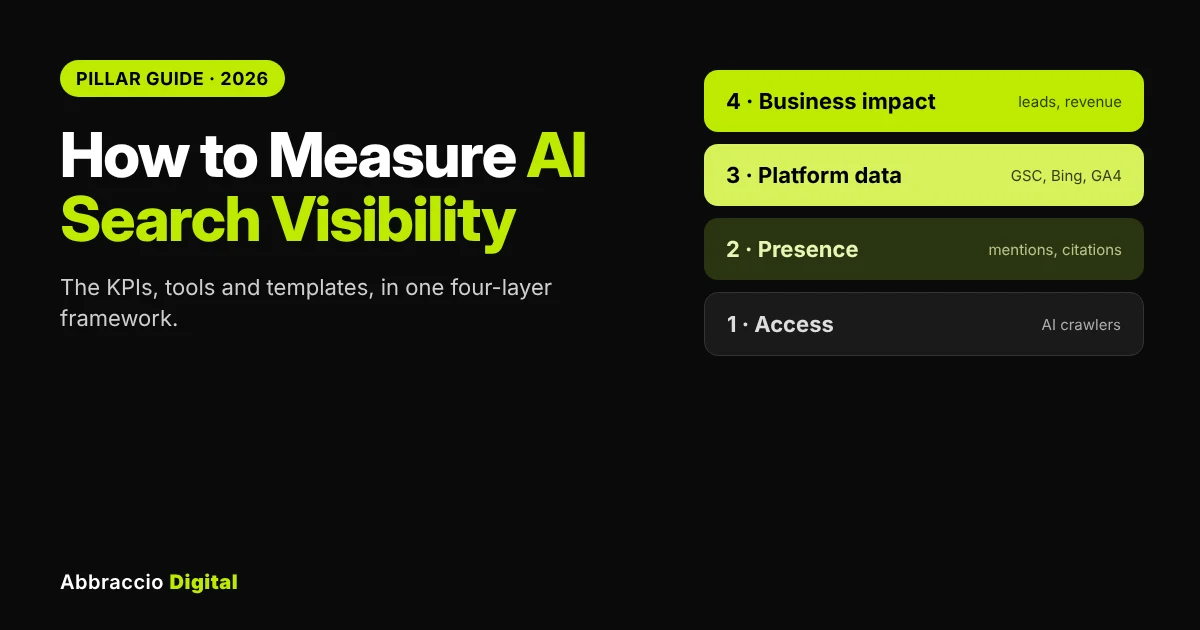
In the first four months of 2026, 68% of US Google searches ended without a click, up from 60% in 2024. More and more of the search journey now happens inside AI answers: Google’s AI Overviews and AI Mode, ChatGPT, Gemini, Perplexity and Copilot. Your brand can be recommended in those answers, or left out, without your traffic reports showing either.
That’s why “how do we measure AI visibility?” has become one of the hardest questions in marketing. There’s no single rank to track, answers change from one run to the next, and each platform shares different data, if any.
The good news: in 2026 the data finally arrived. Google added AI reports to Search Console, Bing launched an AI Performance report, and GA4 gained an AI Assistant channel. This guide puts all of it into one four-layer framework, explains which KPIs to track at each layer, which tools to use, and how often to report, and links to step-by-step guides for each part.
Quick Answer
How do you measure AI search visibility? Measure four layers. Access: can AI crawlers reach your site (server logs)? Presence: how often AI names and cites you for buyer prompts (mention rate, citation rate, share of voice)? Platform data: Search Console’s AI report, Bing’s AI Performance report and GA4’s AI Assistant channel. Business impact: AI-referred conversions, self-reported “heard via AI” leads and branded search demand. Report monthly; judge trends quarterly.
Why AI Visibility Is Hard to Measure
Classic SEO has one clean loop: rank, impression, click, session, conversion. AI search breaks that loop in four places.
|
Problem
|
Why it happens
|
What it means for measurement
|
|---|---|---|
|
No fixed rankings
|
AI answers are generated fresh and vary by user, wording and run
|
Track rates across many prompts and runs, not single positions
|
|
Influence without clicks
|
68% of US Google searches ended without a click in early 2026 (SparkToro, Similarweb data)
|
Clicks understate impact; you need presence metrics too
|
|
Each platform shares different data
|
Google reports AI impressions, Bing reports citations, ChatGPT shares nothing
|
Combine several sources; no single tool sees everything
|
|
Attribution leaks
|
AI app visits often arrive without a referrer; people search your brand later
|
Add self-reported attribution and brand-demand signals
|
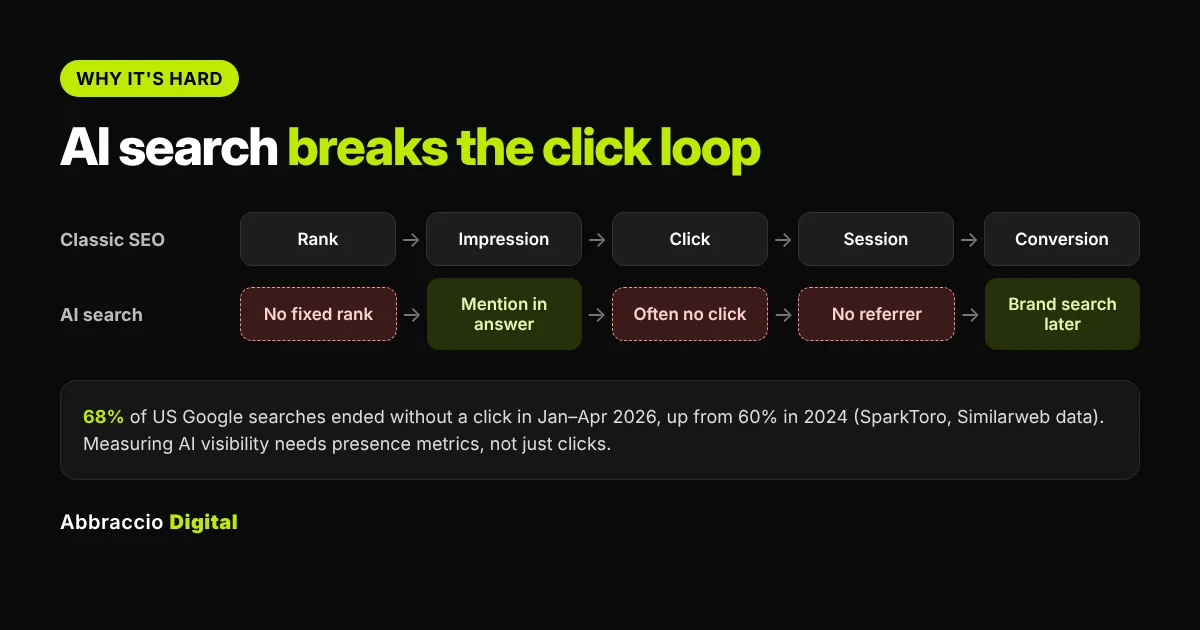
The fix isn’t one perfect metric. It’s a small set of complementary metrics, each answering a different question.
The 4-Layer AI Visibility Measurement Framework
Each layer depends on the one below it. If AI crawlers can’t reach you, you won’t be mentioned; if you’re not mentioned, you won’t get AI traffic; without traffic or awareness, there’s no business impact.
|
Layer
|
The question it answers
|
Core KPIs
|
Main data source
|
Deep-dive guide
|
|---|---|---|---|---|
|
Access
|
Can AI systems read our site?
|
Search-bot requests, error rate, key pages crawled
|
Server logs
|
AI Crawler Log File Analysis
|
|
Presence
|
Does AI mention and cite us?
|
Mention rate, citation rate, share of voice, position, accuracy
|
Prompt tests or tracking tools
|
Free AI Visibility Audit
|
|
Platform data
|
What do the platforms report?
|
AI impressions, Copilot citations, AI Assistant sessions
|
Search Console, Bing Webmaster Tools, GA4
|
GA4 AI Assistant Channel
|
|
Business impact
|
Is it driving business?
|
AI-referred conversions, "heard via AI" leads, branded search demand
|
GA4, CRM, forms, Search Console
|
GEO Services Cost (ROI section)
|
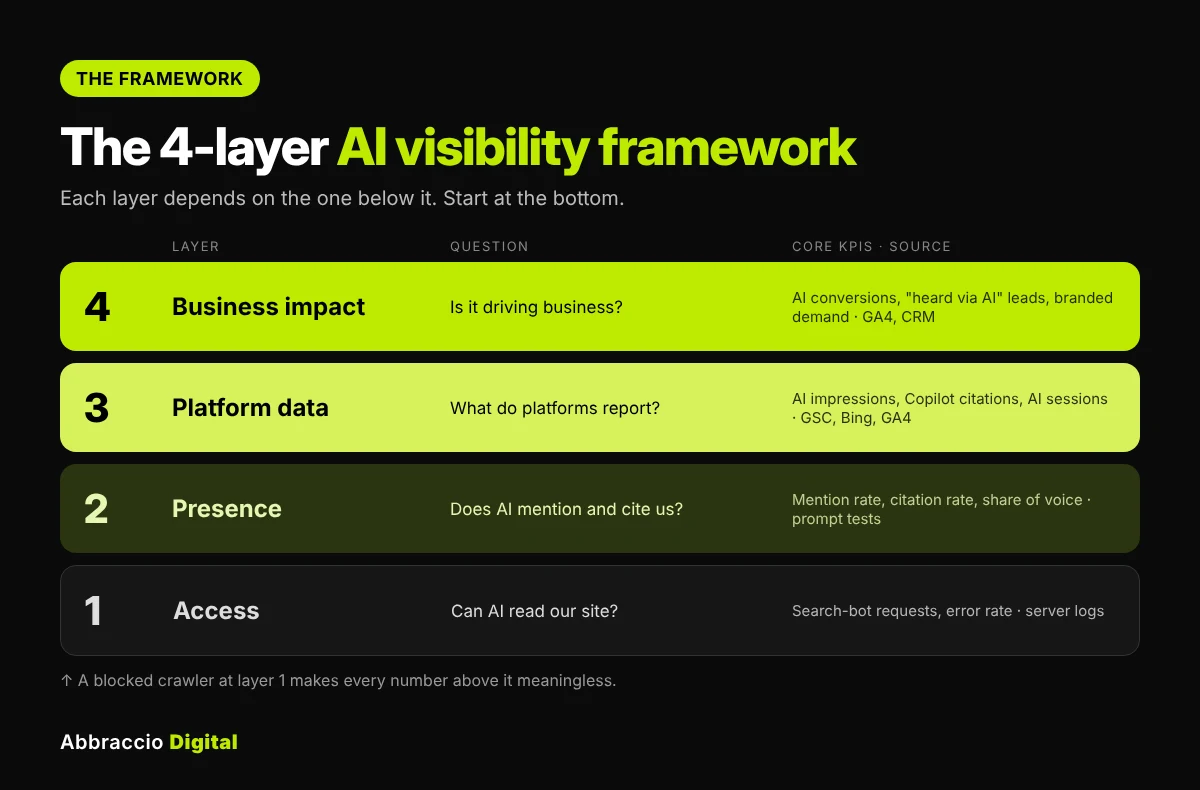
Most teams start at layer 3 because the data is easiest to pull. Start at layer 1 instead: a blocked crawler makes every other number meaningless.
Layer 1 — Access: Can AI Crawlers Reach You?
AI answers can only cite what AI systems can fetch. Measure access from your server logs, because analytics tags don’t see bots.
|
KPI
|
How to calculate
|
Healthy sign
|
|---|---|---|
|
Search-bot presence
|
Requests per month from OAI-SearchBot, Claude-SearchBot, PerplexityBot, Bingbot, Googlebot
|
Every search bot you want to be cited by appears
|
|
Bot error rate
|
4xx + 5xx responses ÷ requests, per verified bot
|
Low and stable; spikes in 403s usually mean a firewall rule
|
|
Key-page coverage
|
Share of your priority pages requested by AI search bots in the period
|
Your money pages and best guides are fetched regularly
|
|
Freshness lag
|
Days between publishing and the first AI search-bot request
|
Falling over time
|
Why it matters: in Cloudflare’s data, 38.1% of crawler requests got a 4xx response in September 2026, many of them blocks. Verify bots against the vendors’ official IP lists before trusting the numbers.
Go deeper: AI Crawler Log File Analysis walks through the setup in Screaming Frog, with a free script for the command line.
Layer 2 — Presence: Does AI Mention and Cite You?
This is the heart of AI visibility, and the one layer no platform reports for you. You measure it by running a fixed set of buyer prompts across AI platforms and logging the answers.
|
KPI
|
Formula
|
What it tells you
|
|---|---|---|
|
AI mention rate
|
Prompts where your brand is named ÷ prompts tested
|
How often you're in the answer
|
|
AI citation rate
|
Prompts citing one of your URLs ÷ prompts tested
|
How often AI sends readers to you
|
|
AI share of voice
|
Your mentions ÷ mentions of you + tracked competitors
|
Whether you're winning your category
|
|
Average position
|
Average rank when named in list-style answers
|
How prominently you're recommended
|
|
Accuracy and sentiment
|
Factual errors found; % positive mentions
|
Whether AI describes you correctly
|
|
Source presence
|
Share of the most-cited third-party sources that feature you
|
Whether you're on the sites AI trusts
|

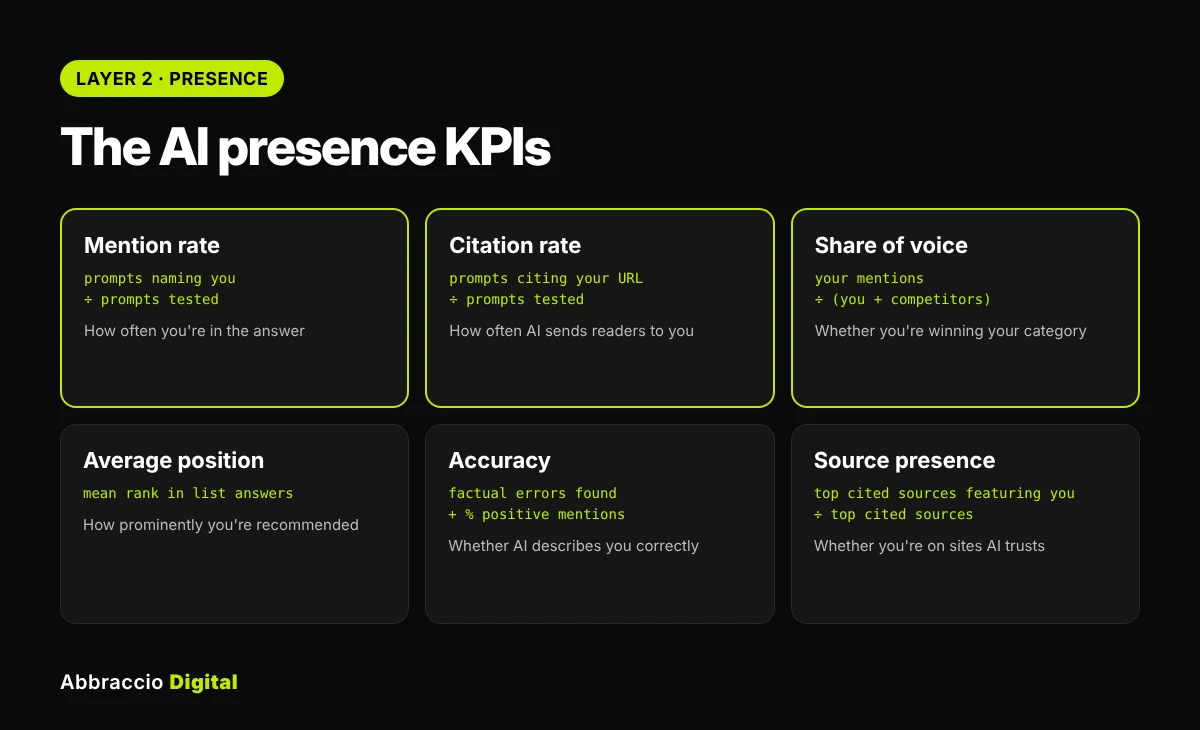
Rules for reliable numbers: use the same 25–50 prompts every month, test in clean sessions with memory off, run each prompt at least twice, and track competitors alongside yourself. Build prompts around the hidden sub-questions AI researches, not just head terms.
Go deeper: How to Do a Free AI Visibility Audit for the full method and a score out of 100, and Query Fan-Out SEO for choosing prompts that reflect how AI actually searches.
Layer 3 — Platform Data: What Google, Bing and Ga4 Now Report
In 2026, three first-party data sources arrived. Each covers a different part of the picture, and none covers it all.
|
Source
|
What it shows
|
What it doesn't show
|
Since
|
|---|---|---|---|
|
Google Search Console: Search Generative AI performance report
|
Impressions of your URLs in AI Overviews and AI Mode, by page, country, device and date; a separate view for Discover's AI features
|
Clicks, positions or the queries behind AI impressions (as of its rollout)
|
Announced 3 June 2026; worldwide rollout 31 August 2026
|
|
Bing Webmaster Tools: AI Performance
|
How often Microsoft Copilot cites your pages, which pages, and the grounding queries
|
Clicks
|
Public preview since February 2026
|
|
GA4: AI Assistant channel
|
Sessions, key events and revenue from recognised AI chatbots such as ChatGPT, Gemini and Claude
|
Google AI Overviews and AI Mode clicks (Organic Search), Perplexity (Referral), visits without a referrer (Direct)
|
May 2026
|
Search Console details from PPC Land and Webiano; Bing from Search Influence; GA4 from Search Engine Journal.
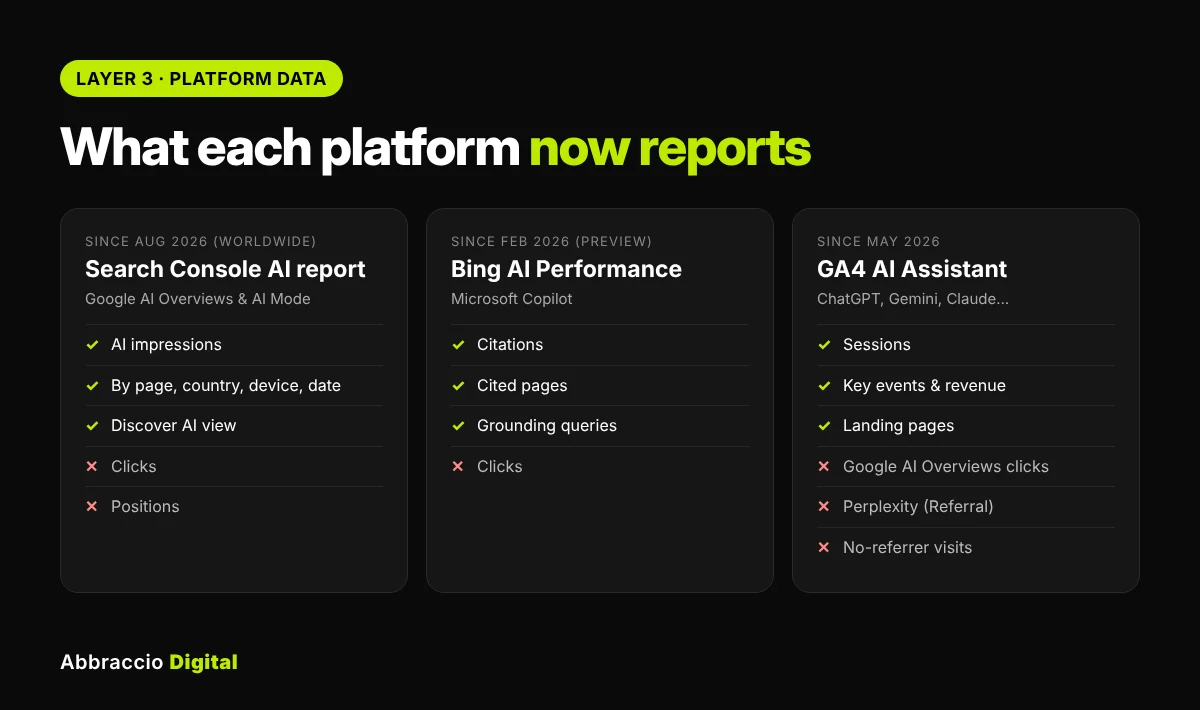
How to use them together:
- Search Console’s AI report is your Google AI-presence trend. Track AI impressions per month and the pages that earn them. Note that sites with very few AI impressions may not see the report, and AI impressions also still count in the main Performance report.
- Bing AI Performance is the only report that shows citations directly, plus the grounding queries Copilot used, which are excellent prompts to add to your layer 2 testing.
- GA4 turns visibility into visits. Use a custom AI channel group to add Perplexity and other tools the default channel misses.
Go deeper: GA4 AI Assistant Channel covers setup, gaps and a custom channel group regex.
Layer 4 — Business Impact: Is AI Visibility Paying Off?
Visibility is a means, not an end. Connect it to outcomes with three kinds of evidence.
|
Evidence
|
KPI
|
How to collect it
|
|---|---|---|
|
Direct
|
AI-referred key events, leads and revenue
|
GA4 with a custom AI channel group; CRM source fields
|
|
Self-reported
|
Share of new leads or customers who say they found you through an AI assistant
|
Add "How did you hear about us?" with an "AI assistant (ChatGPT, Gemini, etc.)" option to forms and checkout
|
|
Indirect
|
Branded search demand
|
Branded query impressions and clicks in Search Console; brand search volume in your keyword tool
|
Branded demand matters because many people read an AI answer and then search your name or type your URL. That visit shows up as Organic Search or Direct, not AI, but rising branded searches alongside rising AI presence is a reasonable signal that AI is building awareness. Treat it as a correlation, not proof.
On value per visit, early evidence is encouraging but limited to individual companies. Ahrefs reported that its AI search visitors converted 23 times better than organic search, but that’s one company’s data, not a benchmark.
Go deeper: How Much Do GEO Services Cost? includes a break-even formula for judging whether AI visibility work pays for itself.
The Measurement Stack: Free vs Paid
You can cover all four layers for free. Paid tools save time once you track many prompts or many clients.
|
Layer
|
Free option
|
Paid option (entry price)
|
|---|---|---|
|
Access
|
Server logs + command line; Cloudflare AI Crawl Control
|
Screaming Frog Log File Analyser (licence)
|
|
Presence
|
Manual prompt tests in a spreadsheet
|
Otterly.AI from $29/month, Peec AI from $95, Semrush AI tracking from $199, Ahrefs Brand Radar with paid plans
|
|
Platform data
|
Search Console, Bing Webmaster Tools, GA4
|
Looker Studio dashboards (free) or BI tools to combine them
|
|
Business impact
|
GA4, form question, Search Console branded queries
|
CRM attribution
|
Tool prices as checked on 24 October 2026 by GTM 80/20; confirm before buying.
A sensible starting stack: Search Console, Bing Webmaster Tools and GA4 (all free), a monthly manual prompt test of 25 prompts, a quarterly log check, and one form question. Add a paid tracker when manual testing takes more than a few hours a month.
How Often to Measure, and How Mature Is Your Setup?
Cadence
|
Frequency
|
What to check
|
|---|---|
|
Weekly (optional)
|
Search Console AI impressions and GA4 AI sessions for sudden drops
|
|
Monthly
|
Full prompt test, Bing citations, GA4 AI channel, self-reported leads; publish the monthly report
|
|
Quarterly
|
Server log review, competitor share-of-voice trend, prompt-set refresh, regex update
|
|
Annually
|
Re-baseline: a full AI visibility audit with an updated prompt set
|
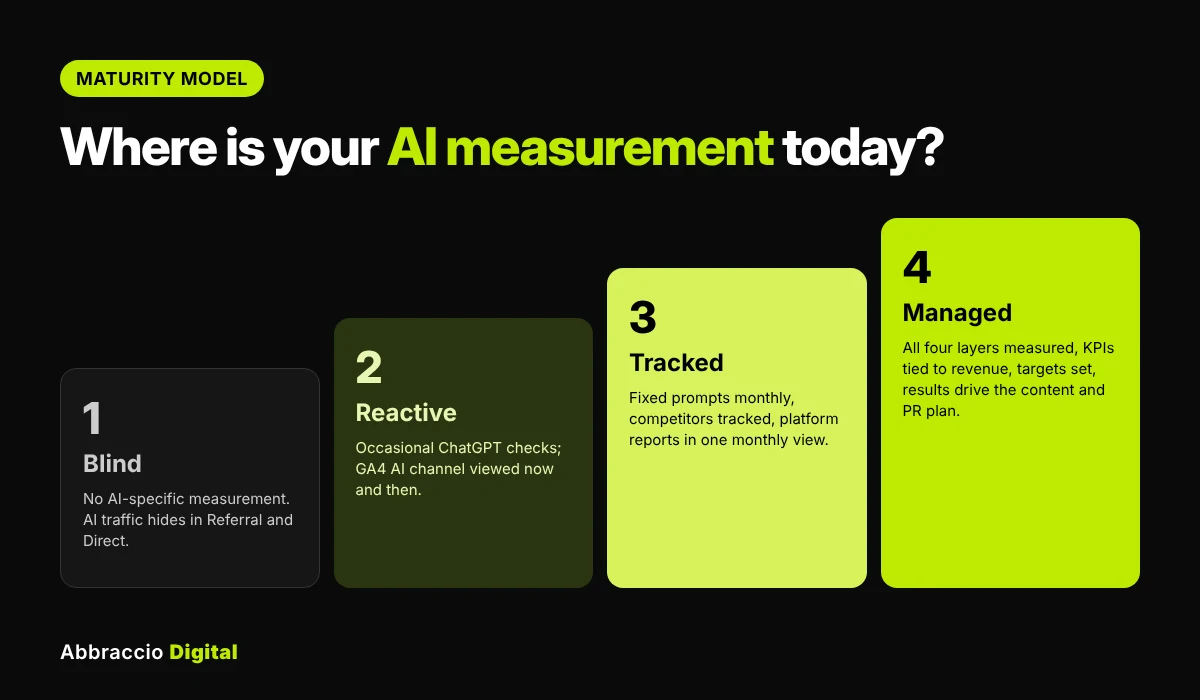
Maturity model: where are you now?
- Blind. No AI-specific measurement. AI traffic sits unnoticed in Referral and Direct.
- Reactive. Occasional manual checks in ChatGPT; GA4 AI Assistant channel viewed now and then.
- Tracked. Fixed prompt set tested monthly, platform reports pulled into one monthly report with competitors.
- Managed. All four layers measured, KPIs tied to business outcomes, targets set, and results driving the content and PR plan.
If you’re at stage 1 or 2, moving to stage 3 needs little more than a spreadsheet and a monthly routine: the free GEO reporting template is built for exactly that.
7 Common AI Visibility Measurement Mistakes
|
Mistake
|
Fix
|
|---|---|
|
Treating one ChatGPT check as a result
|
Run fixed prompts at least twice, monthly, and track the rate
|
|
Measuring only your own brand
|
Always measure share of voice against named competitors
|
|
Reading GA4's AI Assistant channel as total AI traffic
|
Label it a minimum; add a custom channel group and self-reported data
|
|
Expecting clicks from Search Console's AI report
|
It reports impressions; use it as a presence trend
|
|
Skipping the access layer
|
Check server logs first; a blocked bot invalidates everything else
|
|
Changing prompts every month
|
Keep a fixed core set; add new prompts as a separate group
|
|
Reporting numbers without actions
|
End every report with the next two or three fixes
|
Key takeaways
- Measure AI visibility in four layers: access, presence, platform data and business impact. Each depends on the one below.
- Presence (mention rate, citation rate, share of voice) is the core of AI visibility, and no platform reports it for you: test a fixed prompt set monthly.
- 2026 brought first-party data: Search Console’s AI report (impressions in AI Overviews and AI Mode, worldwide since 31 August 2026), Bing’s AI Performance report (Copilot citations) and GA4’s AI Assistant channel.
- None of those shows the full picture; combine them, and add self-reported attribution and branded demand.
- Report monthly, review trends quarterly, re-baseline yearly.
Conclusion
AI visibility used to be a guess. In 2026 it became measurable, not through one perfect metric, but through four layers that each answer a different question: can AI reach you, does it mention you, what do the platforms report, and is it paying off?
Start with access, set a fixed prompt set, pull the new Search Console, Bing and GA4 reports into one monthly view, and connect it to leads and brand demand. Then use the deep-dive guides linked above to improve each layer.
Sources
- 68% of US Google searches ended without a click in early 2026 — TechWyse, reporting SparkToro’s study
- Google gives Search Console its own generative AI visibility reports — PPC Land, June 2026
- Google Search Console shows AI impressions but still no AI clicks — Webiano
- Inside Bing’s new AI Performance report — Search Influence, Feb 2026
- Google Analytics adds AI Assistant as default channel group — Search Engine Journal, May 2026
- Monthly AI crawler report: September 2026 — SEOmator, Cloudflare Radar data
- AI chatbot traffic — Ahrefs, May 2026
- AI visibility tool pricing — GTM 80/20, Oct 2026
Frequently Asked Questions
AI search visibility is how often and how favourably your brand appears in AI-generated answers from tools like Google AI Overviews and AI Mode, ChatGPT, Gemini, Perplexity and Copilot, including whether those answers name you, cite your pages and describe you accurately.
Yes. Google’s Search Generative AI performance report, announced on 3 June 2026 and rolled out worldwide on 31 August 2026, shows impressions of your URLs in AI Overviews and AI Mode by page, country, device and date. As of its rollout it doesn’t show clicks.
AI mention rate, AI citation rate and AI share of voice against competitors, supported by AI impressions from Search Console, Copilot citations from Bing, AI-referred sessions and conversions from GA4, and self-reported “heard via AI” leads.
ChatGPT doesn’t provide a report for brands. Test a fixed set of buyer prompts monthly in a clean session, log whether you’re named and cited, and measure ChatGPT referral sessions in GA4’s AI Assistant channel.
No. Search Console, Bing Webmaster Tools, GA4, server logs and a spreadsheet cover all four layers. Paid trackers help when you monitor many prompts, competitors or clients.
Monthly for the core report, quarterly for log reviews and prompt-set updates, and yearly for a full re-baseline audit.