
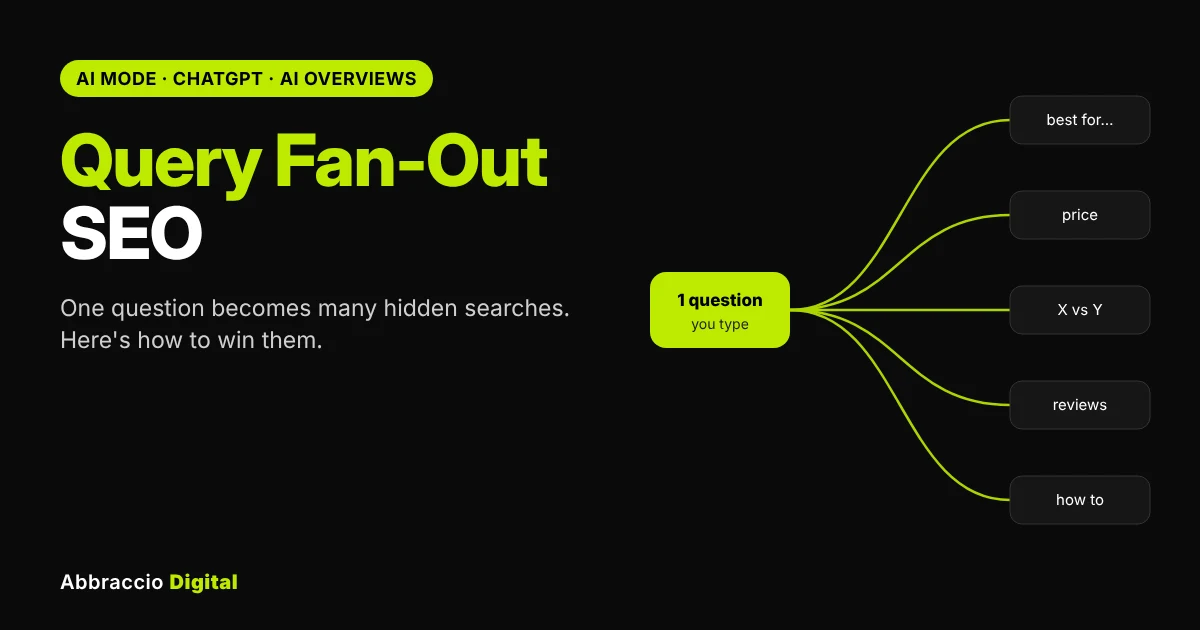
When someone types one question into Google’s AI Mode, Google doesn’t run one search. It runs several, sometimes dozens, on subtopics the person never mentioned. Then it writes one answer from everything those searches found.
That process is called query fan-out, and it quietly changes the SEO game. You’re no longer competing to rank for the query a person typed. You’re competing to be the best result for the hidden queries the AI runs on their behalf. A page that ranks #1 for the head term can be missing from the AI answer, while a page that answers three of the hidden sub-questions gets cited.
This guide explains how query fan-out works in Google AI Mode, AI Overviews and ChatGPT, what the data says about which pages get cited, and a step-by-step method to find your fan-out queries and build content that wins them.
Quick answer
What is query fan-out? Query fan-out is the technique AI search engines use to answer a question: they break it into several related sub-queries, run those searches in the background across subtopics and data sources, and combine the results into one answer. Google confirms AI Mode and AI Overviews may use it. To win, your content must rank for and clearly answer those sub-queries, not just the main query.
How query fan-out works
Google describes it plainly in its official documentation: AI Overviews and AI Mode “may use a query fan-out technique”, issuing multiple related searches across subtopics and data sources, which lets Google show “a wider and more diverse set of helpful links” than a classic search.
Google’s VP of Product for Search, Robby Stein, gave more detail in an interview reported by Search Engine Journal. For a question about a trip, the model “may think of a bunch of questions like great restaurants, great bars, things to do if you have kids”. It runs those searches using Google Search as a backend tool, alongside real-time systems such as the Shopping Graph, Google Finance, and flight and movie data.
In five steps:
- Interpret. A language model reads the question and works out what the person really needs.
- Fan out. It writes several related sub-queries, including angles the person never typed.
- Search in parallel. It runs those sub-queries against the web index and Google’s live data systems.
- Select. It picks the most relevant passages from the results, often from different pages for different sub-queries.
- Synthesise. It writes one answer and links to the sources it used.
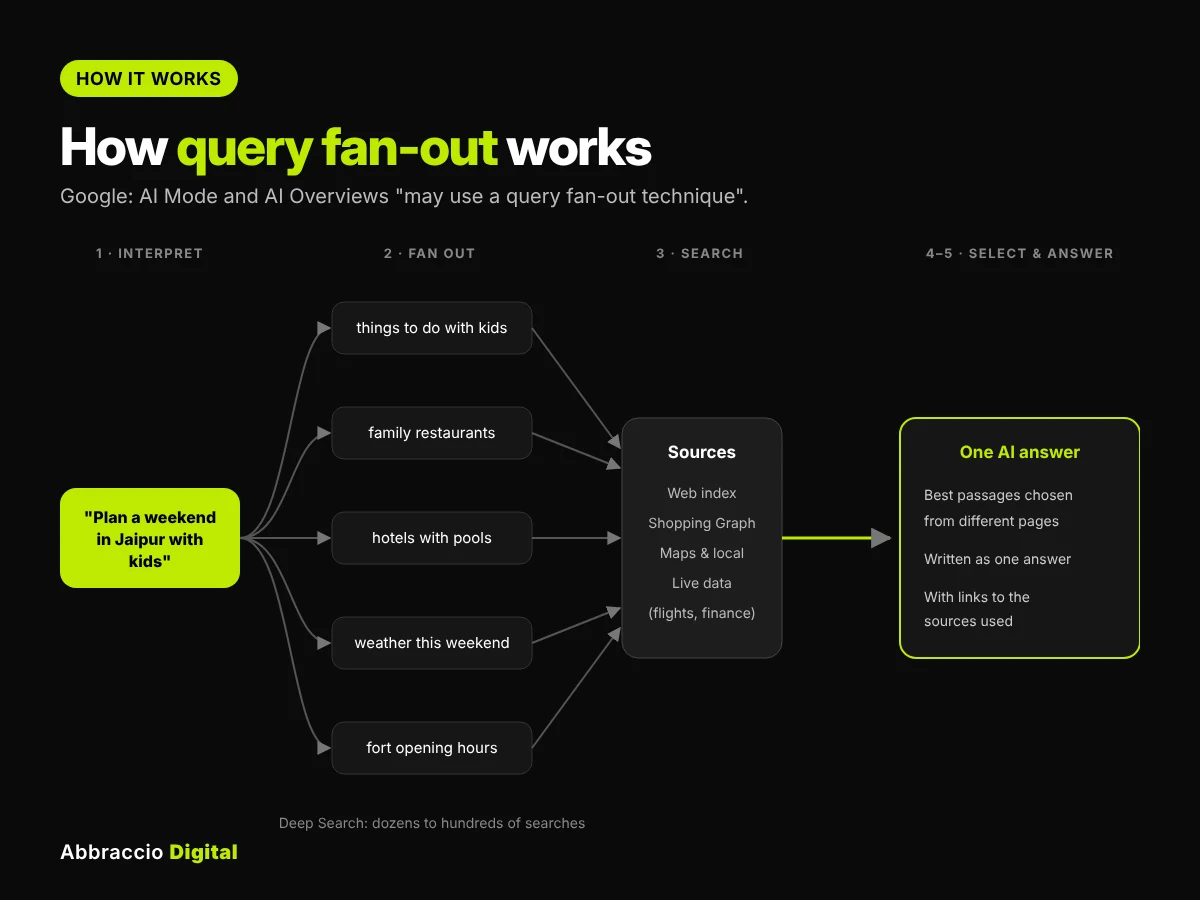
For harder questions, AI Mode’s Deep Search goes further. According to Stein, it can issue dozens or even hundreds of background searches and spend several minutes researching before it answers.
It's not just Google: how other AI engines fan out
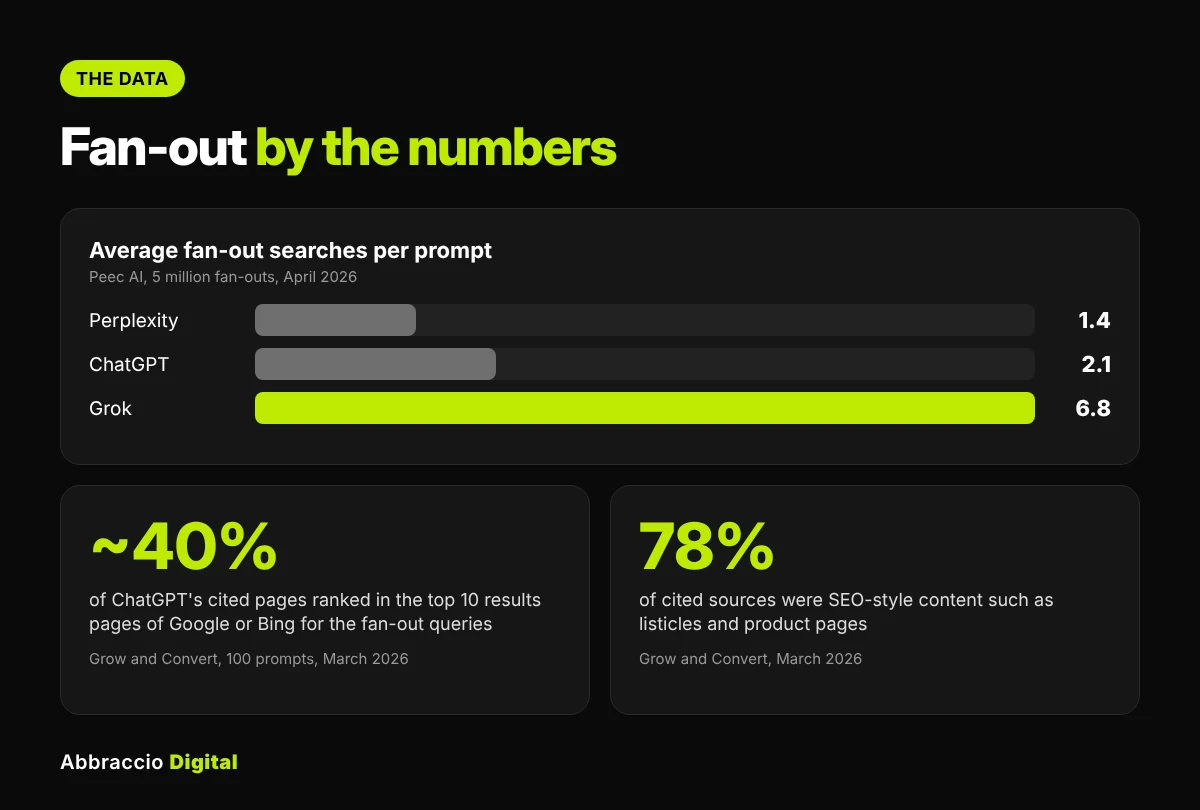
ChatGPT, Perplexity and Grok also rewrite and expand prompts into web searches, but they do it very differently. Peec AI analysed 5 million fan-out queries from April 2026:
|
Engine
|
Average fan-out searches per prompt
|
How it fans out
|
|---|---|---|
|
Perplexity
|
1.4
|
Mostly cleans up the prompt and reruns a tidier version of the same search
|
|
ChatGPT
|
2.1
|
Stays close to intent but adds brand names, comparisons and words like "best", "top" and "reviews"
|
|
Grok
|
6.8
|
Treats the prompt as a research brief: broad first, then year modifiers, brand-vs-brand and site-specific searches
|
|
Google AI Mode (Deep Search)
|
Dozens to hundreds, per Google
|
Subtopics plus live data systems like the Shopping Graph
|
Peec AI figures for Perplexity, ChatGPT and Grok; Google figure from Robby Stein via Search Engine Journal.
Two patterns matter for content. First, ChatGPT’s fan-outs lean towards comparison and review language, so comparison pages and “best X” content are the natural targets. Second, Grok used the site: operator in 18.3% of chats, often to search Reddit directly, which is another sign that third-party communities feed AI answers.
Why query fan-out changes SEO
Fan-out shifts the target from one keyword to a cluster of hidden questions. Three findings show what that means in practice.
1. Ranking still matters, but for the sub-queries. Grow and Convert ran 100 buying-intent prompts through ChatGPT and checked where its cited pages ranked for the fan-out queries. 27% of cited URLs ranked on Google for those fan-out queries and 23% on Bing; about 40% appeared somewhere in the top 10 results pages of either engine. Counting any page from the same domain, the share rose to about 50%.
2. Classic SEO content gets cited. In the same study, 78% of all cited sources were SEO-style content, such as listicles and product pages. Fan-out isn’t a reason to abandon what works; it’s a reason to cover more of the questions around it.
3. There’s no special AI markup to add. Google says pages only need to be indexed and eligible to show with a snippet. In its words, there are no extra requirements, AI text files or special schema needed for AI Overviews or AI Mode, and the usual SEO fundamentals still apply.
The practical shift: instead of asking “what’s our keyword?”, ask “what are the five to fifteen questions an AI would research to answer our buyer’s question, and do we have the best answer to each?”
Once you start optimizing for fan-out queries, you need a way to track which sub-queries actually cite your content. Our free GEO reporting template helps you monitor AI Mode visibility, citations, and progress month by month.
How to find your fan-out queries (step by step)
You can’t see Google’s exact fan-out queries, but you can reconstruct them closely. Use several sources and look for the questions that keep coming up.
- Start with one buyer question. Pick a high-value prompt, written the way a person would ask it: “What’s the best CRM for a 10-person sales team in India?”
- Watch the AI search. Where the interface shows its search steps, as Perplexity and ChatGPT’s search often do, note every search it ran. Run the prompt several times; the searches vary.
- Ask the models directly. Prompt ChatGPT or Gemini: “List the web searches you would run to answer this question thoroughly.” This isn’t the real internal list, but it reliably surfaces the facets an AI considers.
- Mine Google’s own hints. People Also Ask boxes, related searches and the follow-up questions suggested under AI Overviews and in AI Mode all point to sub-topics Google connects to the query.
- Check Search Console. Filter for long, question-style queries containing your topic. These often mirror the sub-questions people and AI ask.
- Use tool data where you have it. Some AI visibility tools now log the fan-out queries engines run for tracked prompts. Export them.
- Group by facet. Sort everything into a handful of facets: definition, comparison (“X vs Y”), “best for” use cases, price, how-to, risks, alternatives, and local or year-specific angles.
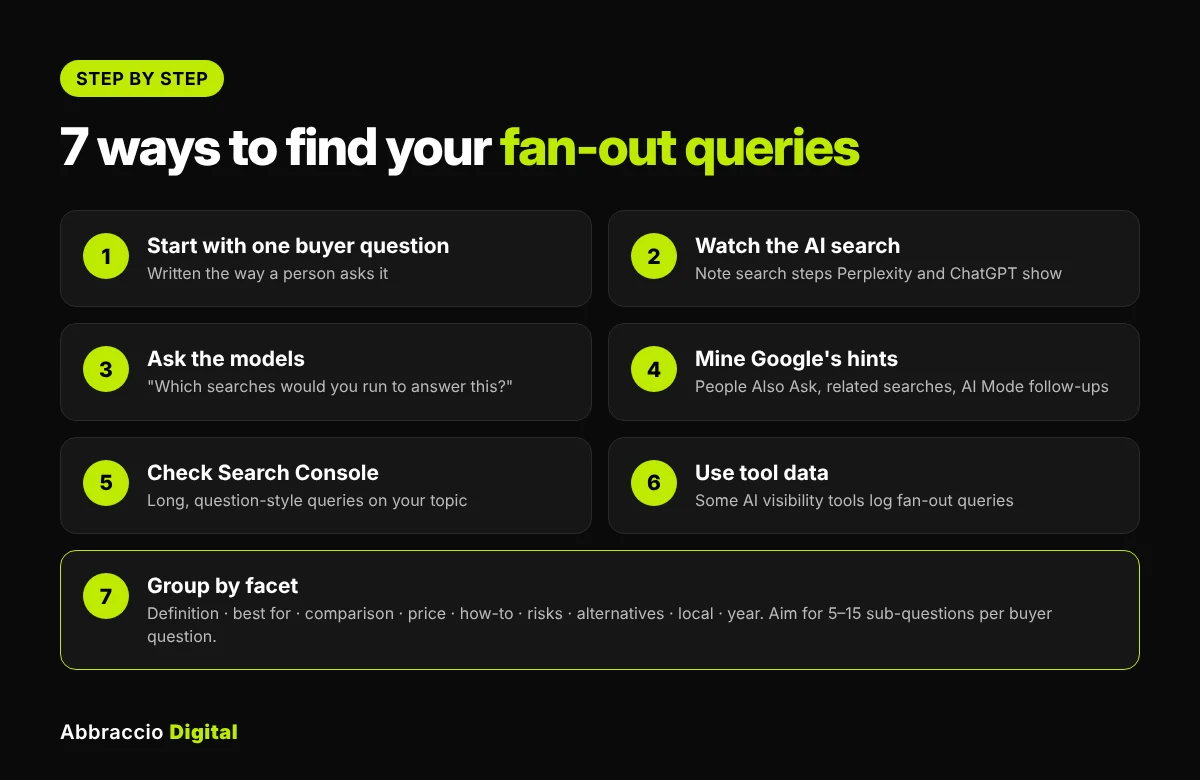
You should end up with five to fifteen distinct sub-questions per buyer question. That list, not the head keyword, is your content brief.
How to optimise content for query fan-out
The goal is simple: for every sub-question an AI might research, make one of your pages the clearest, most extractable answer.
Content
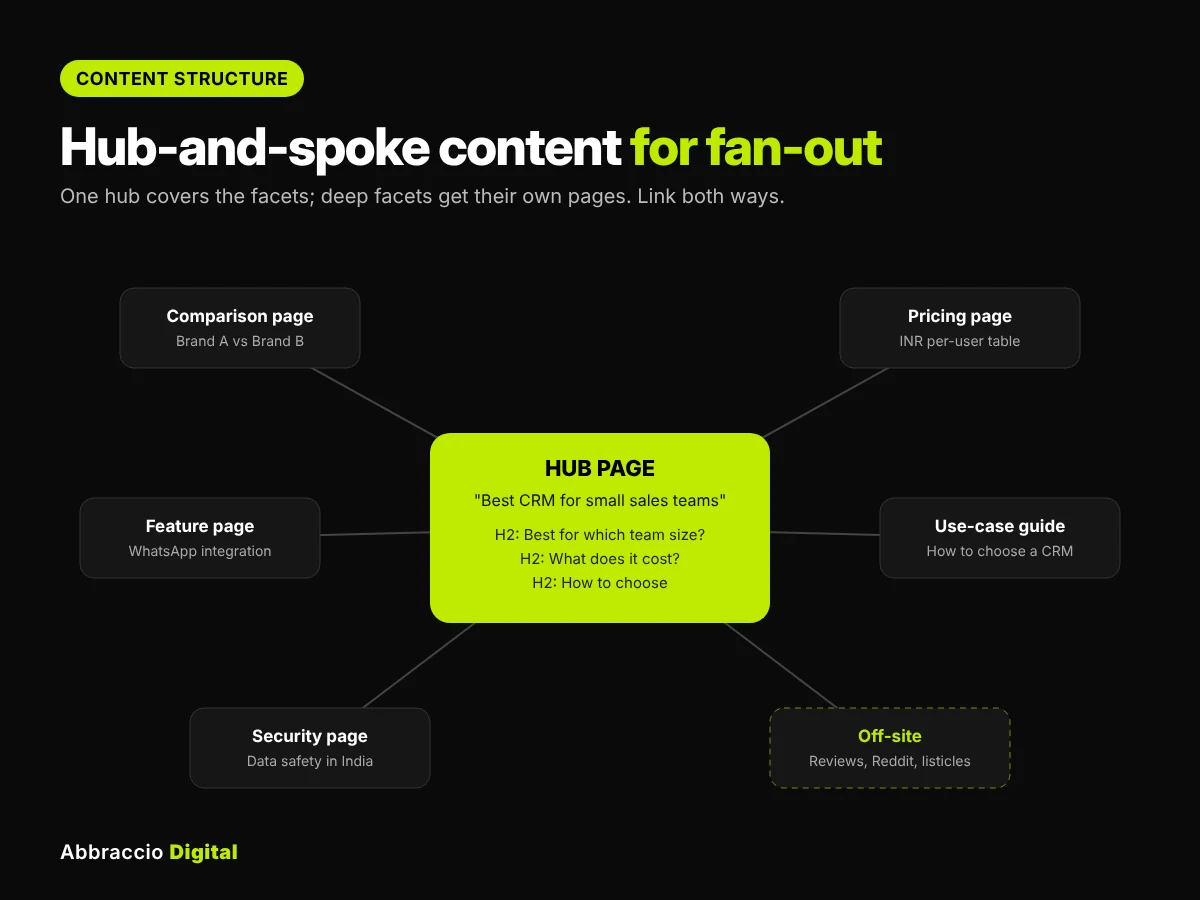
- Build a hub page that covers the facets. One comprehensive page with a clear section for each major sub-question can match several fan-out searches at once.
- Add dedicated pages for deep facets. Where a sub-question deserves its own page, such as a comparison, pricing or a specific use case, create it and link it from the hub.
- Answer first, then explain. Open each section with a direct one-to-three-sentence answer, then add detail. The passage AI extracts should make sense on its own.
- Include specifics AI can quote. Prices, numbers, dates, named features and comparison tables give the AI concrete facts to cite.
- Keep it current. Fan-outs often add year modifiers (“best X 2026”), so update dates, prices and examples, and say when you did.
Structure
- Use question-style H2s and H3s that match how sub-queries are phrased.
- Use tables for comparisons and numbered lists for steps.
- Link the hub and its spokes both ways with descriptive anchor text.
Technical
- Make sure pages are indexed and snippet-eligible: no
nosnippeton key content, and no important text locked inside images or late-loading JavaScript. - Keep structured data consistent with the visible text, as Google requires.
Off-site
- Fan-outs often look beyond brand sites, to reviews, Reddit and comparison listicles. Earn genuine presence there for your key comparison and “best for” queries.
Worked example: one buyer question, fanned out
An illustrative reconstruction using the method above, for a fictional CRM company. It’s not Google’s actual internal query list.
Buyer question: “What’s the best CRM for a 10-person sales team in India?”
|
Likely fan-out sub-query
|
Facet
|
Page that should answer it
|
|---|---|---|
|
best CRM for small sales teams 2026
|
Best for
|
Hub: "Best CRM for small sales teams"
|
|
CRM pricing per user India
|
Price
|
Pricing page with INR per-user table
|
|
CRM with WhatsApp integration
|
Feature
|
Feature page + section in hub
|
|
Brand A vs Brand B CRM
|
Comparison
|
Dedicated comparison page
|
|
free CRM for startups India
|
Price / alternatives
|
Section in hub + free-plan page
|
|
easiest CRM to set up
|
Use case
|
Section in hub with setup time
|
|
CRM GST invoicing India
|
Local
|
Help article + section in pricing page
|
|
CRM reviews small business
|
Reviews
|
Review-platform presence + testimonials page
|
|
how to choose a CRM for sales team
|
How-to
|
Guide linked from hub
|
|
CRM data security India
|
Risk
|
Security page
|
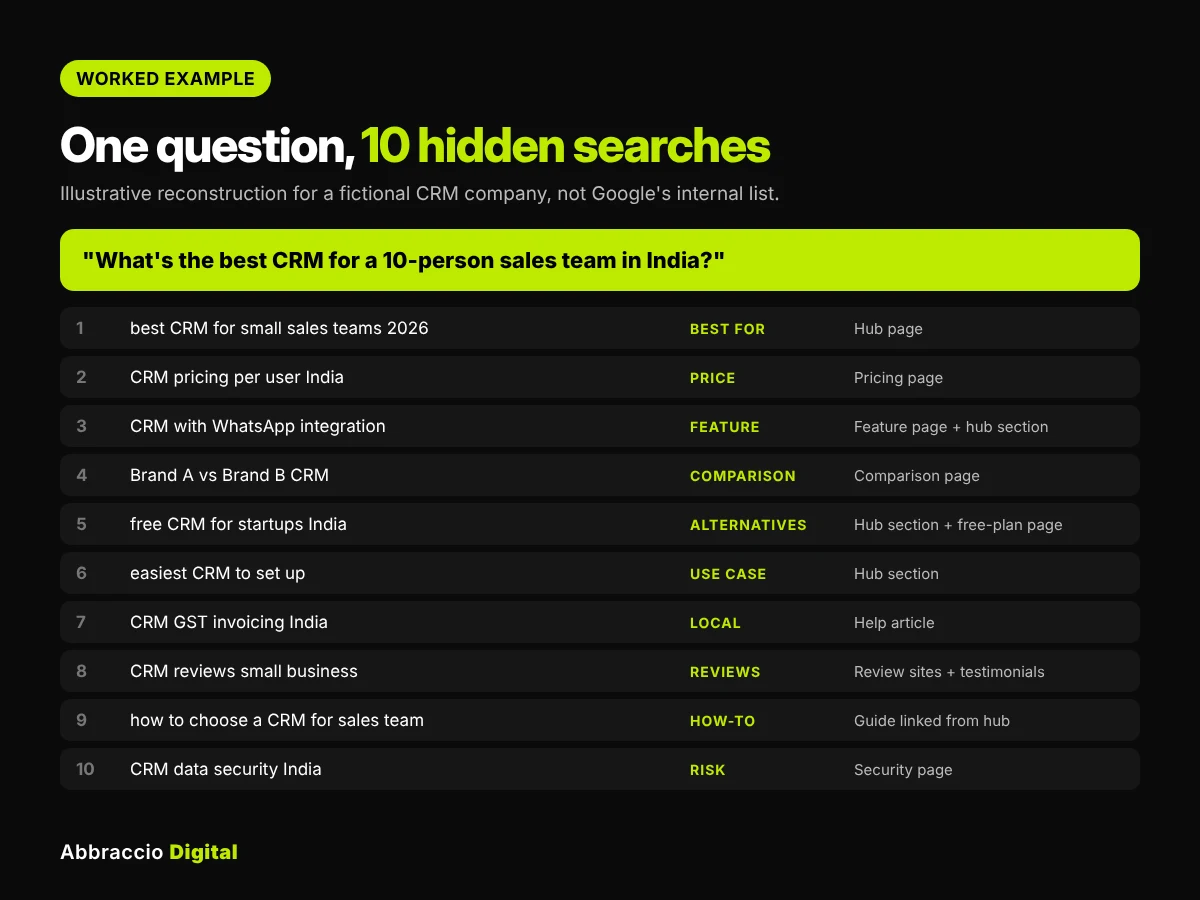
The content plan writes itself: one hub page, three or four dedicated pages for the deep facets, and an off-site plan for reviews. The free content map template lets you build this table for your own buyer questions and track which sub-queries you cover.
How to measure fan-out coverage
Track three things for each buyer question:
- Coverage: the share of its sub-queries for which you have a page that clearly answers it. Aim for full coverage of the facets that matter commercially.
- Ranking: the share of sub-queries where that page ranks in Google’s top 10. The Grow and Convert data suggests ranking for fan-out queries is one of the routes into AI citations.
- Citation: whether AI engines cite you when you run the original buyer question (log this with the AI visibility audit workbook).

AI Mode and AI Overview clicks are counted inside Google Search Console’s normal Performance report under the “Web” search type, according to Google, so you can’t separate them there. Use GA4’s AI Assistant channel for ChatGPT, Gemini and Claude referrals, and re-test your buyer questions monthly.
6 common query fan-out mistakes
|
Mistake
|
Why it fails
|
Fix
|
|---|---|---|
|
Optimising only for the head keyword
|
AI answers come from the sub-queries you ignored
|
Map 5–15 sub-questions per buyer question
|
|
One thin page per sub-query
|
Dozens of near-duplicate pages dilute quality
|
Hub page for related facets, separate pages only for deep ones
|
|
Burying the answer
|
AI extracts passages; a vague intro gets skipped
|
Answer in the first one to three sentences of each section
|
|
Key facts in images or JavaScript
|
Text that isn't readable can't be quoted
|
Keep facts, prices and tables in HTML text
|
|
Stale dates and prices
|
||
|
Ignoring off-site sources
|
AI searches reviews, Reddit and listicles too
|
Earn genuine presence where your buyers' questions get answered
|
Key takeaways
- Query fan-out is how AI search turns one question into several background searches, then writes one answer from the results. Google confirms AI Mode and AI Overviews may use it.
- Engines differ: Perplexity averages 1.4 searches per prompt, ChatGPT 2.1 and Grok 6.8; Google’s Deep Search can run hundreds.
- Ranking still matters, but for the sub-queries: in one study, about 40% of ChatGPT’s cited pages ranked in the top 10 pages of Google or Bing for the fan-out queries.
- No special AI markup is needed. Google requires pages to be indexed and snippet-eligible, and standard SEO fundamentals apply.
- Map 5–15 sub-questions per buyer question, cover them with a hub page and a few deep pages, and answer each one in the first sentences of its section.
Conclusion
Query fan-out means the search a person types is no longer the search that decides who gets cited. The AI does its own research, on questions they never asked, and builds its answer from the best page for each one.
The brands that win will treat every important buyer question as a cluster: find the sub-questions, answer each one clearly and early, keep the facts current, and make sure the wider web backs them up. It’s classic SEO discipline, applied to a bigger and partly hidden set of queries.
Sources
- AI features and your website — Google Search Central
- Query fan-out technique in AI Mode: new details from Google — Search Engine Journal, July 2025
- Fan-outs per prompt by engine — Peec AI, April 2026
- Fan-out query SERP study — Grow and Convert, March 2026
Frequently Asked Questions
It’s when an AI search engine breaks your question into several smaller searches, runs them in the background, and combines what it finds into one answer. Asking for a weekend plan might trigger separate searches for restaurants, bars and things to do with kids.
Yes. Google’s documentation says AI Overviews and AI Mode may use a query fan-out technique, issuing multiple related searches across subtopics and data sources. AI Mode’s Deep Search can run dozens or hundreds of searches for complex questions.
Yes, in its own way. When ChatGPT searches the web, it rewrites and expands prompts into searches; one analysis of 5 million fan-outs found an average of 2.1 searches per prompt, often adding comparison and review terms.
Not directly. You can reconstruct them from People Also Ask, related searches, AI Mode follow-up suggestions, the search steps some AI tools display, and by asking AI models which searches they would run.
No. Google says there are no additional technical requirements, AI text files or special structured data needed for AI Overviews or AI Mode. Pages must be indexed and eligible for a snippet.
Long-tail SEO targets specific phrases people type. Fan-out optimisation targets the sub-questions an AI researches on the person’s behalf, many of which they never typed. In practice it means covering the facets of a topic completely, not just more keyword variations.