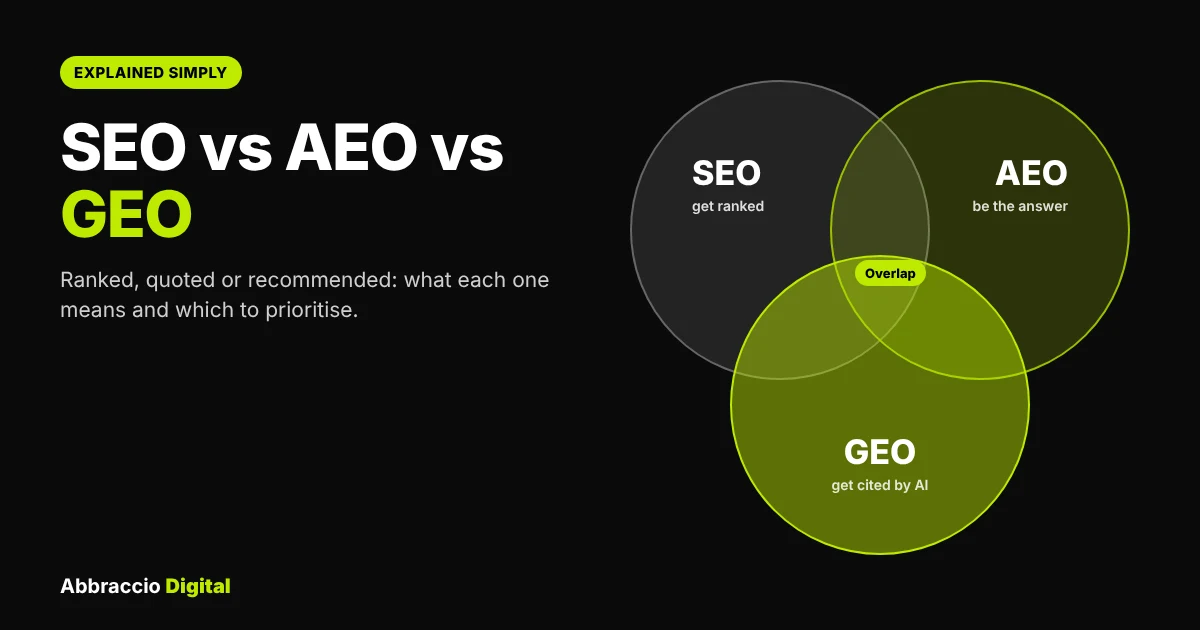
A few years ago, “search marketing” meant one thing: SEO. Now agencies pitch AEO, GEO, LLMO, AIO and “AI SEO”, often for the same work, and business owners are left wondering whether they need all of them.
The shift behind the acronyms is real. In February 2024, Gartner predicted that traditional search engine volume would drop 25% by 2026 as people move to AI chatbots and virtual agents. A Fractl and Search Engine Land analysis of over a million keywords later found that 29% of high-volume search demand is in decline, while nearly the same amount is growing elsewhere. Search isn’t disappearing; it’s spreading across more places.
This guide explains SEO, AEO and GEO in plain English: what each one means, where they overlap, how the same topic looks through each lens, and which to focus on first for your business.
Table of Contents
ToggleQuick Answer
What’s the difference between SEO, AEO and GEO? SEO (search engine optimisation) helps your pages rank in search results so people click through. AEO (answer engine optimisation) structures your content so search engines and assistants can lift it as the direct answer, as in featured snippets, voice answers and AI summaries. GEO (generative engine optimisation) makes your brand get mentioned and cited inside AI-generated answers from ChatGPT, Google AI Overviews and AI Mode, Gemini and Perplexity. They aren’t rivals: AEO and GEO build on SEO, and for Google, Google itself says optimising for AI search is still SEO.
|
|
SEO
|
AEO
|
GEO
|
|---|---|---|---|
|
Goal
|
Rank and get clicks
|
Be the direct answer
|
Be mentioned and cited by AI
|
|
Where
|
Google and Bing results
|
Featured snippets, voice, AI summaries
|
ChatGPT, AI Overviews, AI Mode, Gemini, Perplexity
|
|
Success looks like
|
Rankings, clicks, traffic
|
Answer boxes won, answers quoted
|
Share of AI answers, citations, AI referrals
|
What is SEO?
SEO (search engine optimisation) is the work of helping your web pages rank higher in search engines like Google and Bing, so more people click through to your site.
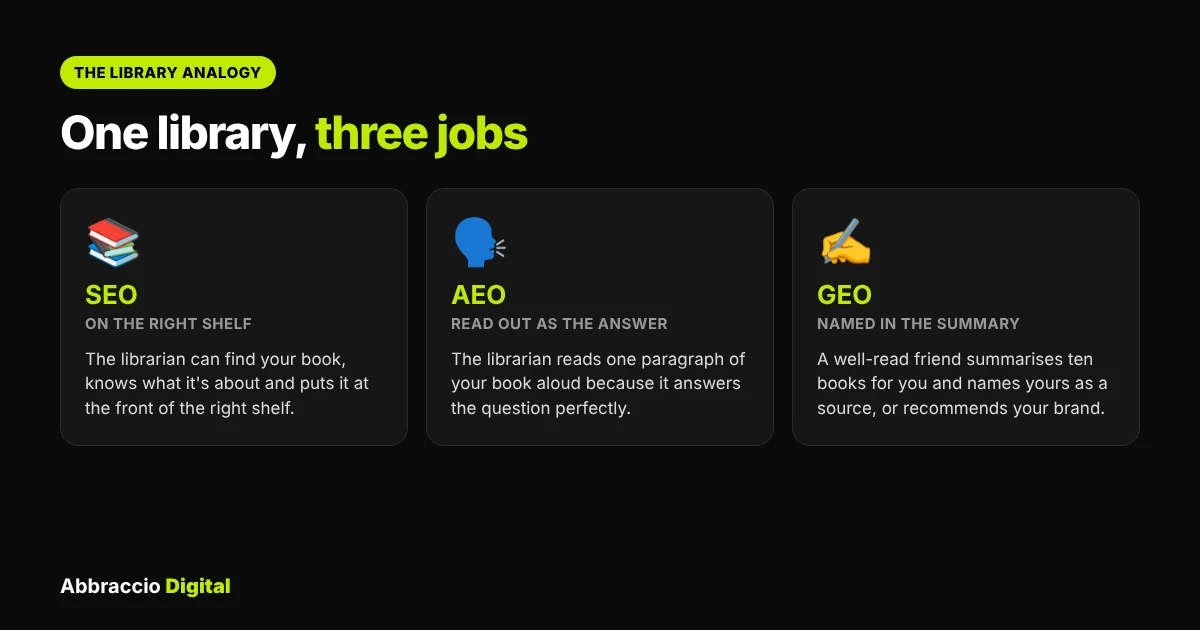
Think of a library. SEO makes sure the librarian can find your book, understands what it’s about, and puts it near the front of the right shelf.
What SEO covers:
- Technical SEO: making pages crawlable, indexable, fast and mobile-friendly
- On-page SEO: titles, headings and content that match what people search for
- Off-page SEO: links and mentions from other sites that build authority
- Local SEO: Google Business Profile, reviews and local listings
How it’s measured: rankings, impressions, clicks, organic traffic and conversions.
What is AEO?
AEO (answer engine optimisation) is structuring your content so search engines and assistants can pull it out as the answer to a question, without the user needing to click.
In the library, AEO is the librarian reading one paragraph of your book out loud because it answers the question perfectly.
AEO is older than the AI boom. It grew up with featured snippets, “People also ask” boxes and voice assistants like Alexa and Siri. Today it also covers the answers inside AI summaries.
What AEO covers:
- Answering a question directly in the first sentence or two of a section
- Question-style headings that match how people ask
- Short definitions, numbered steps, lists and comparison tables
- FAQ sections and structured data that matches visible content
How it’s measured: featured snippets and answer boxes won, “People also ask” appearances, and how often your wording is used in answers.
What is GEO?
GEO (generative engine optimisation) is making your brand and content get mentioned, recommended and cited inside answers written by generative AI: ChatGPT, Google AI Overviews and AI Mode, Gemini, Perplexity, Copilot and Claude.
In the library, GEO is a well-read friend who writes you a summary of ten books and names yours as a source, or recommends your brand by name.
The term comes from a 2023 research paper by Aggarwal and colleagues, which tested how changes to content affected visibility in AI-generated answers. It has since become the most-searched of the new labels: global searches for “generative engine optimization” reached 54.3K in January 2026, against 30K for “answer engine optimization”, according to Similarweb.
What GEO covers:
- Letting AI search crawlers access and read your site
- Content with original information worth citing (data, experience, expert views)
- Being mentioned by trusted third parties: reviews, media, forums, lists
- Accurate product, business and brand information across the web
- Covering the follow-up questions AI asks behind the scenes (query fan-out)
How it’s measured: share of AI answers, share of voice versus competitors, citations, accuracy, and AI-referred traffic and conversions. See our guide to measuring AI search visibility.
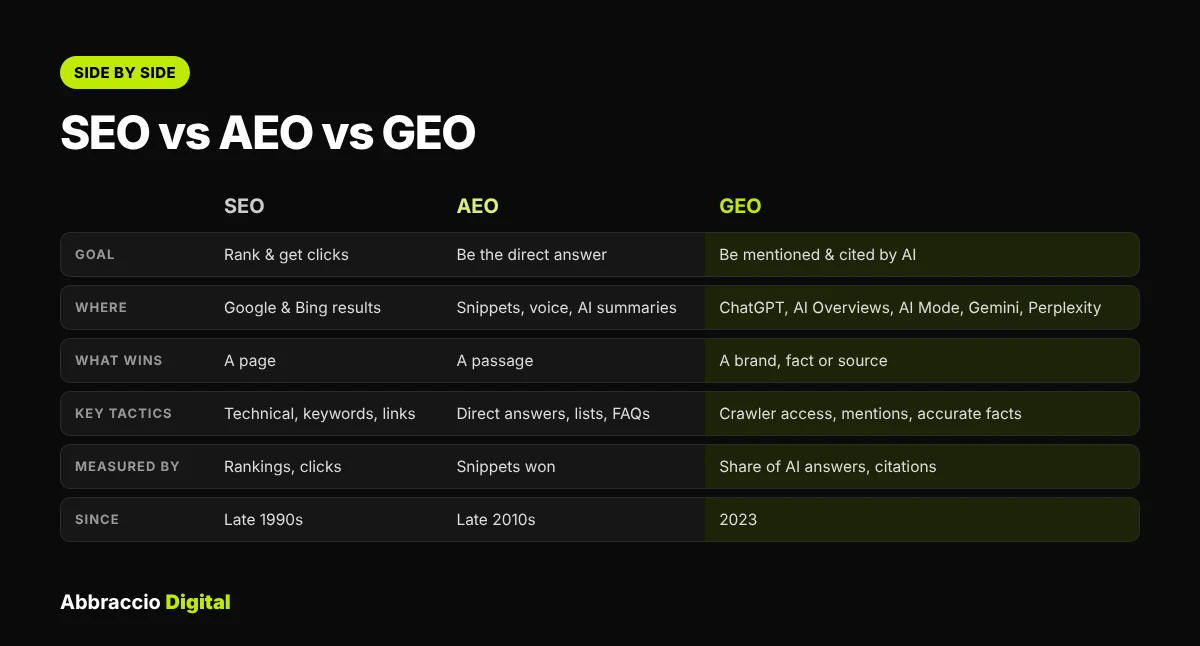
SEO vs AEO vs GEO: side by side
|
|
SEO
|
AEO
|
GEO
|
|---|---|---|---|
|
Stands for
|
Search engine optimisation
|
Answer engine optimisation
|
Generative engine optimisation
|
|
Main question
|
Can people find my page?
|
Can my content be the answer?
|
Will AI mention and recommend me?
|
|
Where it shows
|
Blue links in Google and Bing
|
Featured snippets, "People also ask", voice answers, AI summaries
|
AI Overviews, AI Mode, ChatGPT, Gemini, Perplexity, Copilot, Claude
|
|
Unit that wins
|
A page
|
A passage or answer
|
A brand, fact or source
|
|
Key tactics
|
Technical health, keywords, content, links
|
Direct answers, question headings, lists, tables, FAQs
|
Crawler access, original information, third-party mentions, accurate facts everywhere
|
|
Click needed?
|
Yes, that's the goal
|
Often not
|
Often not; citations can send highly qualified visits
|
|
How it's measured
|
Rankings, clicks, traffic
|
Snippets and answers won
|
Share of AI answers, citations, AI referrals
|
|
Maturity
|
Since the late 1990s
|
Since featured snippets and voice search (late 2010s)
|
Since 2023
|
How they overlap: one strategy, three layers
The easiest way to understand the three is as layers that build on each other, not as separate services.
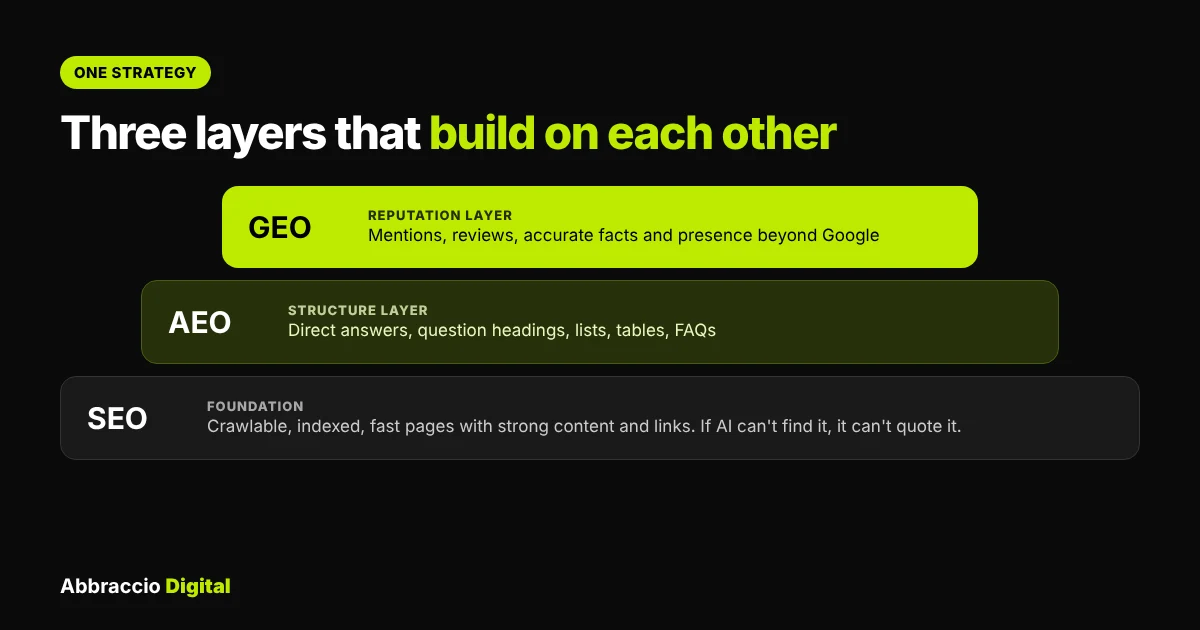
- SEO is the foundation. If AI can’t crawl and index a page, it can’t quote it. Google’s AI Overviews and AI Mode pull from pages ranked by Google’s core systems, and Google’s own guide says optimising for generative AI search “is still SEO”. Read our summary of Google’s official AI search guide.
- AEO is the structure. Clear question-and-answer formatting makes your content easy to lift for snippets, voice and AI summaries alike.
- GEO is the reputation layer. AI tools don’t just quote pages; they decide which brands to recommend, based partly on what others say about you across the web, and they live on platforms beyond Google.
Where they genuinely differ:
- Platforms beyond Google. ChatGPT, Perplexity and Claude use their own crawlers and indexes, so blocking their crawlers or hiding content behind JavaScript can cut you out even if you rank well on Google.
- Brand, not just pages. GEO cares about whether AI describes your brand correctly and positively, which depends on reviews, media and community mentions, not just your own site.
- Measurement. There’s no stable “rank” in AI answers, so GEO is measured as a share of answers across many prompts.
Our take at Abbraccio Digital: if someone sells you AEO or GEO as a replacement for SEO, be cautious. The best AI visibility is built on strong SEO, structured with AEO, and extended with GEO.
Same topic, three ways: a worked example
An illustrative example for a fictional dental clinic in South Delhi.
The clinic wants more patients for teeth whitening. Here’s how each discipline approaches the same topic.
|
|
SEO
|
AEO
|
GEO
|
|---|---|---|---|
|
Target
|
Rank for "teeth whitening in South Delhi"
|
Be the answer to "Is teeth whitening safe?" and "How long does teeth whitening last?"
|
Be recommended when someone asks ChatGPT or AI Mode "best clinic for teeth whitening in South Delhi"
|
|
What they build
|
A fast, mobile-friendly service page with the right title, headings, local schema and internal links; Google Business Profile optimised
|
An FAQ block where each answer starts with a 1–2 sentence direct reply, then detail; a simple "before, during, after" list
|
Consistent clinic facts (hours, prices, dentist credentials) everywhere; patient reviews on Google and Practo; a dentist quoted in local media; a page explaining whitening options with the clinic's own before/after cases and costs
|
|
Success signal
|
Page 1 ranking, calls from organic search
|
Featured snippet and "People also ask" wins
|
Clinic named in AI answers for whitening prompts; enquiries saying "found you on ChatGPT"
|
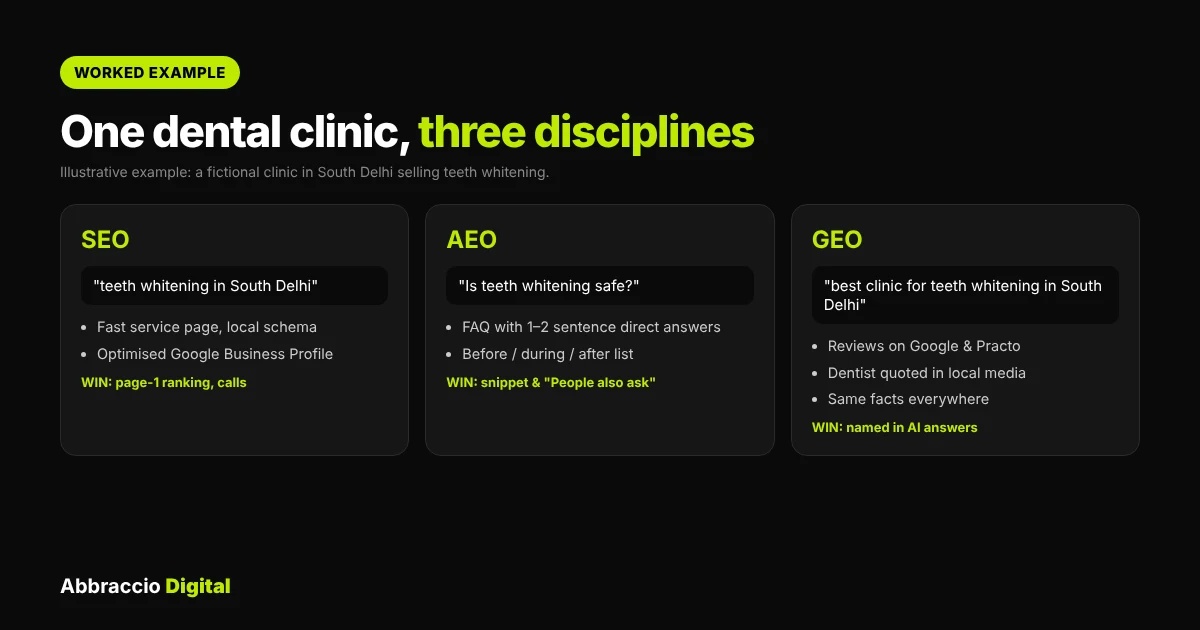
Notice that the work overlaps. The service page (SEO) holds the FAQ (AEO), and both feed the AI answers (GEO). The extra GEO effort is mostly off the site: reviews, mentions and consistent facts.
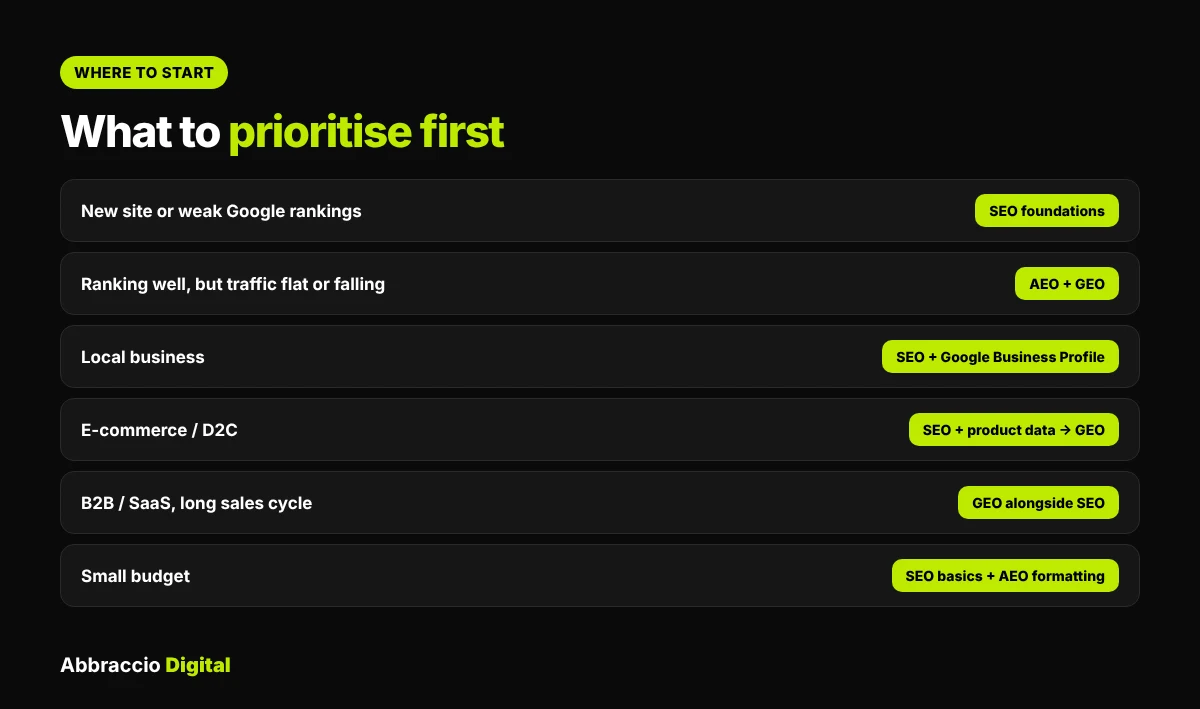
Which should you prioritise?
Almost every business needs all three eventually. The question is where to put effort first.
|
Your situation
|
Focus first
|
Then
|
|---|---|---|
|
New website or weak Google rankings
|
SEO: technical health, core pages, Google Business Profile
|
AEO formatting on key pages
|
|
Ranking well but traffic is flat or falling
|
AEO and GEO: answer-first content, check AI crawler access, start tracking AI answers
|
Earn mentions on review sites and media
|
|
Local business (clinic, restaurant, home services)
|
SEO + local: Google Business Profile, reviews, accurate details everywhere
|
GEO for "best [service] in [city]" prompts
|
|
E-commerce / D2C
|
SEO + product data: Merchant Center, product schema, fast product pages
|
|
|
B2B / SaaS with long sales cycles
|
GEO alongside SEO: buyers research in AI tools before they ever visit
|
AEO for comparison and "how to" questions
|
|
Small budget
|
SEO basics + AEO formatting (they also feed AI answers)
|
How to split a budget (rule of thumb): for most businesses starting out, put most of the effort into SEO foundations, a smaller share into AEO formatting, and a smaller share again into GEO work like mentions and AI tracking. Shift the balance towards GEO as your SEO base becomes solid and as more of your buyers use AI tools. Use the free planner to work out a split for your business.
Key takeaways
- SEO gets your pages ranked and clicked in search engines.
- AEO structures content so it can be lifted as the direct answer in snippets, voice and AI summaries.
- GEO gets your brand mentioned, recommended and cited inside AI-generated answers across ChatGPT, Google’s AI features, Gemini and Perplexity.
- They’re layers, not rivals: SEO is the foundation, AEO the structure, GEO the reputation and multi-platform layer.
- For Google’s AI features, Google says optimising for AI search is still SEO.
- GEO adds work beyond your own site: AI crawler access, third-party mentions and accurate facts everywhere.
- Start with whatever your weakest layer is, and measure each one differently.
Frequently Asked Questions
SEO helps pages rank and get clicks in search engines. AEO structures content so it can be used as the direct answer in snippets, voice and AI summaries. GEO helps a brand get mentioned and cited inside AI-generated answers from tools like ChatGPT, Google AI Overviews, Gemini and Perplexity.
They overlap heavily and many people use them interchangeably. AEO is older and focuses on being the extracted answer; GEO focuses on being cited and recommended by generative AI tools, including platforms outside Google.
No. AI answers rely on content they can crawl, index and trust, which is what SEO builds. Google says optimising for its generative AI features is still SEO. GEO adds work on top, especially for other AI platforms.
Usually not. They share most of the same foundations, so one team should plan them together. Ask any agency how they measure AI visibility and how their GEO work connects to SEO.
SEO basics first: a crawlable site, strong service pages and a complete Google Business Profile. Then format key pages for AEO, and check monthly how AI tools describe your business.
LLMO (large language model optimisation) is another name for much the same idea as GEO: getting mentioned by AI language models. You’ll also see AIO and “AI SEO”.
AEO: featured snippets and “People also ask” wins. GEO: share of AI answers across a fixed set of prompts, citations, accuracy, and AI-referred visits and conversions in GA4.
Conclusion
SEO, AEO and GEO aren’t three competing strategies. They’re three questions about the same goal: can people find you, can your content be the answer, and will AI recommend you?
Get the foundation right with SEO, make your content easy to quote with AEO, and build the reputation and multi-platform presence that GEO needs. Most of the work overlaps, and the best results come from planning all three together.
Download the SEO vs AEO vs GEO Priority Planner to see where your business stands on each layer and what to focus on first.
Sources
- CMSWire — AEO, GEO, SEO: what’s the best search playbook? (Gartner’s February 2024 prediction)
- Search Engine Land — What 1 million keywords reveal about AI’s impact on search
- Aggarwal et al., 2023 — GEO: Generative Engine Optimization
- Similarweb — AEO vs GEO: what’s the difference?
- Google Search Central — Optimizing your website for generative AI features on Google Search