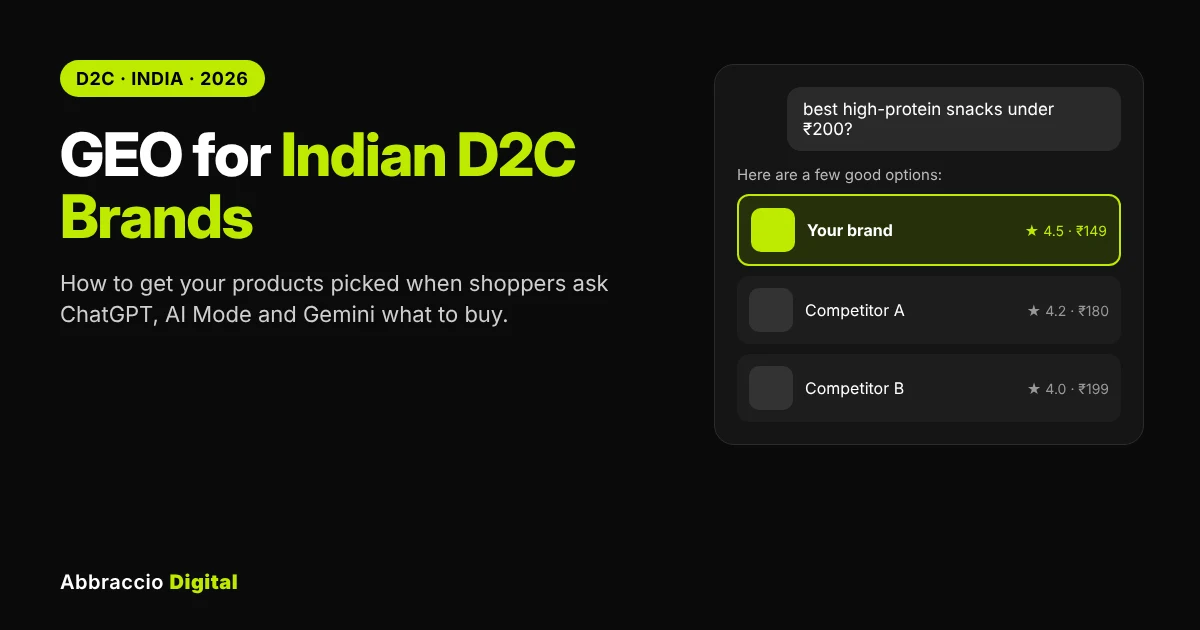
In 2026, Indian shoppers started buying inside AI chats. Nykaa put its beauty and fashion catalogue inside ChatGPT in June. In July, GoKwik and PayU launched what they call India’s first multi-brand D2C shopping experience in ChatGPT, with UPI checkout in the chat. Google had already given AI Mode its “biggest-ever upgrade to shopping” in India, in English and Hindi.
For D2C brands, that changes where the shelf is. A shopper who asks “best healthy snacks for office under ₹500” now gets a shortlist of three or four brands with prices, reviews and a buy button. If you’re not on that shortlist, you’re not on the shelf.
This guide shows how AI shopping answers choose products, and gives Indian D2C brands an eight-move playbook to get recommended: product feeds, marketplaces, reviews, creators, Hindi content and more, plus a 90-day plan and a free checklist.
Quick Answer
How do Indian D2C brands get recommended by AI? Make your products machine-readable and widely trusted. Keep a complete product feed in Google Merchant Center, list consistently on the marketplaces AI checks, build answer-first category and comparison pages, earn genuine reviews and creator coverage, publish in Hindi where your buyers search in Hindi, and track your share of AI recommendations monthly. Join AI checkout programmes (via your commerce platform) where available.
Why AI search matters for Indian D2C brands now
Three things happened in 2026 that make AI visibility a sales channel, not a branding exercise.
|
Date (2026)
|
What happened
|
Why it matters for D2C
|
|---|---|---|
|
7 April
|
Google launched its biggest shopping upgrade to AI Mode in India, plus shopping in the Gemini app, in English and Hindi
|
|
|
16 June
|
Nykaa signed a multi-year deal to put its beauty and fashion catalogue inside ChatGPT
|
|
|
29 July
|
GoKwik and PayU launched multi-brand D2C shopping in ChatGPT, with UPI, cards and wallets in the chat; early brands include Hyphen, Beardo and Kilrr
|
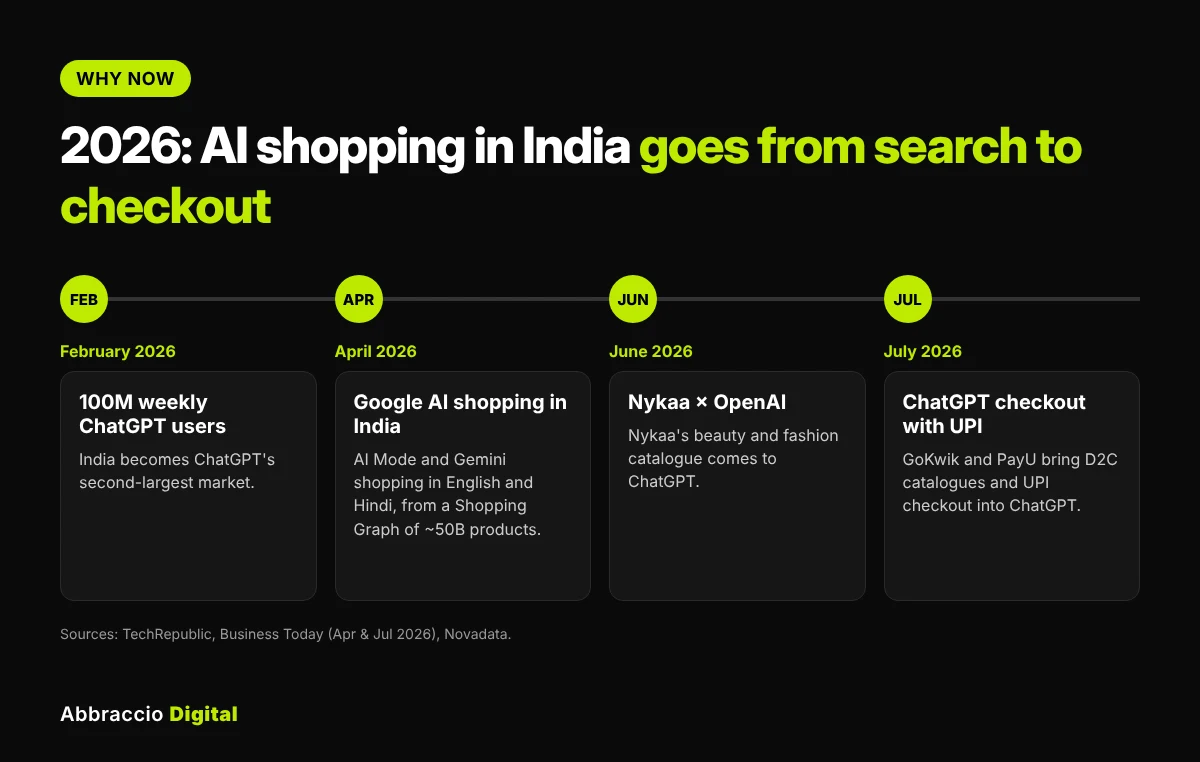
The audience is already there: India is ChatGPT’s second-largest market, with 100 million weekly users as of February 2026. And the category is big: a Shiprocket, CII and Praxis study projected Indian D2C could become a $60 billion industry by FY27.
The window is now. AI shopping answers show a short list rather than pages of results, so brands that get onto those lists early have an advantage that’s hard to take back.
Getting mentioned by ChatGPT or Gemini is only useful if you can track it over time. Learn how to measure AI search visibility so you know which products and prompts are actually bringing your brand into AI answers.
How AI shopping answers pick products
AI engines build a product shortlist from three kinds of input. You need to be strong in all three.
|
Input
|
What the AI reads
|
Examples
|
|---|---|---|
|
Structured product data
|
Name, price, availability, variants, images, ratings
|
Google's Shopping Graph (fed by Merchant Center), commerce-platform catalogues connected to ChatGPT, marketplace listings
|
|
Web content
|
Pages that explain and compare products for a need
|
Your category pages and guides, listicles ("best makhana brands"), comparison articles, recipe or how-to content
|
|
Third-party signals
|
What others say about you
|
Reviews and ratings, Reddit and Quora threads, YouTube and Instagram creators, news coverage
|
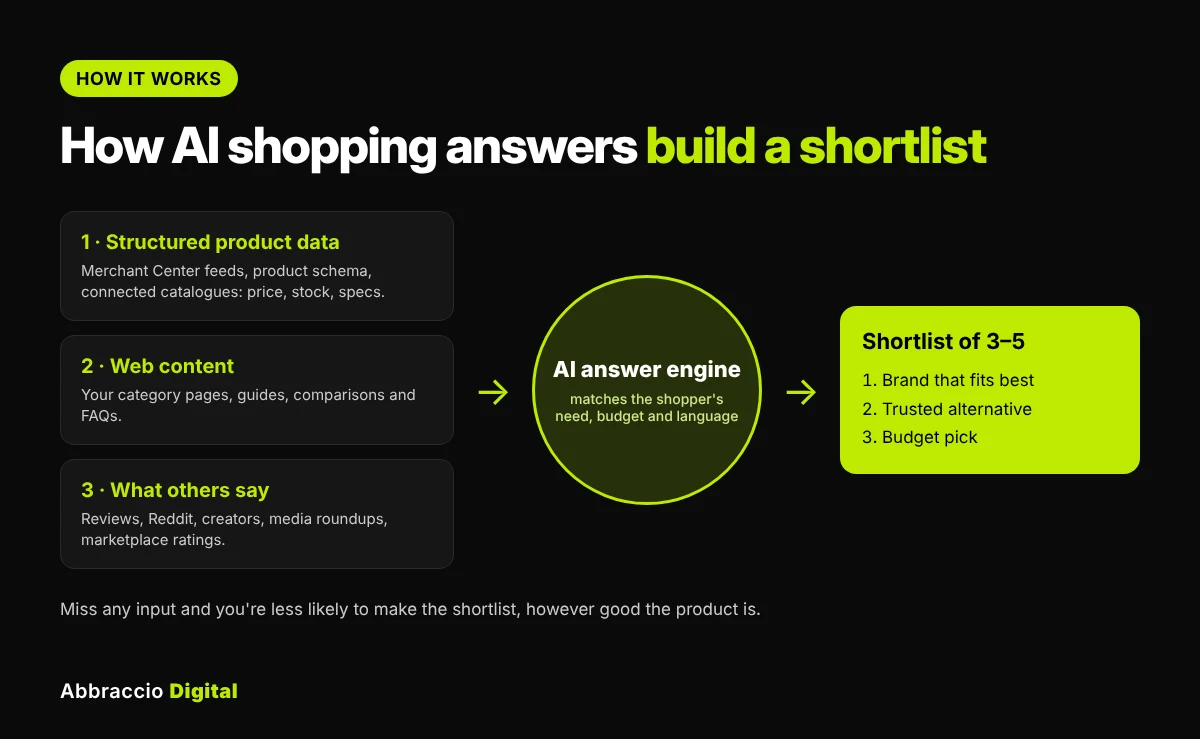
Google’s AI Mode makes the first input explicit: its shopping answers combine visuals, prices, reviews and real-time inventory from the Shopping Graph. In ChatGPT, D2C products now reach shoppers through connected catalogues such as Nykaa’s and GoKwik’s, alongside what ChatGPT finds on the web.
The practical rule: an AI can’t recommend a product it can’t read, and it won’t recommend one nobody vouches for. Structured data gets you considered; web content and third-party signals get you chosen.
Remember that AI also fans out: one shopping question becomes several hidden searches for price, reviews, comparisons and use cases. See Query Fan-Out SEO for how to cover them.
The D2C GEO playbook: 8 moves
|
Move
|
What to do
|
Effort
|
|---|---|---|
|
Fix your product data
|
Complete Merchant Center feed: GTINs where you have them, accurate prices and stock, clear titles, every variant, good images
|
Low
|
|
Be consistent on marketplaces
|
Same product names, sizes, prices and claims on your site, Amazon, Flipkart, Nykaa, Blinkit, Zepto
|
Medium
|
|
Build answer-first category pages
|
"Best [product] for [need]" pages that answer in the first lines, with comparison tables and specs
|
Medium
|
|
Publish honest comparisons
|
"Your brand vs [competitor]" and "[ingredient A] vs [ingredient B]" pages with real differences
|
Medium
|
|
Earn genuine reviews
|
Post-purchase review requests on your site, Google and marketplaces; reply to reviews
|
Ongoing
|
|
Get creator and community coverage
|
Product seeding to relevant creators, honest brand presence on Reddit and Quora
|
Ongoing
|
|
Publish in Hindi and regional languages
|
Translate and localise top category pages and FAQs where your buyers search in those languages
|
Medium
|
|
Join AI checkout where you can
|
Ask your commerce platform or marketplace about ChatGPT and Google AI checkout programmes
|
Low
|
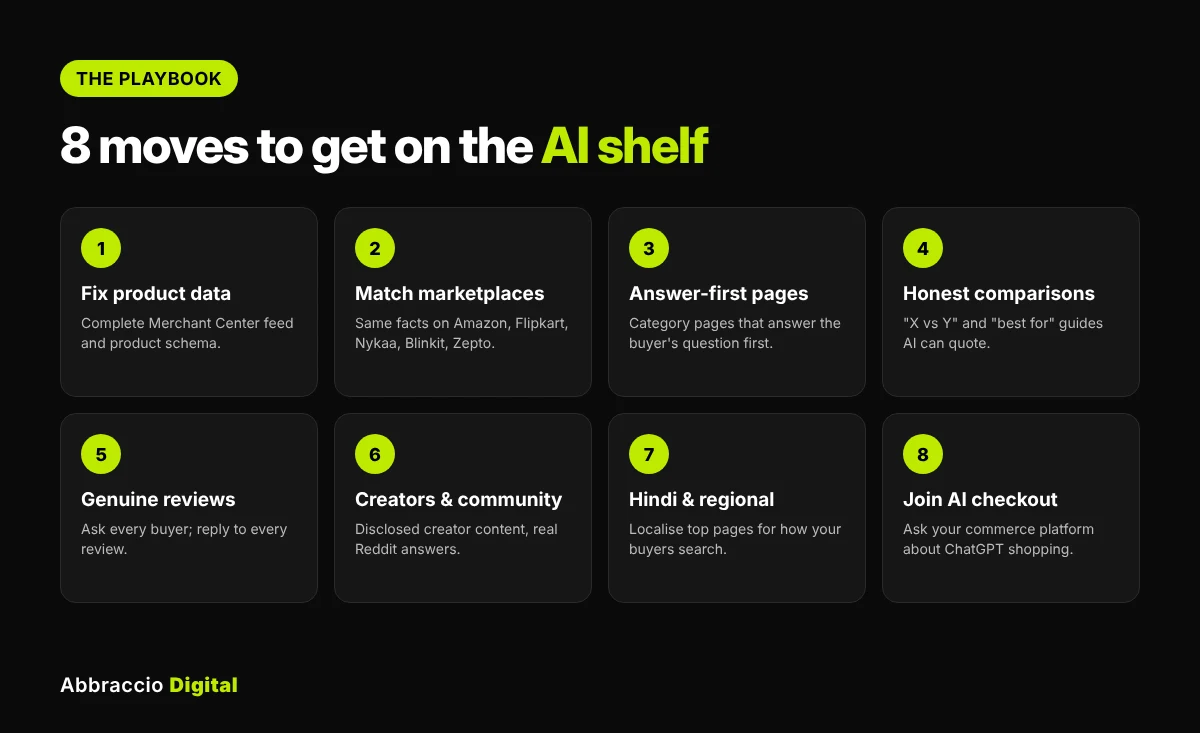
Start with moves 1, 2 and 8: they’re low effort and decide whether AI can see and sell your products at all. Moves 3 to 7 decide whether it chooses you.
Product data: Merchant Center, feeds and marketplaces
This is the plumbing. Get it right once, then keep it current.
Google Merchant Center checklist
- Free product listings switched on, so products can appear without ads
- Every product and variant in the feed, with price and stock that match your site
- Titles that say what it is and who it’s for: “Roasted Makhana, Peri Peri, 75 g, High Protein Snack” beats “Peri Peri Crunch”
- GTINs (barcodes) added where your products have them; brand and MPN where they don’t
- Product highlights and descriptions that state key facts: ingredients, size, shelf life, certifications
- Product ratings and seller ratings connected, if you’re eligible
- Shipping and return policies set up
- Product schema on your product pages that matches the feed
Marketplace consistency
AI engines often see your product on several sites. If your website says 75 g and ₹149, Amazon says 70 g and ₹169, and Blinkit uses a different product name, the AI has to guess. Audit your top 10 products across every channel every quarter and make the facts match.
AI checkout programmes
In India, the fastest route into ChatGPT shopping in 2026 has been through platforms: GoKwik merchants can make their catalogues available in ChatGPT without extra engineering or listing fees, and Nykaa’s catalogue sits inside ChatGPT. Ask your checkout provider, Shopify partner or marketplace manager what they offer, and what data you keep.
Before you fix anything, you need to know where your brand stands. An AI visibility audit shows whether ChatGPT, Gemini, and Google AI mention your products, and which competitors they recommend instead.
Reviews, community and creators
Structured data gets you considered. What other people say gets you chosen. In Ahrefs’ study of 75,000 brands, branded web mentions were the factor most strongly correlated with visibility in Google’s AI Overviews, ahead of backlinks.
|
Channel
|
What to do
|
What to avoid
|
|---|---|---|
|
Reviews
|
Ask every buyer for a review 7–14 days after delivery, on your site, Google and the marketplace they bought from. Reply to every review, especially the bad ones
|
Buying reviews, or offering rewards only for positive reviews
|
|
Reddit and Quora
|
Answer genuine questions in your category as the brand, openly. Share useful facts, not just links
|
Fake accounts or undisclosed promotion; communities spot it and AI may repeat the backlash
|
|
YouTube and Instagram
|
Seed products to creators whose audience matches yours; encourage honest reviews and comparisons
|
Scripted ads disguised as reviews without disclosure
|
|
Listicles and media
|
Pitch "best [product]" roundups and food, beauty or lifestyle editors with a clear reason to include you
|
Paying for placements that aren't labelled as sponsored
|
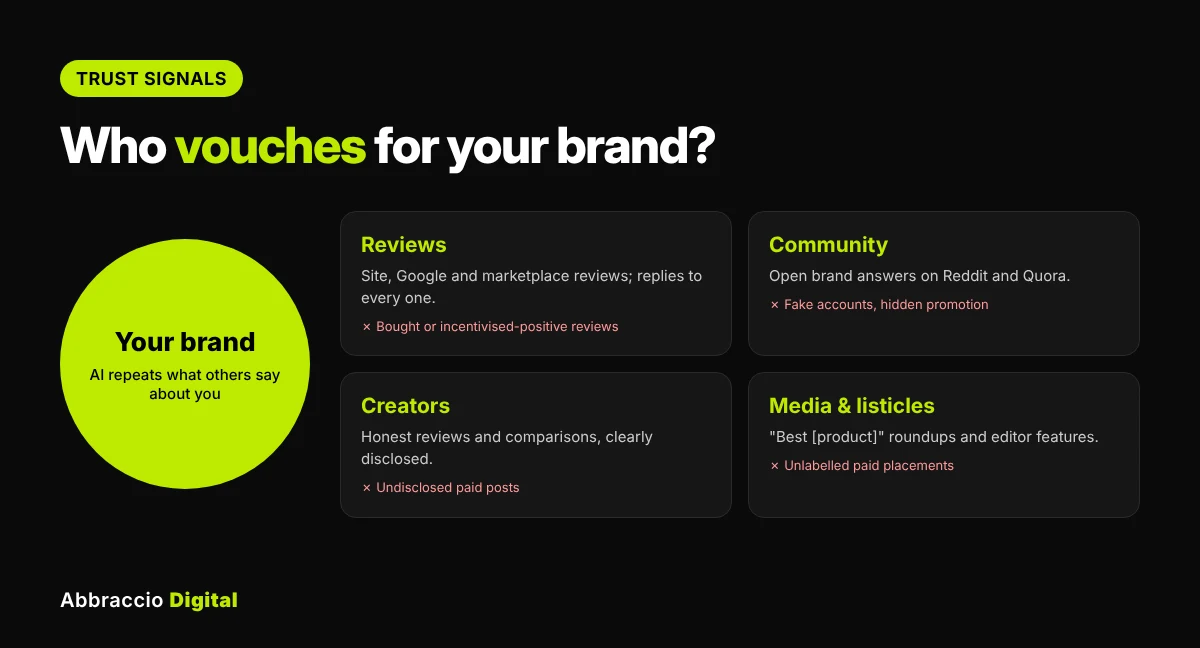
Indian rules matter here too: India’s Advertising Standards Council has influencer advertising guidelines that require paid or gifted content to be clearly labelled. Honest, disclosed coverage is safer and more durable.
Hindi and regional-language content
Google’s AI Mode works in Hindi and seven other Indian languages, and Google’s 2026 shopping upgrades in AI Mode and Gemini launched in English and Hindi. Few D2C brands publish quality product content in those languages, so it’s one of the easiest gaps to win.
Where to start:
- Check demand. In Search Console and your keyword tool, look for Hindi or Hinglish queries in your category (for example “स्वस्थ स्नैक्स” or “healthy snacks kaun se le”).
- Localise your top pages first. Your best-selling product pages, top category page and FAQ.
- Write for people, not word-for-word. Use the words your buyers use, including common English product terms.
- Mark it up correctly. Separate URLs per language,
hreflangtags between versions, and the rightlangattribute. - Keep facts identical. Prices, sizes and claims must match the English version exactly.
If you sell mainly in one region, prioritise that region’s language over Hindi.
When a shopper asks Gemini or Google AI Mode for “best healthy snacks in India,” the AI quietly runs dozens of related sub-searches before it picks brands. Understanding query fan-out SEO helps your D2C brand show up in those hidden searches, not just the main one.
What this looks like by category (illustrative)
These are fictional examples to show how the playbook changes by category. They are not client results.
|
|
Healthy snacks brand
|
Skincare brand
|
Apparel brand
|
|---|---|---|---|
|
Prompts to win
|
"best high-protein snacks under ₹200", "healthy snacks for office"
|
"best sunscreen for oily skin India", "niacinamide serum for acne marks"
|
"best linen shirts for summer India", "office wear brands for women"
|
|
Facts AI needs
|
Protein per serving, ingredients, shelf life, FSSAI licence, pack sizes
|
Key ingredients and %, skin type, SPF/PA rating, dermatologically tested claims (with proof)
|
Fabric, fit, size chart, care, return policy
|
|
Content to create
|
Comparison: "makhana vs chips vs protein bars"; "snacks for diabetics" written with a nutritionist
|
Ingredient guides; "routine for oily skin" reviewed by a dermatologist
|
Fit guides by body type; fabric guides; "what to wear for…" by occasion and climate
|
|
Who vouches
|
Fitness and food creators, quick-commerce reviews
|
Dermatologists, skincare creators, Reddit (r/IndianSkincareAddicts)
|
Fashion creators, Myntra/Ajio reviews, style editors
|
|
Biggest risk
|
Health claims you can't prove
|
Medical claims and inconsistent ingredient %s across sites
|
Size and fit complaints repeated in reviews
|
Your 90-day plan
Search Console details from PPC Land and Webiano; Bing from Search Influence; GA4 from Search Engine Journal.
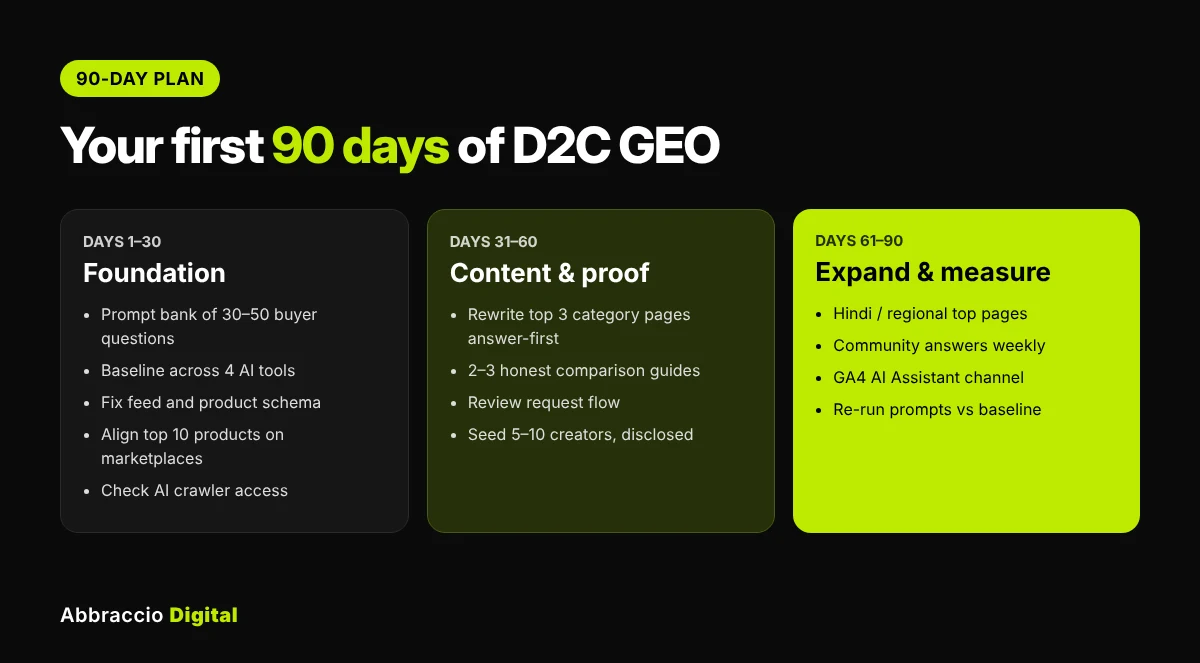
Days 1–30: Foundation
- Build a prompt bank of 30–50 buyer questions for your category (the checklist download includes starter prompts)
- Run a baseline: ask each prompt in ChatGPT, Google AI Mode, Gemini and Perplexity; note who gets recommended and what’s said about you
- Fix your Merchant Center feed and product schema; align your top 10 products across marketplaces
- Check
robots.txtlets search-focused AI crawlers in (see our AI crawler log guide) - Ask your checkout or commerce platform about AI shopping programmes
Days 31–60: Content and proof
- Rewrite your top 3 category pages answer-first, with a comparison table and FAQs
- Publish 2–3 honest comparison or “best for” guides
- Start a review request flow; reply to existing reviews
- Seed products with 5–10 relevant creators, with clear disclosure
Days 61–90: Expand and measure
- Localise your top pages into Hindi or your main regional language
- Join 2–3 community conversations a week as the brand
- Re-run your prompt bank and compare with the baseline
- Set up the GA4 AI Assistant channel and track AI-referred sessions, revenue and “how did you hear about us?” answers
What to measure
|
Metric
|
How
|
How to collect it
|
|---|---|---|
|
Share of AI answers
|
% of your prompt bank where your brand is recommended
|
|
|
Accuracy
|
Are prices, sizes and claims stated correctly?
|
|
|
AI-referred revenue
|
GA4 AI Assistant channel, plus orders from AI checkout partners
|
|
|
Branded search
|
Search Console brand query impressions, month on month
|
For the full framework, read our guide to measuring AI search visibility.
Key takeaways
- In 2026, AI shopping in India moved from searching to buying: ChatGPT checkout with UPI, Nykaa inside ChatGPT, and Google’s AI Mode shopping in English and Hindi.
- AI picks products from three inputs: structured product data, web content, and what other people say.
- Clean, consistent product data across your site, Merchant Center and marketplaces is the foundation.
- Answer-first category pages and honest comparisons give AI something to quote.
- Genuine reviews, community answers and disclosed creator content make AI trust you.
- Hindi and regional-language content is an under-used opportunity.
- Measure share of AI answers, accuracy and AI-referred revenue, not just traffic.
Conclusion
Indian shoppers are starting to ask AI what to buy, and in 2026 they can buy without leaving the chat. The brands that get recommended won’t always be the biggest. They’ll be the ones with clean product data, clear answers, honest comparisons and real people vouching for them.
Start with the basics: fix your product data, check what AI says about you today, and rewrite your top category pages. Then build reviews, community and regional content month by month.
Sources
- Business Today, 29 Jul 2026 — ChatGPT now a shopping destination: GoKwik and PayU’s ChatGPT integration
- Business Today, 7 Apr 2026 — Google brings new shopping experiences to Gemini app, AI Mode and Circle to Search
- Google India blog — New ways Google is using AI to make shopping easier
- Novadata, Jun 2026 — Nykaa and OpenAI bring Nykaa’s catalogue to ChatGPT
- TechRepublic, Feb 2026 — India hits 100M weekly ChatGPT users
- ITLN — D2C brands estimated to become a $60 billion industry by FY27
- Ahrefs — AI Overview brand correlation study (75,000 brands)
Frequently Asked Questions
GEO (generative engine optimisation) for D2C brands is the work of making your products show up, accurately, when shoppers ask AI tools like ChatGPT, Google AI Mode, Gemini or Perplexity what to buy. It covers product data, content, reviews and mentions across the web.
Yes. In 2026 ChatGPT added shopping results and, through partners like GoKwik and PayU, checkout with UPI for Indian merchants. Ask your checkout or commerce platform whether they offer it, and make sure your product data is complete.
Not necessarily, but it helps. AI engines read marketplace listings and reviews. If you sell there, keep product facts consistent with your own site.
It builds on SEO. Crawlable pages, product schema and good content still matter. GEO adds a focus on being recommended inside answers: product feeds, comparisons, reviews, community mentions and tracking AI answers.
If your buyers search in Hindi or Hinglish, yes. Google’s AI Mode supports Hindi and other Indian languages, and few brands publish good product content in them yet.
Product data fixes can show up within weeks. Content, reviews and mentions usually take two to three months to show a clear change in AI answers.
It depends on catalogue size and how much content you need. See our GEO services pricing guide for ranges and a budget calculator.