Ask ChatGPT for the best brands in your category. Then ask Gemini, Perplexity and Google. Are you in the answers? Is what they say about you correct? Most brands have never checked, and the ones that do are often surprised: a competitor named first, an outdated price, or no mention at all.
That gap matters more every month. Google’s AI Mode has passed 1 billion monthly users, and ChatGPT has 1.2 billion weekly users. When AI answers a buyer’s question, it builds a shortlist, and you’re either on it or you’re not.
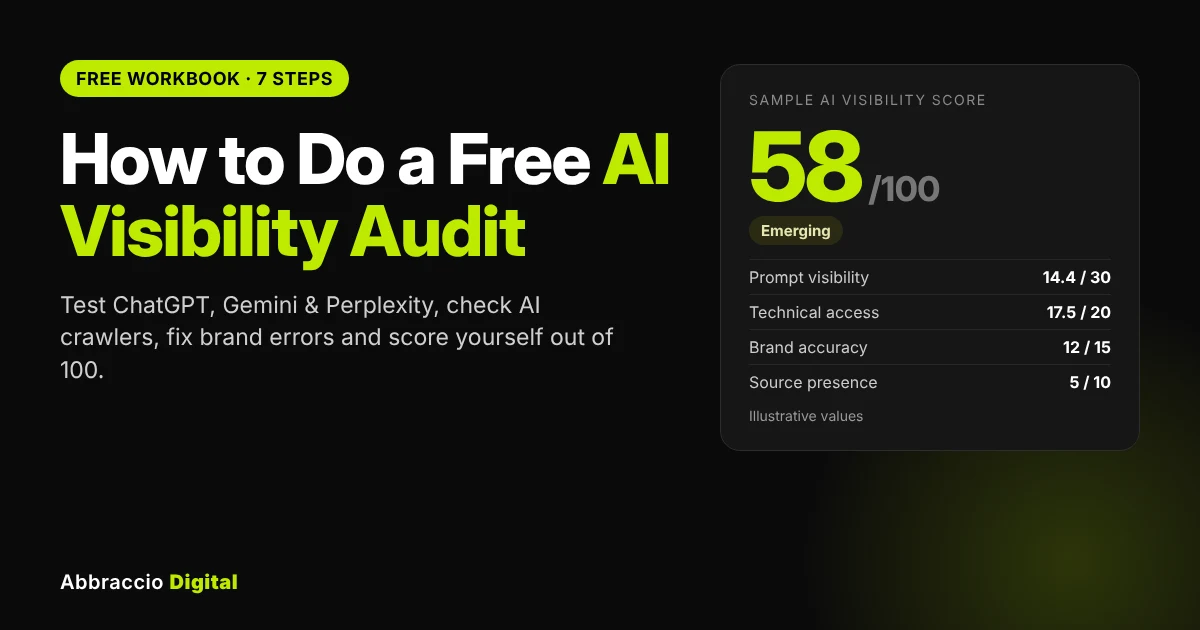
An AI visibility audit tells you exactly where you stand. This guide walks you through one in seven steps using only free tools. You’ll test real buyer prompts, find the sources AI trusts in your category, check whether AI crawlers can even read your site, fix what AI gets wrong about your brand, and finish with a score out of 100 and a prioritised action plan.
Quick answer
What is an AI visibility audit? An AI visibility audit measures how often, how accurately and how favourably AI engines like ChatGPT, Gemini, Perplexity, Copilot and Google AI Overviews mention your brand. It covers five areas: prompt visibility, cited sources, technical AI access, brand accuracy and first-party AI traffic. A first audit takes about half a day by hand.
What an AI visibility audit measures (and why it's different from an SEO audit)
An SEO audit asks whether Google can crawl and rank your pages. An AI visibility audit asks a different question: when an AI writes the answer, does it pick you, and does it get you right? Two findings explain why you need both.
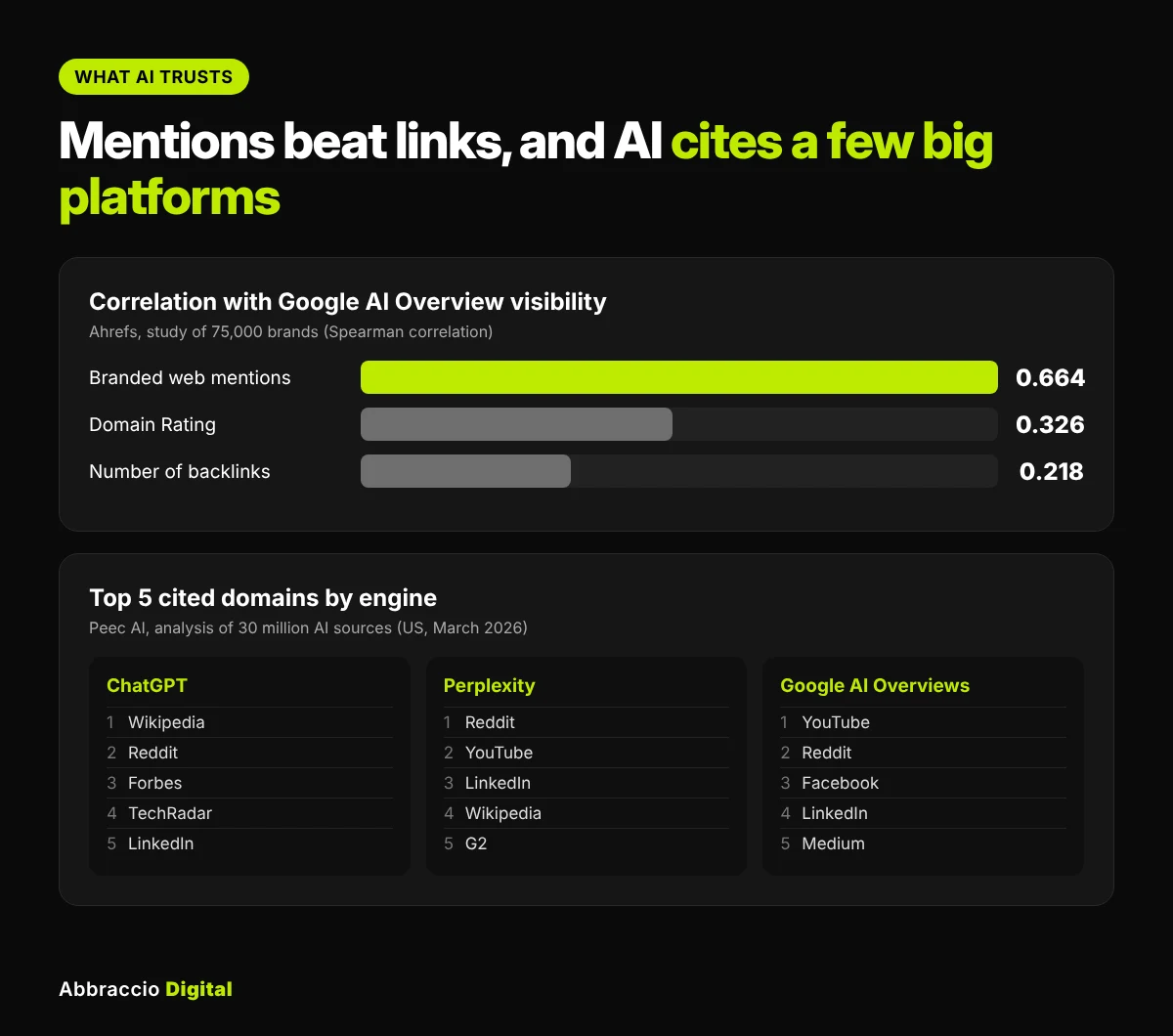
What other sites say about you matters more than links. Ahrefs studied 75,000 brands and found that branded web mentions had a 0.664 correlation with visibility in Google AI Overviews. Domain Rating scored 0.326 and backlink count only 0.218. Correlation isn’t causation, but it shows why an AI audit must look beyond your own website.
AI leans on a small set of third-party platforms. Across 30 million cited sources, Peec AI found the most-cited domains in AI answers were Reddit, YouTube, LinkedIn, Wikipedia and Forbes, followed by G2, Yelp, Facebook, Medium and TechRadar. Each engine has its own favourites: ChatGPT leans on Wikipedia, Perplexity on Reddit, and Google AI Overviews on YouTube.
So a complete audit covers five areas:
|
Area
|
The question it answers
|
Audit steps
|
|---|---|---|
|
Prompt visibility
|
Does AI mention and recommend us?
|
Steps 1–2
|
|
Cited sources
|
Which sites does AI trust in our category, and are we on them?
|
Step 3
|
|
Technical access
|
Can AI crawlers reach and read our site?
|
Step 4
|
|
Brand accuracy
|
Is what AI says about us correct and consistent?
|
Step 5
|
|
First-party AI data
|
Is AI already sending us traffic or citations?
|
Step 6
|
Before you start: tools and setup
Everything here is free. You need:
- AI platforms: ChatGPT, Gemini, Perplexity and Microsoft Copilot (free tiers are fine), plus Google Search for AI Overviews and AI Mode.
- A private or logged-out browser window with chat memory and personalisation turned off, so past chats don’t skew the answers.
- Google Search Console, GA4 and Bing Webmaster Tools access for your site.
- Three competitors you lose deals to most often.
- The free audit workbook (download above): it logs every test and calculates your score.
Time needed: plan for half a day. The prompt tests take the longest: 30 prompts across 4 platforms, run twice each, is 240 checks. Start with 15 prompts if you’re short on time; you’ll still see the pattern.
Step 1: Build your buyer prompt set
Write 15–30 prompts that a real buyer would type into an AI assistant. Cover four types, because AI behaves differently for each:
|
Prompt type
|
Example (D2C snack brand)
|
What it reveals
|
|---|---|---|
|
Category discovery
|
"Best healthy snacks to order online in India"
|
Whether you make the shortlist at all
|
|
Problem-solution
|
"Low-calorie snacks for late-night cravings"
|
Whether AI links your product to the need
|
|
Comparison
|
"Brand A vs Brand B makhana"
|
How AI positions you against rivals
|
|
Brand
|
"Is Brand A good? What does it cost?"
|
Whether facts about you are correct
|
Find real phrasing in Search Console (filter queries containing “best”, “vs”, “how”, “which”), People Also Ask boxes, Reddit threads in your niche, and questions your sales team hears every week. Write prompts the way people talk, not as keywords: “which CRM is easiest for a 10-person sales team” beats “best CRM small team”.
Step 2: Run the prompt tests
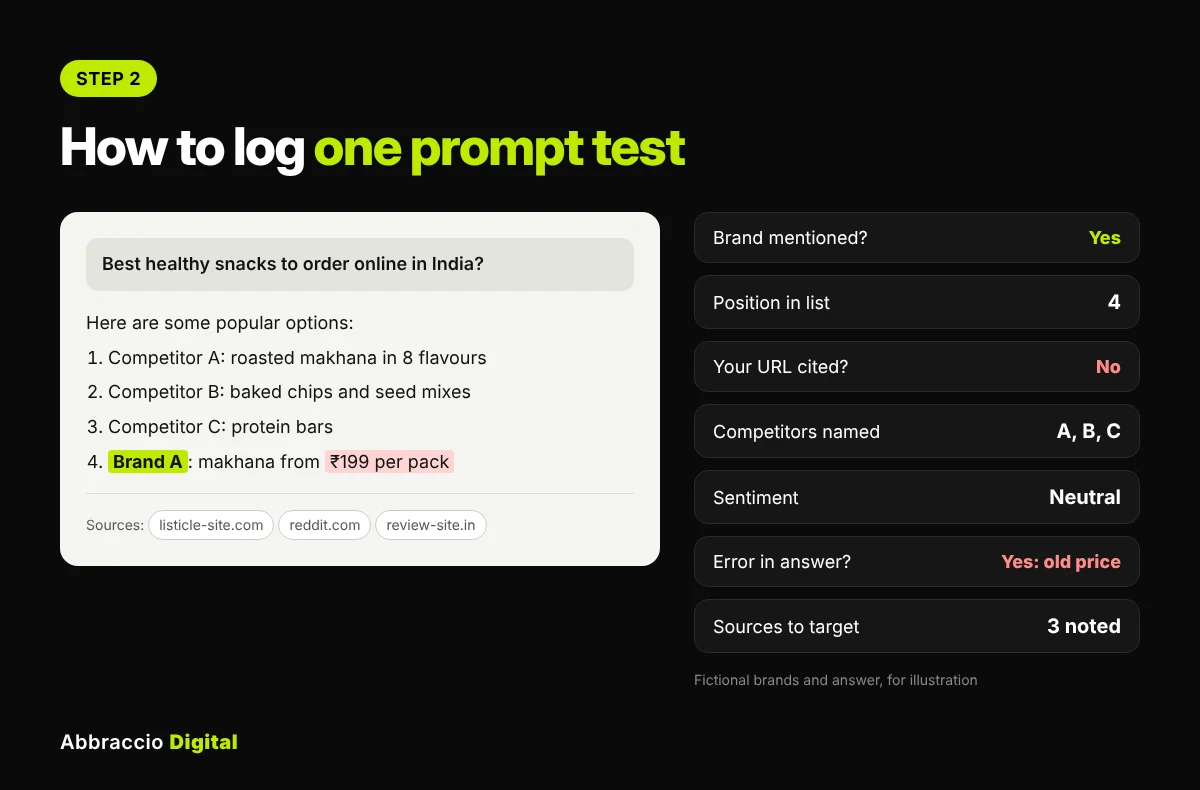
Run every prompt on each platform in a clean session, at least twice, and log each run as a row in the workbook. For each answer, record:
- Mentioned? Is your brand named in the answer text?
- Position: If the answer is a list, where are you? (1 = first)
- Cited? Does a link to your site appear in the sources?
- Competitors: Which of your three competitors are named?
- Sentiment: Is the mention positive, neutral or negative?
- Accuracy: Is anything wrong (price, features, location, founding date)?
Two tips save hours. First, paste the same prompt into all platforms in parallel tabs. Second, screenshot any answer that’s wrong about your brand; you’ll need it in Step 5.
Step 3: Find the sources AI trusts in your category
AI engines don’t invent shortlists; they assemble them from sources. Your job in this step is to find those sources, because getting onto them is often faster than ranking your own pages.
- Collect every cited URL from your Step 2 tests. Perplexity, Copilot, Google AI Overviews and ChatGPT search all show their sources.
- Group them by type: listicles (“10 best…”), review platforms (G2, Trustpilot, Google reviews), community (Reddit, Quora), video (YouTube), reference (Wikipedia, directories) and news.
- Count how often each domain appears. The top five or six are your target list.
- Check whether you appear on each one. If a listicle cited for “best X” names three competitors and not you, that’s a clear gap to close.
Record this in the workbook’s Sources tab. Expect a pattern: a few domains appear again and again. Across AI engines overall, the most-cited platforms are Reddit, YouTube, LinkedIn or Wikipedia, so check your presence there first, then add the niche review and comparison sites your tests surfaced.
What to do with the gaps: ask to be included in cited listicles with genuine reasons to feature you, encourage real customers to leave reviews on the cited review platforms, answer relevant Reddit and Quora threads openly as the brand, and publish YouTube videos for the comparison prompts where video is cited. Never fake reviews or post undisclosed promotional content; it breaks platform rules and can backfire badly.
Step 4: Check that AI crawlers can read your site
If AI crawlers are blocked, nothing else in this audit matters. Open yourdomain.com/robots.txt and check these user agents:
|
Crawler
|
Operator
|
What it does
|
Block it and…
|
|---|---|---|---|
|
OAI-SearchBot
|
OpenAI
|
Indexes sites for ChatGPT search
|
You won't appear in ChatGPT search answers (OpenAI)
|
|
GPTBot
|
OpenAI
|
Collects content for model training
|
Your content isn't used for training; search visibility is unaffected
|
|
ChatGPT-User
|
OpenAI
|
Fetches a page when a user asks ChatGPT to
|
User-initiated, so robots.txt rules may not apply
|
|
PerplexityBot
|
Perplexity
|
Indexes for Perplexity answers
|
You'll drop out of Perplexity citations
|
|
Claude-SearchBot
|
Anthropic
|
Indexes for Claude's search results
|
You'll drop out of Claude's search answers
|
|
ClaudeBot
|
Anthropic
|
Collects content for model training
|
Training only
|
|
Bingbot
|
Microsoft
|
Indexes for Bing and Copilot
|
You lose Bing and Copilot visibility
|
|
Google-Extended
|
Google
|
Controls use in Gemini Apps and Vertex AI training
|
Google says it doesn't affect Google Search
|
Crawler purposes from OpenAI’s crawler documentation and Otterly’s AI crawler reference.
The key distinction: search crawlers decide whether you’re cited; training crawlers don’t. Many sites block GPTBot or ClaudeBot for content-protection reasons, which is a fair choice. Blocking OAI-SearchBot, PerplexityBot or Bingbot, often by accident through a security plugin or CDN bot setting, removes you from those answers.
Then check three more things:
- Rendering: View your key pages with JavaScript turned off (or use Screaming Frog’s text-only mode). Text that only appears after JavaScript runs may be invisible to some AI crawlers.
- Firewall and CDN: Ask your developer whether Cloudflare or a similar service is blocking “AI bots” by default. This is a common hidden cause.
- Schema: Run your homepage and a key product or service page through the Schema Markup Validator. You want at least Organization schema on the homepage and the right type (Product, Service, Article) on key pages.
Step 5: Check that AI describes your brand correctly
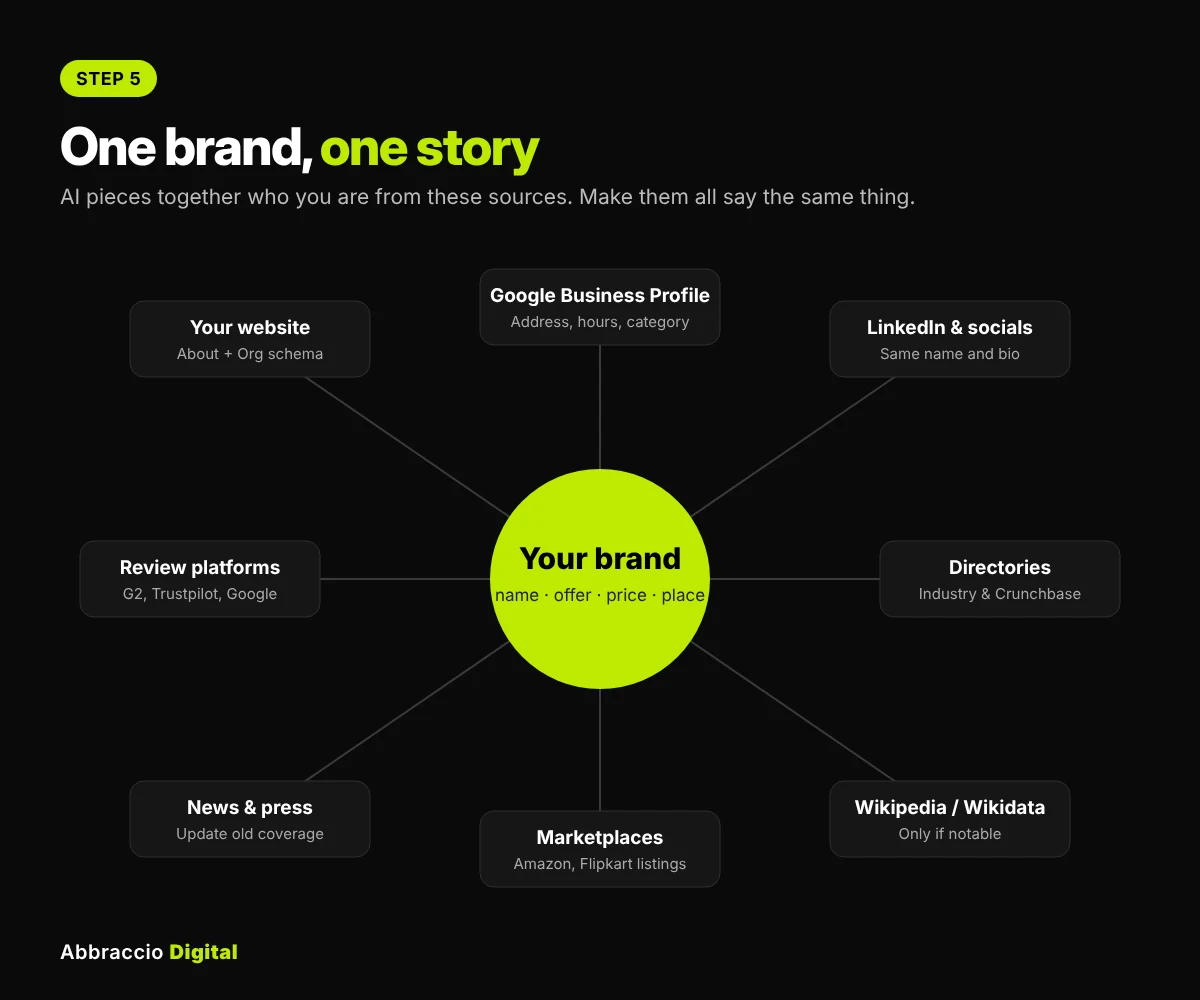
AI engines piece together who you are from many sources. If those sources disagree, the answer is vague or wrong. This step finds and fixes the inconsistencies.
- Ask each platform directly: “What is [Brand]? What does it sell, where is it based, and how much does it cost?” Compare every answer to the truth.
- List every error in the workbook’s Brand Accuracy tab: wrong price, discontinued product, old address, wrong founder, confused with a similarly named company.
- Trace each error to its source. Ask the platform “where did you find that?” or check the cited links. The usual culprits are an outdated About page, old press coverage, an unclaimed directory listing or a stale Google Business Profile.
- Make your facts consistent everywhere: your About page, Google Business Profile, LinkedIn page, Crunchbase or industry directories, marketplace listings and social bios should state the same name, description, location and offering.
- Add Organization schema to your homepage with your official name, logo, URL, founding date and
sameAslinks to your official profiles. It gives machines one clear statement of who you are.
After fixing sources, re-test the brand prompts in four to six weeks. Engines that search live, like Perplexity and Copilot, tend to update faster than answers drawn mainly from a model’s training data.
Step 6: Check your first-party AI data
Your own analytics show whether AI is already sending you visitors or citing you. Three free sources:
|
Source
|
Where to look
|
What it tells you
|
|---|---|---|
|
GA4
|
Reports → Acquisition → Traffic acquisition, Session default channel group = AI Assistant
|
Sessions and key events from ChatGPT, Gemini, Claude and other recognised assistants. GA4 added this channel on 13 May 2026
|
|
Bing Webmaster Tools
|
AI Performance report
|
|
|
Google Search Console
|
Performance report, filtered to long question-style queries
|
Rising impressions with flat clicks on question queries often signal AI Overviews answering above you
|
Two caveats. GA4 only counts AI visits that carry a referrer, so visits from AI mobile apps can land in Direct; treat the number as a minimum. And Bing’s AI Performance report shows citations but not clicks.
The pages that appear in GA4’s AI Assistant channel and Bing’s cited pages are your AI-proven pages. Note them in the workbook: they show what kind of content AI already trusts from you, so you can make more of it.
Step 7: Score the audit and build your action plan
Turn the findings into one number out of 100, so you can track progress and explain it to a boss or client in one sentence. The workbook calculates this automatically.
|
Component
|
Max points
|
How it's scored
|
|---|---|---|
|
Prompt visibility
|
30
|
Mention rate × 30 (mentioned in 40% of tests = 12 points)
|
|
Share of voice
|
15
|
|
|
Citation rate
|
10
|
Share of tests citing your URL × 10
|
|
Brand accuracy
|
15
|
15 minus 3 points per factual error found (minimum 0)
|
|
Technical access
|
20
|
Share of the 8 technical checks passed × 20
|
|
Source presence
|
10
|
Share of your category's top cited sources where you appear × 10
|
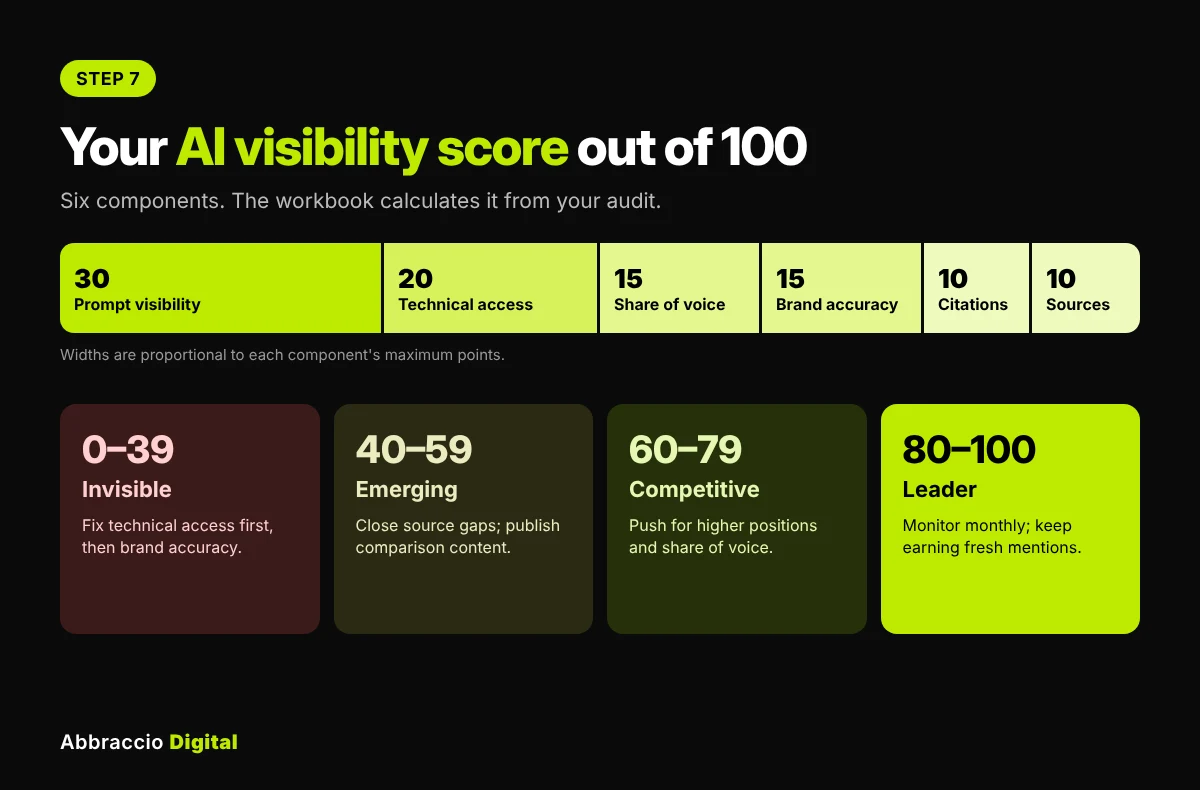
What your score means:
- 0–39 · Invisible. AI rarely mentions you. Fix technical access first, then brand accuracy.
- 40–59 · Emerging. You appear sometimes. Close the source gaps and create answer-first comparison content.
- 60–79 · Competitive. You’re in most shortlists. Work on position and share of voice.
- 80–100 · Leader. Protect it: monitor monthly and keep earning fresh mentions.
Prioritise fixes in this order, because each one unlocks the next:
- Access: unblock search crawlers and fix rendering. Quick, and everything depends on it.
- Accuracy: correct wrong facts at their source and add Organization schema.
- Answers: create or rewrite pages that directly answer your weakest prompts, especially comparisons.
- Authority: get onto the cited listicles, review platforms and communities from Step 3
Worked example: a D2C snack brand's first audit
This is an illustrative example with made-up numbers, showing how the scoring works. “Brand A” is fictional.
Brand A tested 20 prompts on 4 platforms, twice each: 160 checks.
|
Component
|
Finding
|
Points
|
|---|---|---|
|
Prompt visibility
|
Mentioned in 36 of 160 tests (22.5%)
|
6.8/30
|
|
Share of voice
|
36 of 200 total brand mentions (18%)
|
2.7/15
|
|
Citation rate
|
Site cited in 13 of 160 tests (8%)
|
0.8/10
|
|
Brand accuracy
|
3 errors: old price, discontinued flavour, wrong city
|
6/15
|
|
Technical access
|
||
|
Source presence
|
On 2 of the 6 most-cited sources
|
3.3/10
|
|
Total
|
|
34.6 / 100 · Invisible
|
Brand A’s action plan:
- Unblock PerplexityBot in the security plugin (15 minutes).
- Update the pricing page, About page and marketplace listings; add Organization schema (1 week).
- Publish a “Brand A vs Brand B” comparison page and a “best healthy snacks for office” guide (2–3 weeks).
- Pitch the two most-cited listicles and ask recent customers for reviews on the cited review site (ongoing).
Re-audit in 90 days with the same prompts to measure the change.
Key takeaways
- An AI visibility audit checks five areas: prompt visibility, cited sources, technical access, brand accuracy and first-party AI data.
- Off-site mentions matter: in Ahrefs’ study of 75,000 brands, branded web mentions correlated far more strongly with AI Overview visibility (0.664) than backlinks (0.218).
- Allow search crawlers like OAI-SearchBot, PerplexityBot, Claude-SearchBot and Bingbot; blocking training crawlers like GPTBot doesn’t affect search visibility.
- Fix in order: access, accuracy, answers, authority.
- Score yourself out of 100, then re-audit every 90 days with the same prompts.
Conclusion
You can’t improve what you’ve never measured, and most brands have never measured how AI sees them. An afternoon with this audit tells you whether AI mentions you, what it gets wrong, which sources it trusts, and whether your site is even readable to AI crawlers.
The fixes are rarely mysterious. Unblock the right crawlers, make your brand facts consistent, answer your buyers’ real questions directly, and get onto the sites AI already cites. Then audit again in 90 days and watch the score move.
Sources
- AI Overview brand correlation study (75,000 brands) — Ahrefs, May 2025, updated April 2026
- Top domains cited by AI search: analysis of 30M sources — Peec AI, March 2026
- Overview of OpenAI crawlers — OpenAI
- AI crawlers reference guide — Otterly.AI
- Google Analytics adds native AI Assistant channel — TechWyse, May 2026
- Inside Bing’s new AI Performance report — Search Influence, Feb 2026
- Q2 2026 earnings call: remarks from our CEO — Google, July 2026
- ChatGPT now has 1.2 billion weekly users — AIChief, Sept 2026
Frequently Asked Questions
Yes. Everything in this guide uses free tools: the free tiers of ChatGPT, Gemini, Perplexity and Copilot, plus Google Search Console, GA4 and Bing Webmaster Tools. Paid tracking tools only become useful when you want to monitor many prompts every month.
Ask ChatGPT the questions your buyers would ask, such as “best [category] for [need]”, in a logged-out window with memory turned off. Run each prompt at least twice, note whether your brand is named and whether your site is cited, and compare with your top competitors.
Run a full audit once, then re-audit every 90 days with the same prompts. In between, track the core numbers monthly. AI answers change quickly, so a single check is a snapshot, not a verdict.
That’s a business decision. According to OpenAI, GPTBot collects content for model training, while OAI-SearchBot controls whether you appear in ChatGPT search. You can block GPTBot and still allow OAI-SearchBot, so your content isn’t used for training but can still be cited.
Usually because the sources it learns from disagree or are out of date: an old About page, outdated press coverage, unclaimed directory listings or a stale Google Business Profile. Fix the facts at those sources and add Organization schema to your homepage.
On this guide’s 100-point scale, 60 or above means you’re in most AI shortlists, and 80 or above means you’re a category leader. Treat your first score as a baseline; what matters is the trend across quarters.